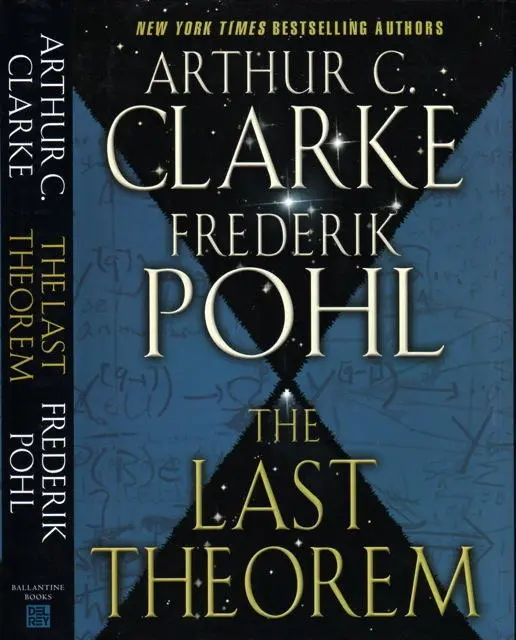
Arthur Clarke - The Last Theorem
Здесь есть возможность читать онлайн «Arthur Clarke - The Last Theorem» — ознакомительный отрывок электронной книги совершенно бесплатно, а после прочтения отрывка купить полную версию. В некоторых случаях можно слушать аудио, скачать через торрент в формате fb2 и присутствует краткое содержание. Город: New York, Год выпуска: 2008, ISBN: 2008, Издательство: Del Rey Books, Жанр: Фантастика и фэнтези, на английском языке. Описание произведения, (предисловие) а так же отзывы посетителей доступны на портале библиотеки ЛибКат.
- Название:The Last Theorem
- Автор:
- Издательство:Del Rey Books
- Жанр:
- Год:2008
- Город:New York
- ISBN:9780345470218
- Рейтинг книги:3 / 5. Голосов: 1
-
Избранное:Добавить в избранное
- Отзывы:
-
Ваша оценка:
The Last Theorem: краткое содержание, описание и аннотация
Предлагаем к чтению аннотацию, описание, краткое содержание или предисловие (зависит от того, что написал сам автор книги «The Last Theorem»). Если вы не нашли необходимую информацию о книге — напишите в комментариях, мы постараемся отыскать её.
.
The Last Theorem In 1637, the French mathematician Pierre de Fermat scrawled a note in the margin of a book about an enigmatic theorem: “I have discovered a truly marvelous proof of this proposition which this margin is too narrow to contain.” He also neglected to record his proof elsewhere. Thus began a search for the Holy Grail of mathematics—a search that didn’t end until 1994, when Andrew Wiles published a 150-page proof. But the proof was burdensome, overlong, and utilized mathematical techniques undreamed of in Fermat’s time, and so it left many critics unsatisfied—including young Ranjit Subramanian, a Sri Lankan with a special gift for mathematics and a passion for the famous “Last Theorem.”
When Ranjit writes a three-page proof of the theorem that relies exclusively on knowledge available to Fermat, his achievement is hailed as a work of genius, bringing him fame and fortune. But it also brings him to the attention of the National Security Agency and a shadowy United Nations outfit called Pax per Fidem, or Peace Through Transparency, whose secretive workings belie its name. Suddenly Ranjit—together with his wife, Myra de Soyza, an expert in artificial intelligence, and their burgeoning family—finds himself swept up in world-shaking events, his genius for abstract mathematical thought put to uses that are both concrete and potentially deadly.
Meanwhile, unbeknownst to anyone on Earth, an alien fleet is approaching the planet at a significant percentage of the speed of light. Their mission: to exterminate the dangerous species of primates known as homo sapiens.
The Last Theorem — читать онлайн ознакомительный отрывок
Ниже представлен текст книги, разбитый по страницам. Система сохранения места последней прочитанной страницы, позволяет с удобством читать онлайн бесплатно книгу «The Last Theorem», без необходимости каждый раз заново искать на чём Вы остановились. Поставьте закладку, и сможете в любой момент перейти на страницу, на которой закончили чтение.
Интервал:
Закладка:
Ranjit consulted his memory and came up empty. “I don’t think so.”
“Pity. He was one of the best minds ever to try to define what thought was, and to find ways of getting a computer to actually do something you could call thinking. He used to tell a story that cheers me up sometimes.” She paused there, as though unsure of her audience’s interest. Ranjit, who would have taken pleasure in hearing her announce train delays or closing stock prices, made the right sounds, and she went on. “Well, the thing is that in the beginning of AI studies, he, and all the other pioneers, too, considered pattern recognition as one of the hallmarks of AI. Then pattern recognition got solved in a rather everyday way. Checkout counters in every supermarket in the world began reading the prices of every item from bar codes. So what happened? AI simply got redefined. Pattern recognition got left out of the recipe because they’d solved that one, even if the computers still couldn’t make up a joke or figure out from the way you looked that you had a hangover.”
Ranjit said, “So can you get a computer to make up a joke now?”
She sat up. “I wish, ” she said moodily. And then she sighed. “Actually, my main interest isn’t in that kind of thing anymore. It’s more in applications. Autonomous prostheses, mostly.” Then she changed expression, and the subject. Without warning she asked, “Ranjit, why do you keep covering your mouth like that?”
It was a more personal question than he had expected from her. He was, however, quite aware of the way his hand kept covering his face. She persisted. “Is it your teeth that bother you?”
He conceded, “I know what I look like.”
“Well, so do I, Ranjit. You look like an honest, decent, and extremely intelligent man who hasn’t gotten around to letting a dentist repair his bite.” She shook her head at him. “It’s the easiest thing in the world, Ranjit, and you will not only look better, you’ll chew better.” She stood up. “I promised Aunt Bea that I wouldn’t stay longer than ten minutes, and she promised me that I could ask you if you wanted to swim in the ocean for a change. On Nilaweli beach. Do you know where that is? We’ve got a little beach house there, so if you’d care to…”
Oh, yes, Ranjit would care to. “We’ll work it out,” she said, and surprised him by giving him a hug. “We missed you,” she said, and then drew back to look at him. “Gamini said you asked him about his old girlfriend. Do you have any of that kind of question for me?”
“Uh,” he said. And then, “Well, yes, I suppose you mean about that Canadian.”
She grinned. “Yes, I suppose I do. Well, the Canadian was in Bora-Bora, last I heard, where they were building an even bigger hotel. But that was long ago. We don’t keep in touch.”
Ranjit hadn’t even known that Gamini and Myra were aware of each other’s existence, much less that they were apparently on easy chatting terms. That wasn’t all he hadn’t known. His density of visitors was getting more so, with the lawyer from Dr. Bandara’s office coming in with more documents to sign—“It’s not that your father’s estate is at all complicated,” he told Ranjit apologetically. “It’s just that you were reported missing and somebody in the bureaucracy interpreted that to mean presumed dead. So we have to clear that up.”
And then there were the police. Not that anybody was filing any charges against Ranjit himself. De Saram made sure of that, before he would allow any questioning at all. But they had loose ends to tie up about the piracy, and Ranjit was the only one who could help tie them.
Then there was the question of Myra de Soyza’s “autonomous prostheses,” whatever they were. His data searches were of limited help. True, they coached him to the right spelling, but what had AI to do with artificial limbs or hearing aids?
Beatrix Vorhulst helped him out there. “Oh, they’re not talking about smart wooden legs, Ranjit,” she told him. “It’s more subtle than that. The idea is to manufacture a lot of really tiny robots that they inject into your bloodstream, and they’re programmed to recognize and destroy, say, cancer cells.”
“Huh,” he said, considering the idea and liking it. It was, of course, the exact right kind of project to interest Myra de Soyza. “And these little robots, are they working out?”
Mevrouw Vorhulst gave him a sad little smile. “If they’d had them a few years ago, I might not be a widow today. No, they’re still just hopes. There just isn’t the funding for the research—even Myra has been waiting and waiting for her own project to be funded, and it just doesn’t happen. Oh, there’s plenty of money for research—as long as what is being researched is some kind of a weapon.”
When at last Ranjit was able to take Myra de Soyza up on her invitation, Beatrix Vorhulst was happy to provide him with a car and driver. When they were well along the road to the beach, he began to recognize landmarks. He and Gamini had of course checked this beach out in their exploration of everything the area had to offer. Not much had changed. The beaches still had their quota of good-looking young women in trivial bathing costumes, of which there were quite a few.
Ranjit had no idea what the de Soyza beach house would look like, until the driver pointed it out: tile roof, screened lanai around the door, nicely planted with bright flowers. It was only when the door opened and Myra de Soyza came out, wearing a light robe over a bikini that was fully as fashionable, and trivial, as any other along the beach, that he was sure he was in the right place.
Then not quite so sure, because right behind her was a five-or six-year-old girl. Ranjit experienced a quick, dismaying reality shift.
Six-year-old girl?
Myra’s?
Had he been gone quite that long?
He hadn’t. Ada Labrooy was the child of Myra’s sister, now seriously pregnant with another and for that reason quite happy to grant her daughter’s wish to spend as much time as possible with her favorite aunt. Myra herself was happy to have Ada there, not least because Ada’s mother had sent along Ada’s nanny to make sure the child was no inconvenience. When Ranjit had changed and been anointed with UV-repellent cream by Myra, which in itself was one of his nicer recent experiences, the two of them minced across the hot sands to the pleasingly cool waters of the gulf.
What was most wonderful about a Sri Lankan beach, apart from the company, was that the water deepened so gradually. Many dozens of meters from the shoreline he could still stand up straight.
He and Myra didn’t go much farther than waist-deep, and they didn’t swim as much as they happily threw themselves about in the water. Ranjit didn’t resist the temptation to show how far he could swim underwater—nearly a hundred meters; a lot less than he had done as a teenager near Swami Rock, but still enough to get compliments from Myra, which was what the purpose had basically been.
The shrewdness of Myra’s deal with the nanny then became evident. By the time they were showered and changed, a pleasant luncheon had been laid out for them. When they finished with that, the nanny took Ada away for a nap, and herself away to wherever it was she went when not visibly on duty.
By and large, that was one of the pleasantest parts of the day for Ranjit. However, when Myra announced that she really needed to put in the exercise of at least a couple hundred yards of actual swimming—and, no, Ranjit shouldn’t come with her, because he needed to keep his time in bright sunlight down to a safe minimum until his skin got used to the stuff again—he was comfortably aware that she would be back. And for the last twenty minutes or so he had been beginning to wonder if he had properly expanded one of Sophie Germain’s terms.
Читать дальшеИнтервал:
Закладка:
Похожие книги на «The Last Theorem»
Представляем Вашему вниманию похожие книги на «The Last Theorem» списком для выбора. Мы отобрали схожую по названию и смыслу литературу в надежде предоставить читателям больше вариантов отыскать новые, интересные, ещё непрочитанные произведения.





Обсуждение, отзывы о книге «The Last Theorem» и просто собственные мнения читателей. Оставьте ваши комментарии, напишите, что Вы думаете о произведении, его смысле или главных героях. Укажите что конкретно понравилось, а что нет, и почему Вы так считаете.