Arthur Clarke - The Last Theorem
Здесь есть возможность читать онлайн «Arthur Clarke - The Last Theorem» — ознакомительный отрывок электронной книги совершенно бесплатно, а после прочтения отрывка купить полную версию. В некоторых случаях можно слушать аудио, скачать через торрент в формате fb2 и присутствует краткое содержание. Город: New York, Год выпуска: 2008, ISBN: 2008, Издательство: Del Rey Books, Жанр: Фантастика и фэнтези, на английском языке. Описание произведения, (предисловие) а так же отзывы посетителей доступны на портале библиотеки ЛибКат.
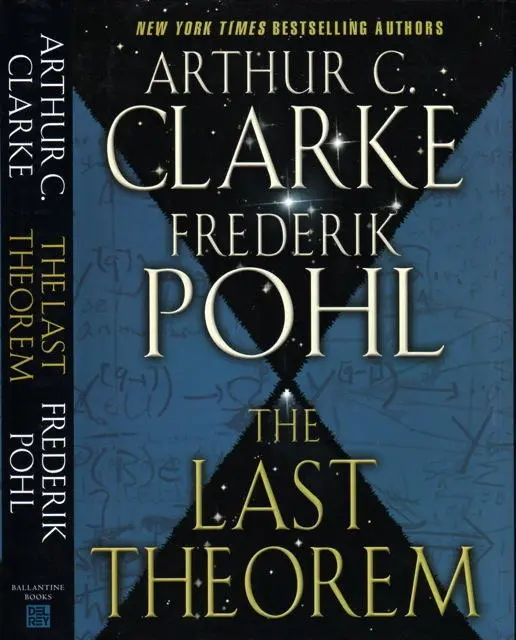
- Название:The Last Theorem
- Автор:
- Издательство:Del Rey Books
- Жанр:
- Год:2008
- Город:New York
- ISBN:9780345470218
- Рейтинг книги:3 / 5. Голосов: 1
-
Избранное:Добавить в избранное
- Отзывы:
-
Ваша оценка:
The Last Theorem: краткое содержание, описание и аннотация
Предлагаем к чтению аннотацию, описание, краткое содержание или предисловие (зависит от того, что написал сам автор книги «The Last Theorem»). Если вы не нашли необходимую информацию о книге — напишите в комментариях, мы постараемся отыскать её.
.
The Last Theorem In 1637, the French mathematician Pierre de Fermat scrawled a note in the margin of a book about an enigmatic theorem: “I have discovered a truly marvelous proof of this proposition which this margin is too narrow to contain.” He also neglected to record his proof elsewhere. Thus began a search for the Holy Grail of mathematics—a search that didn’t end until 1994, when Andrew Wiles published a 150-page proof. But the proof was burdensome, overlong, and utilized mathematical techniques undreamed of in Fermat’s time, and so it left many critics unsatisfied—including young Ranjit Subramanian, a Sri Lankan with a special gift for mathematics and a passion for the famous “Last Theorem.”
When Ranjit writes a three-page proof of the theorem that relies exclusively on knowledge available to Fermat, his achievement is hailed as a work of genius, bringing him fame and fortune. But it also brings him to the attention of the National Security Agency and a shadowy United Nations outfit called Pax per Fidem, or Peace Through Transparency, whose secretive workings belie its name. Suddenly Ranjit—together with his wife, Myra de Soyza, an expert in artificial intelligence, and their burgeoning family—finds himself swept up in world-shaking events, his genius for abstract mathematical thought put to uses that are both concrete and potentially deadly.
Meanwhile, unbeknownst to anyone on Earth, an alien fleet is approaching the planet at a significant percentage of the speed of light. Their mission: to exterminate the dangerous species of primates known as homo sapiens.
The Last Theorem — читать онлайн ознакомительный отрывок
Ниже представлен текст книги, разбитый по страницам. Система сохранения места последней прочитанной страницы, позволяет с удобством читать онлайн бесплатно книгу «The Last Theorem», без необходимости каждый раз заново искать на чём Вы остановились. Поставьте закладку, и сможете в любой момент перейти на страницу, на которой закончили чтение.
Интервал:
Закладка:
Oh, sure, he told himself, he had been full of a thousand other concerns.
But if it had been the other way around, would Ranjit have slipped his father’s mind?
Not counting servants, Mevrouw Vorhulst was his only visitor for the first few days, but then he argued (and the doctors had to agree) that no stress any visitor might cause him would come anywhere near the stress caused by strong young jailers hitting him with clubs. The barriers were reduced. The next morning, while Ranjit was experimenting with some of the Vorhulsts’ exercise machines, the Vorhulsts’ butler came into the gym, cleared his throat, and said, “You have a visitor, sir.”
Ranjit’s mind had been far away. “Have there been any messages for me?” he asked.
The butler sighed. “No, sir. If any messages come, they will be brought to you at once, as you requested. Now Dr. De Saram would like to see you. Shall I show him in?”
Ranjit quickly put on one of the Vorhulsts’ infinite supply of dressing gowns. Lawyer De Saram quickly took charge. He didn’t seem very junior to Ranjit—he was maybe fifty or sixty, maybe more—and he was clearly good at what he did. He didn’t have to be told about the bequest from Ranjit’s father. Although he had been asked to handle Ranjit’s affairs barely forty-eight hours before, he had already established Ranjit’s existence with the appropriate Trincomalee court and had a pretty good idea of the value of the bequest. “Not quite twenty million rupees, Mr. Subramanian,” he said, “but not far under it, either—or, at the current rate of exchange, about ten thousand U.S. dollars. The bulk of it is two pieces of property, your father’s home and a smaller house that is currently unoccupied.”
“I know the house,” Ranjit told him. “Is there anything I have to do?”
“Not just now,” De Saram told him, “although there is one possibility that you may wish to give some thought to. Dr. Bandara himself would have wished to do this for you, but, as you know, he is involved in some highly classified matters with the United Nations.”
“I do know, but I don’t know much,” Ranjit said.
“Of course. The thing is that you might normally have a claim for damages against the people who, ah, prevented you from coming home for so long, but—”
Ranjit said, “I know. We aren’t to talk about those people.”
“Exactly so,” De Saram declared, sounding relieved. “However, there is another avenue you may wish to take. It would be possible for you to bring an action against the cruise line company on the grounds that they should not have allowed their ship to be taken over by pirates. That would not be for as large a sum as the other, of course, both because their responsibility is a little harder to establish and also because their solvency is not very strong—”
“No, wait a minute,” Ranjit said. “They had their ship stolen, which I was on because of my own stupidity, and now I should sue them for letting it happen? That doesn’t sound fair.”
For the first time De Saram gave him a friendly grin. “Dr. Bandara said you would say that,” he announced. “Now I think my car should be about ready….”
And indeed just then there was a knock on the door. It was Vass, the butler, to announce that that was the case. And then, before Ranjit could say anything, the butler addressed him directly: “There are no messages for you, sir,” he added. “And, if I may—I didn’t want to trouble you before—we were all deeply saddened to learn of the loss of your father.”
It wasn’t that what the butler said reminded Ranjit of his father’s death. He didn’t need reminding. The loss was part of him, day and night, a wound that did not heal.
The worst thing about death was that it irrevocably ended communication. Ranjit was left with a long list of things he should have said to his father and never had. Now that the opportunity was lost, all those unsaid expressions of love and respect were silting up inside Ranjit’s heart.
And, of course, there was no more cheer to be found in the news. Fighting had flared up between Ecuador and Colombia, new squabbles were arising over the division of Nile water, and North Korea had filed a complaint before the Security Council accusing China of diverting rain clouds from Korean rice paddies to their own.
Nothing had changed. It was just that the world population was now irretrievably one person short.
But there was one thing he could do—should have done long since—and by his sixth day as a guest in the Vorhulst home, Ranjit finally demanded, and got, a copy of that frantic communication he had rushed off from the plane. He studied it as critically, as demandingly and as judgingly, as any freshman composition teacher had ever looked over a student’s final term paper. If the kind of mistakes that might disqualify him were there, he was going to find them. He was crushed to discover that there indeed were some—two of them on his first look, then four, then one or two additional passages that weren’t entirely wrong but did seem to be not entirely clear, either.
Ranjit had excuses. It was all due to that last stretch of seven or eight weeks, when he had at last completed the proof in his mind—all that he could manage to complete, since he was lacking paper, ink, or computer—and only kept rehearsing it, step by step, terrified that he might forget some crucial step.
The question was, what to do about those mistaken bits?
Ranjit worried over that question for all of one day and much of that night. Should he send the magazine a list of corrections? That would seem the sensible thing to do…but then Ranjit’s pride got in the way, because the “mistakes” were really rather trivial, things that any decent mathematician would spot at once and almost as quickly see how to repair. And he had a horror of seeming to beg.
He did not send another communication to Nature, though most nights after that, while trying to go to sleep, he all over again worried the question of whether he should have.
Ranjit wished he had a better idea of what a publication such as Nature did with submissions like the one he had sent them. He was pretty sure that if they had any idea of publishing it, their first step would be to send copies of it to three or four—or more—experts in that particular area to see that there weren’t any glaring mistakes in it.
How long could that take?
Ranjit didn’t know. What he did know was that it had already taken a lot longer than he would have liked.
So every time the butler knocked on the door to announce a visitor, Ranjit’s hopes soared, and every time the butler announced that visitor’s trivial errand, his hopes crashed again.
18
COMPANY
On the seventh day of Ranjit’s stay with the Vorhulsts the butler announced another visitor, and it was Myra de Soyza. “Am I intruding, Ranjit?” she asked at once. “Aunt Bea said I could look in on you as long as I didn’t keep you from resting.”
Actually he had in fact been resting, and Myra de Soyza was certainly keeping him from it. He didn’t want to say that and did his best to manufacture conversation. “What are you doing now?” he asked. “I mean, are you still at the university?”
She wasn’t. Hadn’t been since that sociology class they had shared; had in fact just come back from a postdoc session (postdoc! He had had no idea how far up the academic ladder she had climbed) at MIT in America, and naturally he asked, “Studying what?”
“Well…artificial intelligence, more or less.”
He decided to ignore the cryptic “more or less.” “So how’s artificial intelligence doing?”
She grinned at last. “If you mean how close are we to getting a computer to have a reasonable chat with us, terrible. If you go back to the kinds of artificial intelligence projects that the people who started the field were trying to solve, not bad at all. Did you ever hear of a man named Marvin Minsky?”
Читать дальшеИнтервал:
Закладка:
Похожие книги на «The Last Theorem»
Представляем Вашему вниманию похожие книги на «The Last Theorem» списком для выбора. Мы отобрали схожую по названию и смыслу литературу в надежде предоставить читателям больше вариантов отыскать новые, интересные, ещё непрочитанные произведения.


Обсуждение, отзывы о книге «The Last Theorem» и просто собственные мнения читателей. Оставьте ваши комментарии, напишите, что Вы думаете о произведении, его смысле или главных героях. Укажите что конкретно понравилось, а что нет, и почему Вы так считаете.