Arthur Clarke - The Last Theorem
Здесь есть возможность читать онлайн «Arthur Clarke - The Last Theorem» — ознакомительный отрывок электронной книги совершенно бесплатно, а после прочтения отрывка купить полную версию. В некоторых случаях можно слушать аудио, скачать через торрент в формате fb2 и присутствует краткое содержание. Город: New York, Год выпуска: 2008, ISBN: 2008, Издательство: Del Rey Books, Жанр: Фантастика и фэнтези, на английском языке. Описание произведения, (предисловие) а так же отзывы посетителей доступны на портале библиотеки ЛибКат.
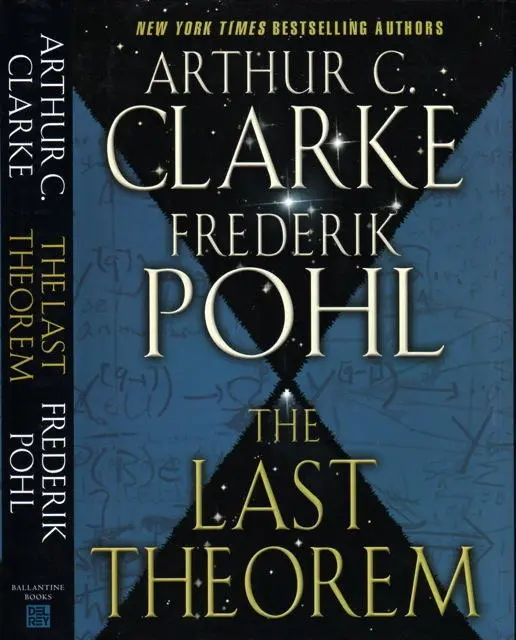
- Название:The Last Theorem
- Автор:
- Издательство:Del Rey Books
- Жанр:
- Год:2008
- Город:New York
- ISBN:9780345470218
- Рейтинг книги:3 / 5. Голосов: 1
-
Избранное:Добавить в избранное
- Отзывы:
-
Ваша оценка:
The Last Theorem: краткое содержание, описание и аннотация
Предлагаем к чтению аннотацию, описание, краткое содержание или предисловие (зависит от того, что написал сам автор книги «The Last Theorem»). Если вы не нашли необходимую информацию о книге — напишите в комментариях, мы постараемся отыскать её.
.
The Last Theorem In 1637, the French mathematician Pierre de Fermat scrawled a note in the margin of a book about an enigmatic theorem: “I have discovered a truly marvelous proof of this proposition which this margin is too narrow to contain.” He also neglected to record his proof elsewhere. Thus began a search for the Holy Grail of mathematics—a search that didn’t end until 1994, when Andrew Wiles published a 150-page proof. But the proof was burdensome, overlong, and utilized mathematical techniques undreamed of in Fermat’s time, and so it left many critics unsatisfied—including young Ranjit Subramanian, a Sri Lankan with a special gift for mathematics and a passion for the famous “Last Theorem.”
When Ranjit writes a three-page proof of the theorem that relies exclusively on knowledge available to Fermat, his achievement is hailed as a work of genius, bringing him fame and fortune. But it also brings him to the attention of the National Security Agency and a shadowy United Nations outfit called Pax per Fidem, or Peace Through Transparency, whose secretive workings belie its name. Suddenly Ranjit—together with his wife, Myra de Soyza, an expert in artificial intelligence, and their burgeoning family—finds himself swept up in world-shaking events, his genius for abstract mathematical thought put to uses that are both concrete and potentially deadly.
Meanwhile, unbeknownst to anyone on Earth, an alien fleet is approaching the planet at a significant percentage of the speed of light. Their mission: to exterminate the dangerous species of primates known as homo sapiens.
The Last Theorem — читать онлайн ознакомительный отрывок
Ниже представлен текст книги, разбитый по страницам. Система сохранения места последней прочитанной страницы, позволяет с удобством читать онлайн бесплатно книгу «The Last Theorem», без необходимости каждый раз заново искать на чём Вы остановились. Поставьте закладку, и сможете в любой момент перейти на страницу, на которой закончили чтение.
Интервал:
Закладка:
They were sitting by the Vorhulsts’ pool, De Saram and Ranjit and Myra de Soyza and Beatrix Vorhulst herself; trips to the de Soyza beach house were no longer much fun for Ranjit and Myra, because the press pests had found them there, so Myra now came to swim with Ranjit in the pool. “I’ve spoken to Dr. Bandara about it,” De Saram said, inching his chair closer to the shade of the great pool umbrella. “He is confident the university will make a space available for you to hold your press conference. Indeed, he says it would be an honor for the school.”
Ranjit said uncomfortably, “What would I say?”
“You’ll tell them what you did,” De Saram answered. “Leaving out, of course, all the specifics that Dr. Bandara feels must be kept secure.” He set his cup down and smiled at Mevrouw Vorhulst. “No, no more tea, thank you. I need to get back to the office. And I’ll find my way out.”
Mevrouw Vorhulst let him shake her hand, but didn’t protest as he left. “Actually,” she observed to Ranjit and Myra, “that sounds like an excellent idea. I’d love to hear that talk.” Then, turning to Myra, she said, “Dear, do you remember the room we used to put you to sleep in when your parents were going to be really late? It’s still there, right next to Ranjit’s. If you’d like to use it from time to time—or as often as you like—it’s yours.”
So when he went to sleep that night, Ranjit had to count that a good day. He had very little experience in public speaking, and that worried him a bit. But right there was Myra’s head on the pillow next to his own, and, all in all, things seemed to be going very well for him at last.
The auditorium that the university donated for Ranjit’s press conference was quite big, and needed to be. Every one of its 4,350 seats was filled, and not just with newspeople. There were several hundred of those, but it seemed half of Sri Lanka had decided it wanted to be there as well. Besides the lucky 4,350, an additional 1,000, nearly, watched on closed-circuit television in another campus hall, leaving quite a few extremely important (or so self-described) other people consumed with indignation over having to watch the event on (ugh!) broadcast television.
To Ranjit Subramanian, peering out at them through a peephole in the curtain, they looked like a great many people. It wasn’t just the number of the human beings in the room, either. It was the particular human beings they were! The president of Sri Lanka was seated in the front row. Two or three possible candidates for the next election were there, and so was the Vorhulst family, and—believe it or not!—so was Ranjit’s old math professor, not having the grace even to look as embarrassed as he should have felt but instead smiling and nodding to everyone in a less favored seat than his.
As the curtain began to rise, the man sitting in the armchair next to Ranjit’s gave him a reassuring look. “You’ll be fine,” said the august Dr. Dhatusena Bandara, unexpectedly having flown in from his hush-hush UN job just to introduce Ranjit. “I wish Gamini could have been here, and so does he, but he’s busy recruiting in Nepal,” he added, and then the curtain was up and the lights were on him, and—without explaining just what it was that Gamini had to go to Nepal to recruit—Dr. Bandara moved to the lectern.
And then, sooner thereafter than Ranjit would have imagined possible, it was he who was at the lectern, and every pair of hands in that hall began to clap.
Ranjit waited patiently for the sound to stop. When it didn’t seem to be stopping, he cleared his throat. “Thank you,” he said. “Thank you all.” And then, as it abated only slightly, he began:
“The man who presented this problem to me—well, to the world—was named Fermat, an advocate, or lawyer, in France a few centuries ago—”
By the time he got to the famous jotting in the margin of a page of Diophantus the applause had subsided, and the audience was intent. They weren’t quiet throughout the talk. They laughed when he commented that a lot of trouble could have been saved if the book Fermat had been reading had had larger margins. And they applauded again, though not in quite as unruly a fashion, as he described each step in his growing comprehension of what Fermat had been talking about. Then, when he described Sophie Germain’s work and how that turned out to be the key at last, they applauded a lot. And kept on doing so at every opportunity until Ranjit reached the moment when he had become pretty sure, or at least pretty nearly sure, that he had by-God actually completed a defensible proof of Fermat’s Last Theorem.
He stopped, smiled, and shook his head at them. “Do you have any idea how hard it is to memorize a five-page mathematical proof?” he asked. “I didn’t have anything to write with, you see. I couldn’t write it out. All I could do was go over it, over and over again, repeating each little step, I don’t know, hundreds of times, or thousands…. And then when I was rescued, all I could think of was getting to a computer and getting it all down at once….
“And I did,” Ranjit finished, and let them clap the skin off their silly hands at that until they got tired of it. Which took a long time, until he managed to cut in again to say, “And so Gamini Bandara, my oldest and dearest friend, is one of the people I have to thank, and so is his father, Dr. Dhatusena Bandara.” He gestured toward the older man, who politely accepted his share of applause. “And there are two other persons I owe. One is my late father, Ganesh Subramanian of the Tiru Koneswaram temple in Trincomalee. The other person is hiding backstage here, but she is the one who first suggested to me that the clue to finding out what Fermat had discovered lay in looking at the mathematical procedures known to have been in use at around that time, and trying to figure out what other procedures Fermat might have deduced from them. I don’t know what I might have done without her, and I don’t intend to take that chance again. So come out here, Dr. Myra de Soyza, and take my hand—”
Which she did, and though Ranjit was still speaking when she appeared, it was hard to make out just what he was saying. Myra got easily the biggest hand of anyone other than Ranjit himself, perhaps because the audience could read what was written all over his face when he spoke of her, perhaps only because she was definitely the best-looking.
Ranjit might have let her applause go on forever, but Myra was shaking her head. “Thank you,” she called, “but let’s hear the rest of what Ranjit has to say.” She stepped back, and sat down in Ranjit’s own chair to listen.
He turned back to the crowd. “That’s the end of what I wanted to say,” he informed them, “but I promised I would take a few questions….”
And then it was over, and he had successfully ducked all the questions about where he had been jailed and why. They were back in the Vorhulst residence, along with a pared-to-the-bone residue of guests from the university hall. That included nearly all of the first two rows of the auditorium and a scattering of others, as well as a hired-for-the-occasion staff of servants to pass around the drinks and snacks. (That was so the actual Vorhulst household staff, each one of whom felt personally responsible for some part of the event, could attend as guests.) Ranjit and Myra sat side by side, holding hands, and quite remarkably happy to be there. All of the guests were just as happy, so that the champagne the hired staff was passing out was very nearly superfluous.
Dr. Bandara, of course, was already on his way back to New York in his own BAB-2200, but before he’d left, he had taken Ranjit aside for a few words. “You’ll be wanting a job, of course,” he began, and Ranjit nodded.
Читать дальшеИнтервал:
Закладка:
Похожие книги на «The Last Theorem»
Представляем Вашему вниманию похожие книги на «The Last Theorem» списком для выбора. Мы отобрали схожую по названию и смыслу литературу в надежде предоставить читателям больше вариантов отыскать новые, интересные, ещё непрочитанные произведения.



Обсуждение, отзывы о книге «The Last Theorem» и просто собственные мнения читателей. Оставьте ваши комментарии, напишите, что Вы думаете о произведении, его смысле или главных героях. Укажите что конкретно понравилось, а что нет, и почему Вы так считаете.