Robert Sawyer - Foreigner
Здесь есть возможность читать онлайн «Robert Sawyer - Foreigner» весь текст электронной книги совершенно бесплатно (целиком полную версию без сокращений). В некоторых случаях можно слушать аудио, скачать через торрент в формате fb2 и присутствует краткое содержание. Год выпуска: 1994, ISBN: 1994, Издательство: Ace Books, Жанр: Фантастика и фэнтези, на английском языке. Описание произведения, (предисловие) а так же отзывы посетителей доступны на портале библиотеки ЛибКат.
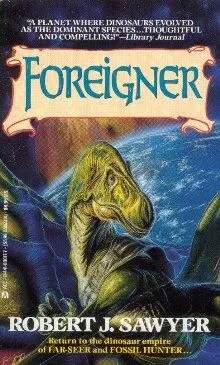
- Название:Foreigner
- Автор:
- Издательство:Ace Books
- Жанр:
- Год:1994
- ISBN:0-441-00017-7
- Рейтинг книги:3 / 5. Голосов: 1
-
Избранное:Добавить в избранное
- Отзывы:
-
Ваша оценка:
Foreigner: краткое содержание, описание и аннотация
Предлагаем к чтению аннотацию, описание, краткое содержание или предисловие (зависит от того, что написал сам автор книги «Foreigner»). Если вы не нашли необходимую информацию о книге — напишите в комментариях, мы постараемся отыскать её.
trilogy depicts an Earth-like world on a moon which orbits a gas giant, inhabited by a species of highly evolved, sentient Tyrannosaurs called Quintaglios, among various other creatures from the late cretaceous period, imported to this moon by aliens 65 million years prior to the story.
Foreigner — читать онлайн бесплатно полную книгу (весь текст) целиком
Ниже представлен текст книги, разбитый по страницам. Система сохранения места последней прочитанной страницы, позволяет с удобством читать онлайн бесплатно книгу «Foreigner», без необходимости каждый раз заново искать на чём Вы остановились. Поставьте закладку, и сможете в любой момент перейти на страницу, на которой закончили чтение.
Интервал:
Закладка:
“Yes.”
“Absolutely sure? There’s no chance that you witnessed the visit of some other dignitary? The provincial governor, perhaps? Or a lesser palace official?”
“No, I’m sure it was Sardon. I remember the blood-red sash; only members of The Family wear those. Why do you ask?”
“Do you know what kiloday that was?”
“I haven’t a clue.”
“It was 7196.”
“Really? Then I would have been—”
“Less than a kiloday old. Much less, in fact, for, according to palace records, Empress Sardon visited Carno on a tour through Arj’toolar in the sixth tenth of that kiloday.”
“Fascinating.”
“Do you remember anything of your life before that?”
“It’s hard to tell. I’ve got lots of memories, but as to which: first, I can’t say.”
“Do you remember the creche?”
“Of course.”
“Do you remember clutches of eggs in the creche?”
“You mean while I was still living in the egg chamber? Goodness, that was a long time ago. Other clutches of eggs? No. No, I can’t say that I—wait a beat. Wait a beat. Yes, I—now that you mention it, I do remember one other clutch. Eight eggs, laid in a circle.”
Mokleb shook her head. “That’s incredible.”
“Oh?”
“You were part of the second-last clutch to hatch during that hatching season, were you aware of that?”
“No.”
“Well, it’s true. The bloodpriests keep meticulous records, copies of which eventually end up in the census bureau here in Capital City. There was one other clutch that hatched after yours.”
“Indeed?”
“Yes. And it hatched eight days after your own clutch did.”
“Eight days? But that would mean…”
“That would mean you have a memory from when you were just eight days old—maybe earlier, even.”
“Is that normal?”
“Who can say? No one has really studied early memories before.”
“Eight days, you say. It seems incredible, but I’m sure I remember those eggs. Not well, you understand—the memory is dim. But I’m sure of it nonetheless.”
“Do you remember anything before that?”
“Like what?” Afsan clicked his teeth. “Like breaking out of my eggshell?”
“Yes. Do you remember that?”
“Oh, be serious, Mokleb.”
“I am. Do you remember that?”
“I—no. I don’t think so. I mean, I’ve seen eggs hatch before. In the very creche I was born in, for that matter, when I paid a return visit to Carno kilodays ago. So, yes, I have mental pictures of eggs cracking open in that creche, of little birthing horns piercing shells. But of my own hatching? No, no memories that I’m aware of.”
“And what about the culling?”
“The culling by the bloodpriest?” Afsan shuddered. “No. No, I do not remember that.”
“Are you sure?”
“That’s something I wouldn’t be likely to forget.” Afsan seemed shaken. “I saw a culling once, you know. During that same trip back to Carno. I came through the wrong door into the creche. Most horrifying thing I’ve ever seen. Babies running across the sands, and a bloodpriest, his purple robe swirling around him, chasing them down, swallowing them whole, his gullet distending as each one slid into his stomach.” Afsan shook his head.
“Did you say purple robe?”
“Yes—that’s the color bloodpriests wear, at least in Arj’toolar, and I’d assume elsewhere, too.”
“A purple robe… swirling around him.”
“Yes, you know: swirling, flapping up.”
“ Flapping . Like wings of cloth?”
“I suppose.”
“Like a purple wingfinger?”
Afsan pushed off his rock and got to his feet. “Good God.”
“You saw a bloodpriest once as an adult. And we’ve already established that you have a memory that’s at most from your eighth day of life. The culling of your own clutch of eggs would have taken place on your second, third, or, depending on the availability of the bloodpriest and on whether the alignment of the moons was appropriate for the sacrament, your fourth day of life. Are you sure you don’t remember it?”
“I tell you I do not.”
“Forgive me, good Afsan, but I suggest that you do remember it.”
Afsan spread his arms. “You can see my muzzle, Mokleb. I’m sure it’s as green as yours.”
She held up her hands. “I meant no insult. I don’t mean you can consciously remember it, but that subconsciously, perhaps, you do recall it.”
Afsan sounded exasperated. “Surely a memory that can’t be recalled consciously is no memory at all.”
“I’d have agreed with you before I began my studies, Afsan. But events from our past do affect our present actions, even if we can’t voluntarily summon up the memories.”
“That makes no sense,” said Afsan.
“Ah, but it does. If does indeed. Have you ever wondered why Quintaglios fight territorial battles to the death, when animals do not? Animals are content to engage in a bluffing display, or to quickly determine who is the strongest without drawing blood. Although we call ourselves civilized and refer to the animals as wild, it’s we who don’t stop when instinct tells us we should.
Instead, we fight with jaws and claws until one of us—even if it is a friend or creche-mate—is dead. Why is that? Why do we do that?”
“I admit that question has puzzled me.”
“And me as well—until now. Afsan, we’re traumatized .”
“Traumatized? The kind of injury that leaves one in shock?”
“Forgive me; I’m using the word in a slightly different way. I’m not referring to physical injury, but rather to emotional injury. Something that causes lasting damage to the mind.”
“Traumatized, you say? By what?”
Mokleb’s tail swished. “By the culling of the bloodpriests! Each of us was once part of a… a family, of eight siblings. Each of us had brothers and sisters. We hatched together, we spent a day or two or three becoming used to each other, impressing each other, bonding with each other. And then what happens? An adult—a male, the first we’ve ever seen—swoops in and chases us, and seven of the eight die, gulped down by the bloodpriest. We see it happen, see our brothers and sisters devoured. You said that, even as an adult, watching a culling was the most horrifying thing you’d ever seen. Imagine the impact, then, of that sight on a child! And imagine, too, the guilt that goes with the eventual realization that you lived only because you outran your seven siblings, that the price of your life was that they died horribly.”
“But I don’t recall my culling!”
“Not consciously, to be sure. But it’s there, Afsan, deep in your mind, beneath the surface, shaping your perceptions, your mental processes. You said, in that early therapy session, that there had been no one in Carno who shared your interests, no one to whom your mathematical skill might have been nothing special. No one… no one except , you said, and then you trailed off. No one except your dead brothers and sisters, Afsan! They would have been more like you than different; you learned that by seeing your own children. And you remember your brothers. You remember your sisters. All seven of them .”
“That’s impossible…”
“They are there, in every one of your fears and bad dreams. You said my interpretation of your fear of Saleed was nonsense. You were afraid that he would dispatch you—the very word you used—just as he had dispatched his six other previous apprentices, to make room for the eighth and final apprentice you were sure must come. You said that couldn’t possibly be related to the culling of a bloodpriest, who likewise judges youngsters, dispatching seven and only keeping the eighth. It couldn’t be related to that, you said, because you hadn’t learned about the culling until after you’d left Saleed. But you already knew about the culling. You’d seen it with your own eyes! You’d seen your seven brothers and sisters die, and it’s the memory of the seven of them that haunts your dreams. Fourteen arms clawing at your own—the arms of seven siblings who died so you could live. The voices calling out ‘I,’ ‘you,’ ‘we’—seven long-forgotten siblings, a part of you, yet separate, seven voices that no matter how hard you try, you can no longer hear. The birthing sands, soaked with blood—the blood of your dead brethren. And swooping over it all, a purple wingfinger, representing the ravenous bloodpriest!”
Читать дальшеИнтервал:
Закладка:
Похожие книги на «Foreigner»
Представляем Вашему вниманию похожие книги на «Foreigner» списком для выбора. Мы отобрали схожую по названию и смыслу литературу в надежде предоставить читателям больше вариантов отыскать новые, интересные, ещё непрочитанные произведения.





Обсуждение, отзывы о книге «Foreigner» и просто собственные мнения читателей. Оставьте ваши комментарии, напишите, что Вы думаете о произведении, его смысле или главных героях. Укажите что конкретно понравилось, а что нет, и почему Вы так считаете.