Robert Sawyer - Foreigner
Здесь есть возможность читать онлайн «Robert Sawyer - Foreigner» весь текст электронной книги совершенно бесплатно (целиком полную версию без сокращений). В некоторых случаях можно слушать аудио, скачать через торрент в формате fb2 и присутствует краткое содержание. Год выпуска: 1994, ISBN: 1994, Издательство: Ace Books, Жанр: Фантастика и фэнтези, на английском языке. Описание произведения, (предисловие) а так же отзывы посетителей доступны на портале библиотеки ЛибКат.
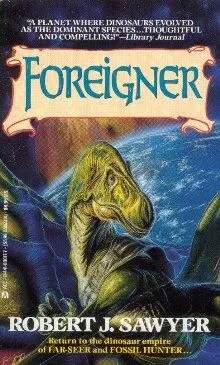
- Название:Foreigner
- Автор:
- Издательство:Ace Books
- Жанр:
- Год:1994
- ISBN:0-441-00017-7
- Рейтинг книги:3 / 5. Голосов: 1
-
Избранное:Добавить в избранное
- Отзывы:
-
Ваша оценка:
Foreigner: краткое содержание, описание и аннотация
Предлагаем к чтению аннотацию, описание, краткое содержание или предисловие (зависит от того, что написал сам автор книги «Foreigner»). Если вы не нашли необходимую информацию о книге — напишите в комментариях, мы постараемся отыскать её.
trilogy depicts an Earth-like world on a moon which orbits a gas giant, inhabited by a species of highly evolved, sentient Tyrannosaurs called Quintaglios, among various other creatures from the late cretaceous period, imported to this moon by aliens 65 million years prior to the story.
Foreigner — читать онлайн бесплатно полную книгу (весь текст) целиком
Ниже представлен текст книги, разбитый по страницам. Система сохранения места последней прочитанной страницы, позволяет с удобством читать онлайн бесплатно книгу «Foreigner», без необходимости каждый раз заново искать на чём Вы остановились. Поставьте закладку, и сможете в любой момент перейти на страницу, на которой закончили чтение.
Интервал:
Закладка:
“I’ll summon a healer. We’ll get you fixed up.”
“I’m fine,” said Novato. “Really, I am.” She beamed at Garios. “It’s so good to see you again, my friend.”
“You’re sure you are all right?”
“I’m better than I’ve ever been before, Garios. How is everyone down here?”
“Most of us are fine,” said Garios, “but there is some bad news, I’m afraid. It happened while you were away, during the landquake.”
“I know,” said Novato, an absolutely calm, peaceful look on her face. “Karshirl is dead, isn’t she?”
An even-day passed, and then it was odd-day again. As the time for their appointment approached, Mokleb walked the path to Rockscape with trepidation. Had she gone too far in her last session with Afsan? She was normally not so brutal with her patients, but, by the Eggs of Creation, she’d had to make Afsan see her point.
It was a lackluster day. The gibbous Big One made a dull smudge behind a stack of clouds on the eastern horizon. The sun was a point drilling through other clouds as it slid down the western sky. Wingfingers of every color—every color except purple, that is—flitted across the gray firmament.
The path to Rockscape took a sharp bend to avoid a thick copse of trees just before it rounded out onto the field of carefully arrayed boulders. Mokleb was too far from Capital City to hear the drums from the Hall of Worship, but was sure that she was on time. She rounded the grouping of trees, and Rockscape was visible before her.
It was deserted.
Afsan wasn’t there.
Mokleb felt her heart sink.
She had been too hard on him. He’d curtailed their sessions. The penalty of wasting part of a volume of Saleed’s treatise was hardly enough in the face of what she’d made him go through last time.
She was about to leave when a thought struck her. She’d sat on a couple of the Rockscape boulders over the course of her long association with Afsan, but had never actually touched the one called Afsan’s rock. She made her way across the field, through the ancient geometric patterns, and came to the large, proud boulder. Mokleb reached out with her left hand and lightly patted the stone. It was worthy of Afsan: strong, hard, weather-beaten, but, despite all it had been through, placidly surviving.
Surviving.
She wondered if she’d ever see Afsan again, if he’d ever forgive her for their last session. She had no desire to be near anyone else today. She began to amble on in the same direction, heading through Rockscape toward the lands beyond.
“Wait!”
Mokleb turned. Emerging from the mouth of the path, beside the dense copse of trees, was Pal-Cadool. “Wait!” he shouted again, and ran toward her, his long legs covering the distance quickly. Mokleb stood dumbfounded as Cadool came within eight paces of her. “Don’t go,” said Cadool. “Afsan is coming.”
She looked back toward the mouth of the path. Soon Afsan did indeed appear. He held his walking stick in his left hand, and his right was on Cork’s harness. Mokleb hurried over to Afsan as fast as she could with her bad knee, Cadool loping alongside. Once the distance between them had closed as much as it reasonably could, Mokleb blurted out, “I thought you weren’t coming.”
Afsan’s face was a portrait in joy. “I’m sorry, Mokleb,” he said. And then, with a deep bow, “I overslept.”
*26*
Mokleb and Afsan headed back to their usual rocks. Afsan was eager to understand all the implications of what Mokleb had revealed in their last session.
“If your low mind remembers your culling by the bloodpriests,” said Mokleb, “then the same is probably true for all Quintaglios. I suspect our suppressed memories of the culling manifest themselves most in the territorial challenge. When we end up in a fight with another, we don’t behave sensibly or logically or instinctively. Instead, our minds, our traumatized minds, cause us to fight uncontrollably until we or our opponent is dead.”
“You sound like Emperor Dybo. He thinks that trait in us will allow us to defeat the Others.”
Mokleb nodded. “He’s probably right.”
“But it sounds like you’re saying we’re insane.”
“That’s a strong word. I might say ‘irrational’ instead. But yes, as a race, we’re deranged.”
“But by definition the majority is always sane. Insanity or irrationality is an aberration from the norm.”
“That’s a semantic game, Afsan, and a dangerous one to play. There was a time when many of our ancestors practiced cannibalism. Today, we find that concept abhorrent. There is a higher arbiter of conduct than simple mob majority.”
“Perhaps,” said Afsan. “But what does the culling of the bloodpriest have to do with the territorial frenzy of dagamant ? It sounds as though you’re trying to link the two.”
“I am indeed. It’s the traumatizing effect of the culling that causes us to have such a wild reaction to territorial invasions. Think about it! The very first time we see someone invade our territory—that someone being the bloodpriest—it results in death and destruction and unspeakable horror right in front of our eyes! No wonder our reaction to future invasions is so strong—far stronger than any animal instinct would require.”
Afsan’s tail shifted as he considered this. “It’s a neat theory, Mokleb, I’ll give you that. But you know what you suggest is only a pre-fact, only a proposition. You can’t test it.”
“Ah, good Afsan, that’s where you are wrong. It already has been tested .”
“What do you mean?”
“Consider your son Toroca.”
“Yes?”
“We’ve discussed him before. He has no sense of territoriality.”
“He doesn’t like people talking about that.”
“Well, doubtless it causes him some embarrassment. But it’s true, isn’t it? He feels no need to issue a challenge when another encroaches on his physical space.”
“That is correct.”
“And when he sees the Others, he, alone amongst those who have encountered them, has no adverse reaction. What was it his missive said? ‘Mere sight of them triggers dagamant in all of us except me.’ ”
“Yes.”
“Well, don’t you see? Don’t you see why that is? What’s different about Toroca?”
“He’s—ah! No, Mokleb, it can’t be that simple…”
“But it is! I’m sure of it. What’s different about Toroca is that he did not undergo the culling of the bloodpriest. None of the offspring of yourself and Wab-Novato did.”
“But not all of them are without territoriality,” said Afsan.
“No, that’s true, although as near as I’ve been able to determine, none of them has ever been involved in a territorial challenge.”
“It pains me to bring up this subject, Mokleb, but what about my son Drawtood…”
“Ah, yes. The murderer.” Mokleb raised a hand. “Forgive me, I shouldn’t have said that. But, yes, Drawtood poses a problem. He killed two of your other children.”
Afsan’s voice was small. “Yes.”
“But consider, good Afsan, exactly how he committed the, ah, the crimes.”
“He approached his siblings,” said Afsan, “presumably with stealth, and slit their throats with a jagged mirror.”
“You’ve said that before, yes. Let’s consider that. He was able to come very, very close to his siblings apparently without triggering their territorial reflexes.”
“He snuck up on them,” said Afsan.
“Perhaps. Or perhaps their own senses of territoriality were so subdued as to allow him to approach them openly.”
Afsan said nothing for a long time, then, slowly, the word hissing out like escaping breath: “Perhaps.”
Читать дальшеИнтервал:
Закладка:
Похожие книги на «Foreigner»
Представляем Вашему вниманию похожие книги на «Foreigner» списком для выбора. Мы отобрали схожую по названию и смыслу литературу в надежде предоставить читателям больше вариантов отыскать новые, интересные, ещё непрочитанные произведения.






Обсуждение, отзывы о книге «Foreigner» и просто собственные мнения читателей. Оставьте ваши комментарии, напишите, что Вы думаете о произведении, его смысле или главных героях. Укажите что конкретно понравилось, а что нет, и почему Вы так считаете.