Greg Keyes - Dawn of the Planet of the Apes - Firestorm
Здесь есть возможность читать онлайн «Greg Keyes - Dawn of the Planet of the Apes - Firestorm» весь текст электронной книги совершенно бесплатно (целиком полную версию без сокращений). В некоторых случаях можно слушать аудио, скачать через торрент в формате fb2 и присутствует краткое содержание. Город: London, Год выпуска: 2014, ISBN: 2014, Издательство: Titan Books, Жанр: Фантастика и фэнтези, на английском языке. Описание произведения, (предисловие) а так же отзывы посетителей доступны на портале библиотеки ЛибКат.
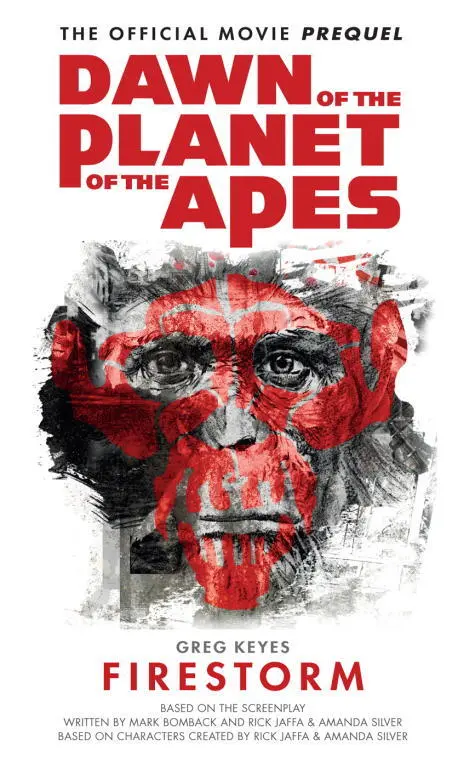
- Название:Dawn of the Planet of the Apes: Firestorm
- Автор:
- Издательство:Titan Books
- Жанр:
- Год:2014
- Город:London
- ISBN:978-1783292257
- Рейтинг книги:3 / 5. Голосов: 1
-
Избранное:Добавить в избранное
- Отзывы:
-
Ваша оценка:
Dawn of the Planet of the Apes: Firestorm: краткое содержание, описание и аннотация
Предлагаем к чтению аннотацию, описание, краткое содержание или предисловие (зависит от того, что написал сам автор книги «Dawn of the Planet of the Apes: Firestorm»). Если вы не нашли необходимую информацию о книге — напишите в комментариях, мы постараемся отыскать её.
movie, scheduled for release in July 2014.
No
fan should miss out on this original Apes story written by
bestselling author Greg Keyes, whose previous works include the
novels
,
, and
.
Bridging the gap between the events of the box office smash
and the eagerly anticipated sequel
, this movie prequel takes readers on a journey through the build up that leads to the action on screen.
Dawn of the Planet of the Apes: Firestorm — читать онлайн бесплатно полную книгу (весь текст) целиком
Ниже представлен текст книги, разбитый по страницам. Система сохранения места последней прочитанной страницы, позволяет с удобством читать онлайн бесплатно книгу «Dawn of the Planet of the Apes: Firestorm», без необходимости каждый раз заново искать на чём Вы остановились. Поставьте закладку, и сможете в любой момент перейти на страницу, на которой закончили чтение.
Интервал:
Закладка:
The other humans weren’t paying much attention. They were talking to each other. He could hear them clearly. He watched the man with the gun, and he listened.
“I don’t know,” Flores said as Corbin took a step toward the trail. “About getting this over with. I mean, we might be safer up here, what with the plague and all.”
“Plague?” Clancy asked.
“Some damn virus,” Flores went on. “It’s killed like a few thousand people in San Fran. Seems like it’s pretty nasty. People start bleeding out of their noses, and the next thing you know they’re dead.”
“When did this begin?” Malakai asked.
“Just a couple of days ago. It just sort of started.”
“Sounds like Ebola,” Malakai said.
“Yeah, they’re comparing it to that. Except it’s a lot easier to get than Ebola.”
“That’s a weird coincidence,” Clancy said.
“Weird?” Flores said. “It’s more than that—it’s scary as shit.”
“No,” Clancy said. “It’s weird that the escape of a bunch of apes would coincide with the onset of an epidemic, especially an epidemic that resembles Ebola.”
“Why?”
“Well, because some scientists think Ebola, like AIDS, got into the human population from animals, and specifically non-human primates.”
“You mean we’re chasing the plague?” Flores said, his voice getting higher.
“Probably not,” Clancy said. “I’m just thinking out loud.”
But that would explain a lot , Malakai thought. A whole lot.
Like why the stores he had called had all had break-ins. In an epidemic, people panicked. They hoarded food and medicine. And if there was a link between the apes and the epidemic—if the apes were carrying it—it would explain the presence of Anvil, the secrecy, all of it.
“Talk a little louder,” Corbin snapped. “Maybe the apes haven’t heard you yet.”
“I don’t know about you,” Flores said, “but I don’t see anywhere you could hide three hundred apes right there. Maybe one or two.”
Corbin frowned and began to walk toward the trailhead, but he hadn’t gone more than another step before he glanced down at the locator.
“Crap,” he swore. “We missed them, somehow. They’re still going. And still headed northwest. They’ve already crossed our perimeter.”
“Headed to Seattle maybe?” a soldier named Kyung joked.
“No,” Corbin said. “But there are pockets of redwood forest all along the coast. God, if they get up to Sonoma County, we’ll never find them.”
“Can they do that?” Malakai asked.
“They would have to cover a lot of open ground, and cross a bunch of roads,” Corbin said. He looked back uneasily at the hill hunkering over them. “But we’ve closed some of those roads, and evacuated some of the homes. If they’re moving by night –” he glanced back at his tablet “– they could be headed for the Point Reyes seashore—the ridges are in forest. But surely someone would see them.”
Then he climbed back in the car and stepped on the gas, a determined look on his face. The Humvee lurched onward. Malakai kept his eye on the stark line between hill and sky.
Still breathing hard, Caesar watched the man get back in the big car. In a moment, it moved on, following the pickup truck, the truck into which he had, moments before, tossed the white rectangles as it slowed for the curve near his hiding place.
When it was clear, he hurried back up and over the hill, racing into the sheltering leaves of the forest. But his mind was busy, stirring around all he had just heard. He knew what disease was. Will had been trying to cure a disease, the one that was hurting Charles. It sounded as if many humans were dying of this new disease. And they seemed to think it had something to do with his troop.
He remembered the people fighting at the market. Was it because they were sick? Will’s father sometimes acted very strangely because of his illness. He didn’t mean to. Caesar remembered the time the man in the house next door had screamed at Charles and grabbed him, pushed and threatened him. That was when Caesar went to protect Charles, and bit the other man, and was sent to the shelter.
Had the man been angry at Charles because he was sick and acting strangely? Or was he afraid? And why did they think the apes brought the disease? There were injured in his troop, but that was different from sick. None of them were sick.
But it meant something. Whether it was good or bad, he did not know.
Delores Park was normally a pretty lively place, but today it was mostly empty. A few brave or deluded parents had brought their kids to the playground. A young couple lay on a blanket, flying a kite shaped like a sailing ship. An old man was walking his dog.
So it wasn’t hard to spot the red-headed woman in the green sweater, standing between the playground and Delores Street. As he approached she smiled uncertainly at him. She wore a white filter mask and carried a leather satchel.
“Are you…?” she asked, when he was close enough to hear her through the muffle of her mask.
“David Flynn,” he said.
She looked around nervously.
“What are you worried about?” he asked.
She shook her head.
“It’s just… You weren’t the first person to come looking for Linda,” she said. “Someone searched her apartment. They took her computer and some other things. They didn’t know she had left it with me.”
She handed him the satchel.
“She already knew she was sick, you see. One of the men on her team, he was the first to die.”
“The first to die at Gen Sys?”
“No. The first to die of the virus, period.”
For a moment all he could do was stand there, stunned.
“You mean in the world?” he said. “How do you know?”
“It’s all in there,” she replied. “She was going to come back for it and get it to the press. But she didn’t come back. I was afraid, so I held on to it. Then you called.” She looked down. “I have to leave,” she said.
“I really am sorry for your loss,” he said. “You’ve done a brave thing. The right thing.”
“What else should a big sister do?” she said, smiling briefly.
She turned and began to walk, then to run. He watched her go, and realized he didn’t even know her name. She had almost reached the street when she stumbled and fell. He started toward her involuntarily, and then checked himself, knowing she would rise long before he could reach her.
Except she didn’t get back up.
He started trotting toward her. Had she hit her head on something?
But when he reached her he saw the blood, and how much there was of it, and he knew she hadn’t just stumbled.
“Easy,” someone said from behind him. “Turn around, slowly.”
Mayor House looked—more than anything—tired, as he took the podium. Dreyfus noticed that he wasn’t wearing a mask or respirator this time. His campaign was apparently adjusting.
He cleared his throat.
“Good morning,” he said. He took a sip of water. “I’m here today to clear up a few misconceptions that have been getting a lot of press lately. There has been so much nonsense thrown around, I’m not sure where to start.
“The so-called ‘monkey problem’ is well in hand. The idea that hundreds of them survive is purest fantasy. The few that remain will be captured or humanely euthanized in the next twenty-four hours.
“That’s all that I have to say about that. That’s all there is to say about it.
“As to the more relevant and serious matter of the virus,” he continued, “we are moving with all due speed to mitigate the situation. Quarantine and isolation treatment areas have been set up by the CDC and the National Guard, in order the give the greatest number of infected persons maximum medical attention, and to keep those who might be infected from spreading the virus until they’ve been cleared by the CDC.
Читать дальшеИнтервал:
Закладка:
Похожие книги на «Dawn of the Planet of the Apes: Firestorm»
Представляем Вашему вниманию похожие книги на «Dawn of the Planet of the Apes: Firestorm» списком для выбора. Мы отобрали схожую по названию и смыслу литературу в надежде предоставить читателям больше вариантов отыскать новые, интересные, ещё непрочитанные произведения.












Обсуждение, отзывы о книге «Dawn of the Planet of the Apes: Firestorm» и просто собственные мнения читателей. Оставьте ваши комментарии, напишите, что Вы думаете о произведении, его смысле или главных героях. Укажите что конкретно понравилось, а что нет, и почему Вы так считаете.