Hal Colebatch - Man-Kzin Wars – XIV
Здесь есть возможность читать онлайн «Hal Colebatch - Man-Kzin Wars – XIV» весь текст электронной книги совершенно бесплатно (целиком полную версию без сокращений). В некоторых случаях можно слушать аудио, скачать через торрент в формате fb2 и присутствует краткое содержание. Год выпуска: 2015, Жанр: Фантастика и фэнтези, на английском языке. Описание произведения, (предисловие) а так же отзывы посетителей доступны на портале библиотеки ЛибКат.
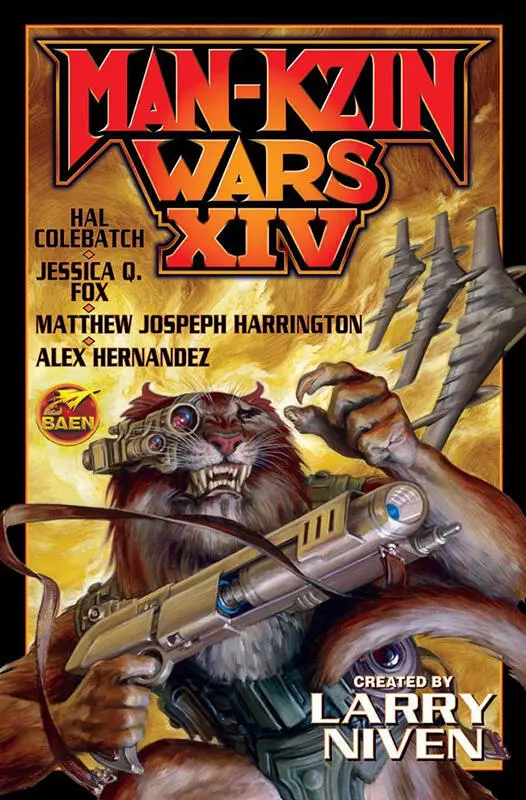
- Название:Man-Kzin Wars – XIV
- Автор:
- Жанр:
- Год:2015
- ISBN:нет данных
- Рейтинг книги:3 / 5. Голосов: 1
-
Избранное:Добавить в избранное
- Отзывы:
-
Ваша оценка:
Man-Kzin Wars – XIV: краткое содержание, описание и аннотация
Предлагаем к чтению аннотацию, описание, краткое содержание или предисловие (зависит от того, что написал сам автор книги «Man-Kzin Wars – XIV»). Если вы не нашли необходимую информацию о книге — напишите в комментариях, мы постараемся отыскать её.
Man-Kzin Wars – XIV — читать онлайн бесплатно полную книгу (весь текст) целиком
Ниже представлен текст книги, разбитый по страницам. Система сохранения места последней прочитанной страницы, позволяет с удобством читать онлайн бесплатно книгу «Man-Kzin Wars – XIV», без необходимости каждый раз заново искать на чём Вы остановились. Поставьте закладку, и сможете в любой момент перейти на страницу, на которой закончили чтение.
Интервал:
Закладка:
“You Johnsons do fine,” said a woman.
“I never said otherwise. It’s just hard.”
Several women cleared their throats, and Tom looked like he’d suddenly remembered something he should never have forgotten. “Sorry. Captain, is your neck in pain? We can’t do real regeneration, but I used the things we do have that improve healing ability.”
“Actually the only thing that hurts is my teeth,” Persoff said, touching his cheek. There were things sticking out of his skin. “What are these?” he said.
“Sutures. You’d lost a tooth. I had to go in from the side to make sure circulation was restored. They should come out now, in fact.” He reached into a bag sitting nearby, and took out tweezers that looked like bamboo, and a small pair of scissors with clay handles and obsidian blades.
As threads were snipped and pulled out of his face, Persoff was able to distract himself by being deeply impressed with the quality of the tools. Ever since the kzinti attacked, History of Technology was a prerequisite for combat officers, so he knew fairly well how difficult those instruments had been to make.
He suspected even his teachers didn’t know it nearly as well as the people here, whose ancestors had grown up with the “everybody play nice” version of social development. They must have had to learn everything down to rock chipping from scratch.
Tom put some goo on the holes and said, “Wash your mouth out with this.”
Persoff obeyed, but regretted it at once. Once he’d spit it out, he said, “What was that?”
“Everyone asks that, but nobody ever likes the details. It’s something that bacteria won’t live in. You won’t have to brush your teeth for a few days.”
“I’ve never had to.”
Tom studied him silently, then said, “May I take it that the process that prevents that still works? On your ship?”
“Absolutely. There’s something I have to discuss with your people.”
Tom nodded. “The Hales aren’t all here yet.”
Persoff said, “The Hale clan are in charge?”
“That would be ‘is.’ The word ‘clan’ is singular. And they’re not a clan, they’re a type. We’d be in a sorry mess if we chose leaders by heredity.”
“You have elections?”
Tom waited until most of the crowd was pretty much done laughing. “If we chose leaders for their ability to talk people into things they’d all be Blackers!” he said, grinning.
“Sounds fair,” said the woman who’d said he was good stock. She was joking.
“Of course it sounds fair. That’s the point, isn’t it?” Tom said, followed by more laughter. When that had diminished, he explained, “Hales are identified by character, same as everybody else.”
“Who chooses them?”
Tom looked confused. “Chooses?”
“I think he means identifies,” said the woman who’d just spoken. “They identify themselves. Anybody can see it. This is interesting. Captain, you clearly have a Hale job, but you talk a lot like a Johnson. How were you chosen?”
Persoff, who was starting to worry that he’d been hit a lot harder than he’d realized, said, “I took placement exams to qualify for the Academy, and after I graduated, the people in charge put me where they needed me.”
“They all sound like Wellses,” she said, to general agreement. “A Wells helps out wherever she can be useful,” she explained.
“She?”
“They’re usually women, like Blackers or Schafers.”
As Persoff opened his mouth, Tom said, “Blackers keep track of things and give advice. A Schafer trains.”
“They’re teachers?”
“They train children, yes, but they train anything. Animals, plants-the plant that produced the sutures I used on you, for instance. Didn’t hurt coming out, did it? When we landed it started out as flax, and the fibers would have soaked up some of your blood, which would have clotted. We have bad stories about those days. There were people hurt in the last landing.” He looked grim.
Persoff could just imagine. “How many landing craft did you have working?”
“One,” said Tom.
Nobody added anything to that. Persoff sought anything to say that didn’t involve asking if anybody had ended up being left on the Galaxias . They would learn that anyway, if McCabe’s plan worked. He remembered about the trees. “I wanted to talk about-”
“They’re here!” someone shouted from down on the beach, and most of the people around him left. Six remained.
The woman who’d spoken first said, “It’ll take a while to sort out protocol. Meanwhile, do you prefer Blacker or Wells?”
“For what?”
“Sex. It’s getting really difficult to find partners with low consanguinity, and yours is zero. So, Blacker or Wells?”
“Uh, Newmar, as a matter of fact. She’s our ship’s master at arms.”
This was greeted with glum expressions. The woman who’d spoken just before the last said, “You have female crewmen.”
“Nine, in a current complement of seventy. We lost six men when your ship fired on us.”
“Oh hell,” she said. “I don’t think anyone expected to be found by anyone but the kzinti. I’m awfully sorry about that.” There was a chorus of agreement.
Lacking a useful comment-“me too” seemed tactless-he said, “What do I call you?”
She looked stunned for a moment. “You don’t know our names, of course! I’m Sophia, this is Betsy, that’s Liz, she’s Susan, and they’re Eva and Donna.” She’d alternated between types, which he took to be Blackers and Wellses. Blackers seemed more intense, Wellses more amiable.
“Hey,” said Betsy, who’d spoken to him first, “their ship only had a complement of seventy-six.”
“Seventy-seven. And forty dolphin fighter pilots. Those died when the kzin ship blew.” They’d been the reason the Yorktown hadn’t included any Wunderkzin, since dolphins became insanely hostile in the presence of kzinti. There had been training incidents.
Betsy said, “But the only way that could be enough people is if you have hyperdrive.” They all went quiet.
“We do.”
It was half an hour or so before he had another quiet moment. By that time they’d learned more than he’d realized he knew about hyperdrive and hyperwave. The first interruption came when a large man-no, a man the size of Tom or Ron, who had built himself up with exercise-came over, shook hands without using a neurotically insecure bonecrusher, and said, “I’m Henry, currently the senior Hale. Understand your ship’s damaged. We’ll be glad to help. How many of us can you take back on this trip?”
“It depends on whether we can fix the Galaxias once we’re in orbit. My storesmaster thinks we probably can, and we have better technology than when it was built, so conceivably thousands. How many of you are there to take back?”
Henry looked at Sophia, who said, “Last count was four thousand nine hundred and three, breeding and sterile. Call it five thousand until we can check.”
“I have a crewman who says the Galaxias was designed to hold up to six thousand,” Persoff said.
“That was before the battle,” said Henry.
Sophia recited: “‘Ship’s original complement was three hundred and two, with thirty-eight survivors after the collision. Thirty-one were in coldsleep and had to be awakened via emergency protocol, resulting in impaired cognition. The remaining seven included the two stowaways, who were instrumental in getting the Galaxias back in working order and the awakened into functional condition, respectively. When the ship reached a system with an adaptable planet, the only survivor of the original mission was the pilot. He died bringing the last of the supplies and the ship’s complement, then numbered one hundred and three, to the surface. He was the only casualty of the ferry trips.” She looked at Persoff and smiled. “That was Stuart William Denver. It was by his order that records were kept of accomplishments, and full acknowledgement given to stowaways Marion Johnson and Russelle Wells, without whose work none of us would have lived to get here. Stuart with a ‘u,’ Marion with an ‘o,’ Russelle with a final ‘e.’ The distinctions are made because one name derives from a profession, and both other names were then considered sexually ambiguous.”
Читать дальшеИнтервал:
Закладка:
Похожие книги на «Man-Kzin Wars – XIV»
Представляем Вашему вниманию похожие книги на «Man-Kzin Wars – XIV» списком для выбора. Мы отобрали схожую по названию и смыслу литературу в надежде предоставить читателям больше вариантов отыскать новые, интересные, ещё непрочитанные произведения.
Обсуждение, отзывы о книге «Man-Kzin Wars – XIV» и просто собственные мнения читателей. Оставьте ваши комментарии, напишите, что Вы думаете о произведении, его смысле или главных героях. Укажите что конкретно понравилось, а что нет, и почему Вы так считаете.