Hal Colebatch - Man-Kzin Wars – XIV
Здесь есть возможность читать онлайн «Hal Colebatch - Man-Kzin Wars – XIV» весь текст электронной книги совершенно бесплатно (целиком полную версию без сокращений). В некоторых случаях можно слушать аудио, скачать через торрент в формате fb2 и присутствует краткое содержание. Год выпуска: 2015, Жанр: Фантастика и фэнтези, на английском языке. Описание произведения, (предисловие) а так же отзывы посетителей доступны на портале библиотеки ЛибКат.
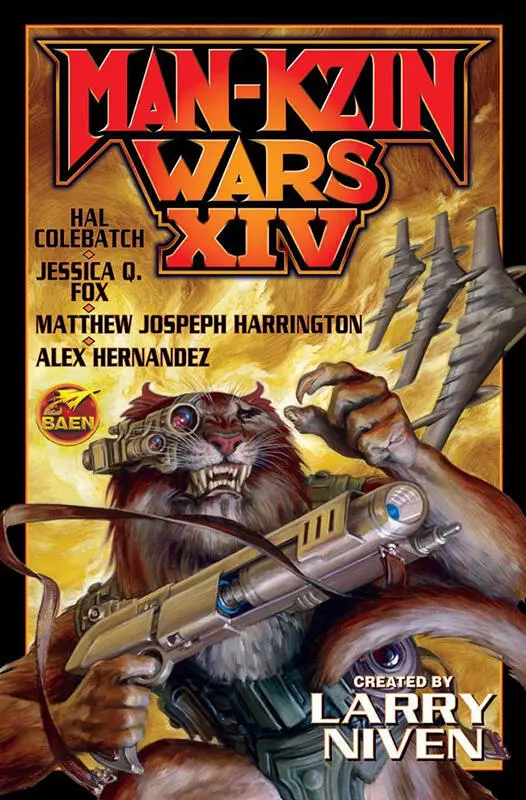
- Название:Man-Kzin Wars – XIV
- Автор:
- Жанр:
- Год:2015
- ISBN:нет данных
- Рейтинг книги:3 / 5. Голосов: 1
-
Избранное:Добавить в избранное
- Отзывы:
-
Ваша оценка:
Man-Kzin Wars – XIV: краткое содержание, описание и аннотация
Предлагаем к чтению аннотацию, описание, краткое содержание или предисловие (зависит от того, что написал сам автор книги «Man-Kzin Wars – XIV»). Если вы не нашли необходимую информацию о книге — напишите в комментариях, мы постараемся отыскать её.
Man-Kzin Wars – XIV — читать онлайн бесплатно полную книгу (весь текст) целиком
Ниже представлен текст книги, разбитый по страницам. Система сохранения места последней прочитанной страницы, позволяет с удобством читать онлайн бесплатно книгу «Man-Kzin Wars – XIV», без необходимости каждый раз заново искать на чём Вы остановились. Поставьте закладку, и сможете в любой момент перейти на страницу, на которой закончили чтение.
Интервал:
Закладка:
Nor, indeed, the extent of the local Oort halo. Something-just what wasn’t clear on the films afterward, but it must have been rock-sheared away a chunk of the outermost ram ring about three seconds after they returned to normal space. When they were checking, the tapes also showed that Kershner had them back in hyperspace something like a hundred and forty milliseconds after the alarm sounded, and they came out again a couple of seconds after that.
“We still have deflection,” Persoff told his crew after checking, “but that ring has to be rebuilt before we can collect fuel. We’ve got enough to make rendezvous, and what the planer can collect will run the ship while we make repairs. Kershner, that was some sweet piloting.”
“Thank you, Captain,” Kershner said, barely audible over the sound of his suit recycler starting up.
“Need anything?”
“Maybe new kidneys? I think I’ve ruined mine.”
Conreid found the beacon again, assessed its motion from the frequency changes, beat drums, burned incense, and gave an opinion of where the ecliptic was which proved to be accurate to within a tenth of a percent.
The planet was weird. It was Earth-like, but lower in density, and had a thicker atmosphere and no moon, and according to what was believed about planetary development that was just wrong. Earth had had much of its lightweight crust knocked off by a major collision, the debris had formed Luna, and the excess atmosphere had been stored as carbonates while things cooled. Just to make things more confusing, this place had too much nitrogen, about twice as much as Earth. Almost half as much as Venus.
There were huge icecaps, a lot of shallow ocean, and not much land. All of the land was islands, and all the islands had volcanoes, with the solitary exception of one big equatorial one. The source of the beacon was in synchronous orbit over that.
The source was colossal.
As they approached it kept getting bigger. It must have been half a mile long, not even counting the big spikes sticking out of each end. There was a hole in the side that the Yorktown would have just fitted into. Persoff, unable to find anything like it in the database, finally called Tokugawa as they were maneuvering for a better view of one of the spikes, to have him look at the images they were getting of it. He couldn’t believe humans had ever built a ship that big.
At his first glance the history buff screamed, “Get us away from that!”
Persoff had the planer at thirty gees before Tokugawa could inhale for the explanation. It was too late. This spike was a railgun longer than the Yorktown , and it threw one rock.
Drill called for everyone to be in suits for maneuvers, and the planer had moved the ship somewhat, but six men died when the rock hit, and most of one end of the ship was sheared off. It was the end the ram was attached to.
Persoff wrecked the railgun with a plasma shot and set about the serious business of getting them onto that island. There was no way they could stay in space to repair the ship. Half of the bio converter had gone with the ram.
He took his time setting the ship down, which was the best part about gravity planers: you could land a ship that was open to space. The bad news about the landing site was also the good news: almost all the island was covered by trees, in perfect rows, which meant that there were definitely people who thought like humans here. Kzinti liked loose forests with large clearings, Jotoki liked groves with pools in the middle, and the sonar-using Kdatlyno kept trees widely separated when they allowed them around at all.
Up close, the trees were mostly pines, which implied humans again; someone else might have taken over a world with a human ship orbiting it, but no race that wasn’t from Earth could stand the smell.
The Yorktown ’s planer cut out just as they settled, and everyone and everything aboard gave a little bounce as the lower local gravity took over. Persoff froze, then said, “Emery, what was that?”
“I don’t know, Captain, but half my board just went black,” she replied. “The cutoff point…looks to be just about where that shot hit us.”
“Sweet reason. We just made it. Tokugawa, what was that ship? — Tokugawa?”
“He hit his head when he fell, sir,” said his assistant, Fiester.
“Tanj. How is he?”
“I got him to sick bay right away. He was doing well when I left.”
“Good grief, how fast were you moving? We just got down.”
“No, sir, not just now; he fainted when they shot at us.”
“Fainted?”
“Passed out? Went all pale and blotchy-”
“I’m familiar with the procedure. Sick bay, this is the captain, connect me with Tokugawa.”
“He’s not well, sir,” said Meier.
“Now, Doctor,” he told her.
“Doctors,” Kershner muttered.
“Sorry I funked, sir,” Tokugawa said.
“I gather you had reason? What is that ship, anyway?”
“It’s the Galaxias, sir. Built by Sinclair Enterprises in 2164. It was supposed to be the first manned ramship.”
“I never heard of it.”
“No, sir, it was headed in this general direction and disappeared in a big flash of light. It just dropped out of the news, and references to it disappeared.”
“That’s weird.”
“Not really. The UN didn’t want any bad publicity for the colony ships, and the ARM had draconian powers over the media even then. It was an experimental design, too. Had a whopping big Sinclair accelerator as part of its drive.”
“I would think they’d have noticed pretty quickly that it doesn’t really reduce inertia,” Persoff remarked.
“Not from outside the field,” Tokugawa agreed. “The thing is, they mounted the generator on a spike that extended way in front of the ship, and used the field as a nonmagnetic ramscoop. Everything went in just fine, but when it tried to get out the aft side of the field, it slowed way down and gathered at the middle. That was what got fed into the fusion drive. Worked great in the tests, and they kept solid objects out of the path with an early version of the medium ionizer all later ramships use, a big blue laser aimed forward from inside the field. Came out as X rays, vaporized everything. I guess the kzinti noticed the laser, attacked, and got fried like the ones we met. I was afraid that was the end pointed at us. Instead we got the exhaust accelerator.”
“Why was it so big?”
“Generation ship, sir. They were planning to go outside the plane of the galaxy and terraform planets, setting down colonies every century or so. The starting crew was three hundred, and they meant to expand to six thousand on each leg, retaining the best gene patterns in the crew for the next trip. They had embryo banks, seeds, bacteria, the works, mostly in stasis. They must have used the accelerator on the planet,” he added.
Persoff frowned. “Explain?”
“They couldn’t have had much choice about where to stop. The planet here would have been the right distance from the primary, but with no collision and no moon it would have been more like Venus or the lowlands of Plateau. If they separated the landing vessels and stocked them as lifeboats, they could have expanded the accelerator around the planet, so it radiated heat five hundred times as fast as it absorbed it. Let me see-Doctor, this computer link doesn’t work.”
“You’re injured,” came her voice.
“My hand is fine. See?” There was an exclamation and the sound of a smack. “Ow. Thanks. Now, yes, nine or ten years would be enough time for the carbonates to form, then they’d have the field timed to shut off, and seed algae and so forth.”
“You sound like you were there.”
“Oh, it’s an old idea. John Smith, an exile on Mars, came up with it before the First War as a way of terraforming Venus. He wanted to leave part of the atmosphere out to let the nitrogen boil off, then add water, and helium to keep the water from breaking down, like Jinx has.”
Читать дальшеИнтервал:
Закладка:
Похожие книги на «Man-Kzin Wars – XIV»
Представляем Вашему вниманию похожие книги на «Man-Kzin Wars – XIV» списком для выбора. Мы отобрали схожую по названию и смыслу литературу в надежде предоставить читателям больше вариантов отыскать новые, интересные, ещё непрочитанные произведения.
Обсуждение, отзывы о книге «Man-Kzin Wars – XIV» и просто собственные мнения читателей. Оставьте ваши комментарии, напишите, что Вы думаете о произведении, его смысле или главных героях. Укажите что конкретно понравилось, а что нет, и почему Вы так считаете.