Ben Bova - Voyagers
Здесь есть возможность читать онлайн «Ben Bova - Voyagers» весь текст электронной книги совершенно бесплатно (целиком полную версию без сокращений). В некоторых случаях можно слушать аудио, скачать через торрент в формате fb2 и присутствует краткое содержание. Год выпуска: 2010, ISBN: 2010, Издательство: Tor, Жанр: Фантастика и фэнтези, на английском языке. Описание произведения, (предисловие) а так же отзывы посетителей доступны на портале библиотеки ЛибКат.
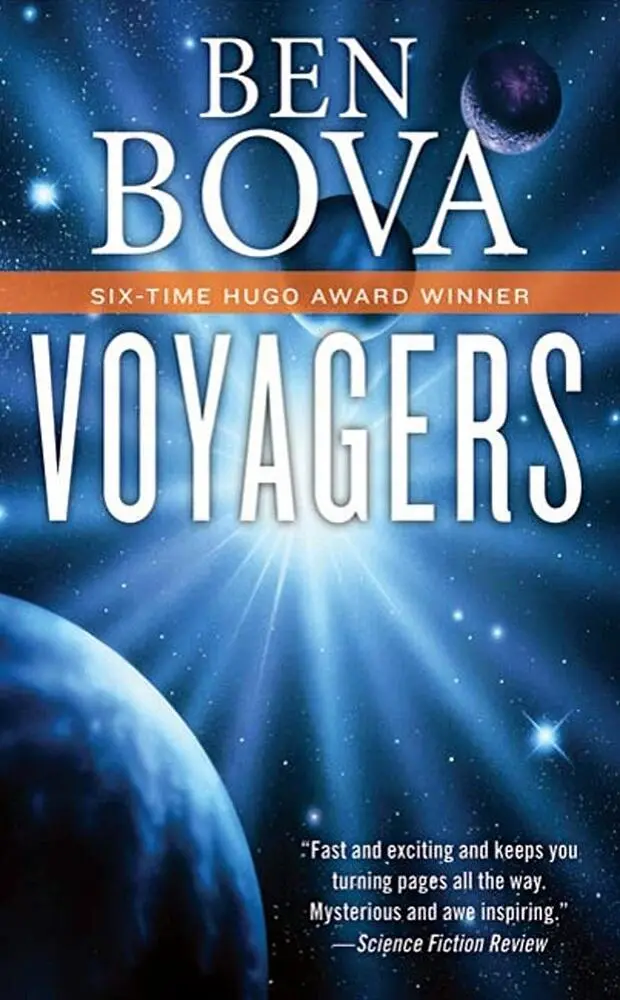
- Название:Voyagers
- Автор:
- Издательство:Tor
- Жанр:
- Год:2010
- ISBN:978-0-765-36365-7
- Рейтинг книги:5 / 5. Голосов: 1
-
Избранное:Добавить в избранное
- Отзывы:
-
Ваша оценка:
Voyagers: краткое содержание, описание и аннотация
Предлагаем к чтению аннотацию, описание, краткое содержание или предисловие (зависит от того, что написал сам автор книги «Voyagers»). Если вы не нашли необходимую информацию о книге — напишите в комментариях, мы постараемся отыскать её.
the signal that his research station is receiving from space is not random. Whatever it is, it’s real.
And it’s headed straight for Earth.
He’ll do anything to be the first man to go out to confront this enigma. Even lose the only woman he’s ever really loved.
And maybe start a world war.
Voyagers — читать онлайн бесплатно полную книгу (весь текст) целиком
Ниже представлен текст книги, разбитый по страницам. Система сохранения места последней прочитанной страницы, позволяет с удобством читать онлайн бесплатно книгу «Voyagers», без необходимости каждый раз заново искать на чём Вы остановились. Поставьте закладку, и сможете в любой момент перейти на страницу, на которой закончили чтение.
Интервал:
Закладка:
“Then it is inert now?”
“Dead as a rock, as far as we can tell,” Cavendish said. “It’s just coasting along.”
“What size is it?”
“Any data about its shape?”
“Surface brightness?”
Cavendish held up both his long-fingered hands to stop the questions from coming faster than he could answer them.
“Well, it’s rather larger than a breadbox…”
The Americans in the audience laughed. The Russians exchanged puzzled glances with each other.
“Actually,” Cavendish went on, “we don’t know very much as yet about its true size, mainly because we haven’t a firm fix on its intrinsic brightness. If it’s made of highly reflective material, then it must be rather small—on the order of a hundred meters or less.”
“What is the maximum size it could be?”
Cavendish hiked his eyebrows and searched through the audience for help. “Anyone care to make an educated guess?”
Stoner called out, “It can’t be more than a few hundred meters across, at most. From the mass measurements we made during the Jupiter encounter, it must be very small, with negligible mass—about what you would expect if you put three or four Salyut or Skylab space stations together.”
Zworkin turned in his chair. “Then it is large for a spacecraft.”
“But tiny in comparison to an asteroid or even a very minor meteor,” Stoner said.
“I see.”
Cavendish tapped the microphone and all eyes focused back on him. “The object is still too far out for accurate radar measurement of its size, although within the next few weeks it should get close enough for a go at it.”
“Why not use the Goldstone or Haystack radars?” someone asked.
“Why not Arecibo?”
McDermott got to his feet and said from where he stood, “Security. Our governments have agreed to keep this project as quiet as possible, to protect the people from undue shock and panic.”
“We can track it with the Landau facility,” Zworkin said, his voice barely audible without the microphone.
“Actually,” Cavendish broke in, trying to regain control of the discussion, “since the object is rushing toward us, all we need do is wait for a few weeks and we should be able to snap its photograph with Brownie cameras.”
“One question on my mind,” said a woman—not one of the Russians—from her chair, “is this: how do we go about making contact with it?”
“By radio, I should think,” Cavendish answered.
“What about lasers?”
“What wavelength should be used for the contact attempt?”
Cavendish shrugged. “As many as we can, I suppose. We really have no idea of which wavelengths it communicates in.”
“If any.”
Stoner rose to his feet and said, “We ought to try to physically intercept it—go out and meet it, rendezvous with it, board it.”
“I suppose we could consider that, of course.”
But McDermott bellowed, “Out of the question! It’d take months to prepare a manned space shot, years, and this thing will whiz past us before we’d be ready. Besides…”
“If we pushed hard,” Stoner countered, “we could set up a Space Shuttle launch in time.”
“And what would we use for the upper stages,” McDermott taunted, “a slingshot?”
“If we have to.”
“Actually,” Cavendish stepped in, “I suppose we should attempt radio contact first, don’t you think?”
Markov stood up, his slightly reddish face set in a puckish grin. He glanced back at Stoner as if he recognized him.
“I am not a physical scientist,” he said, turning toward the podium. “However, in the question of communicating with the spacecraft, may I make a suggestion?”
“Yes, certainly,” said Cavendish.
“If you have made tape transcriptions of the radio signals issued from Jupiter during the spacecraft’s encounter with that planet, perhaps it would be useful to play these recordings back to the spacecraft as it approaches the Earth.”
McDermott scowled. Cavendish knitted his shaggy brows together. “Play back the radio pulses from Jupiter?”
“Yes,” said Markov. “That would immediately tell the alien that we observed the radio pulses that he caused. It would immediately be recognizable to him as an artificial signal from our world.”
“H’mm. Striking.”
“What makes you think it’s a him ?” a woman’s voice called out.
“Shouldn’t we be more cautious?” Jeff Thompson said, getting to his feet beside Stoner. “I mean, maybe we ought to wait for it to signal us before we start bombarding it with radio waves or laser beams. It might not like being bathed in electromagnetic energy.”
“If we wait too long,” Cavendish countered, “it just might sail right past us and leave the solar system entirely, just as Professor McDermott said.”
“That’s why I think we should try to make physical contact with it,” Stoner said, still on his feet. “If it’s unmanned we could even try to capture it and bring it into an orbit around the earth.”
“Absolutely not!” McDermott snapped.
“Why so?” asked Cavendish.
“Too risky. Too many unknowns. It’s one thing to make radio contact, we’ve got the equipment and personnel for that. We are not going to play space pirates—boarding and seizing an extraterrestrial spacecraft. If they want to put that thing in orbit around Earth, they’ll do it themselves.”
“So what’ll happen,” Stoner said, his voice rising, “is that we’ll spend the next few months trying to get an answer out of it, and it’ll sail right on past us and out of the solar system forever. Why wave bye-bye to it when we might be able to get our hands on it?”
“It might not want to be captured,” somebody said.
Cavendish, leaning his elbows on the rickety podium, responded, “That’s assuming there’s a crew aboard, isn’t it?”
“Or a smart computer.”
“Damned smart computer, to take the bird across interstellar distances.”
“We have no authority,” McDermott insisted, hunching his shoulders like a football player about to make body contact, “to attempt to intercept the spacecraft.”
“Then get the authority,” Stoner insisted, “before it’s too late and the thing sails right on past us.”
“We should try to establish radio contact first,” Zworkin said. “If there is a crew aboard…”
“Of course,” Stoner agreed. “But let’s start making the necessary plans for a rendezvous with the bird.”
McDermott’s face was getting splotchy with anger. “Do you have any idea of the magnitude of such a task?”
Stoner let himself grin at Big Mac. “As the only experienced astronaut in this group, yes, I think I do.”
“We don’t have time to play space cadet!”
“You don’t have time for anything else. If that spacecraft just zips past us without our learning anything from it…”
“We’ll make radio contact,” McDermott said.
“And what happens if it doesn’t respond? What if we don’t hit the right communications frequency and it just ignores us?”
Zworkin stood up and made a little bow toward McDermott, almost apologetically. “I believe the young man is correct,” he said, his singsong voice barely carrying back to the row where Stoner stood.
McDermott started to reply, but the Russian went on, “We should, of course, be preparing to meet this alien craft in space and, if it is at all feasible, to bring it back to Earth for careful scrutiny. I will recommend such a course of action to the Soviet Academy. Perhaps the Soviet Union can make rocket boosters and cosmonauts available, even if the United States cannot.”
McDermott looked as if he was choking, but he managed to say, “I understand. And I will recommend to the White House that NASA be alerted to the possibilities of such a mission.”
Читать дальшеИнтервал:
Закладка:
Похожие книги на «Voyagers»
Представляем Вашему вниманию похожие книги на «Voyagers» списком для выбора. Мы отобрали схожую по названию и смыслу литературу в надежде предоставить читателям больше вариантов отыскать новые, интересные, ещё непрочитанные произведения.





Обсуждение, отзывы о книге «Voyagers» и просто собственные мнения читателей. Оставьте ваши комментарии, напишите, что Вы думаете о произведении, его смысле или главных героях. Укажите что конкретно понравилось, а что нет, и почему Вы так считаете.