Ben Bova - Voyagers
Здесь есть возможность читать онлайн «Ben Bova - Voyagers» весь текст электронной книги совершенно бесплатно (целиком полную версию без сокращений). В некоторых случаях можно слушать аудио, скачать через торрент в формате fb2 и присутствует краткое содержание. Год выпуска: 2010, ISBN: 2010, Издательство: Tor, Жанр: Фантастика и фэнтези, на английском языке. Описание произведения, (предисловие) а так же отзывы посетителей доступны на портале библиотеки ЛибКат.
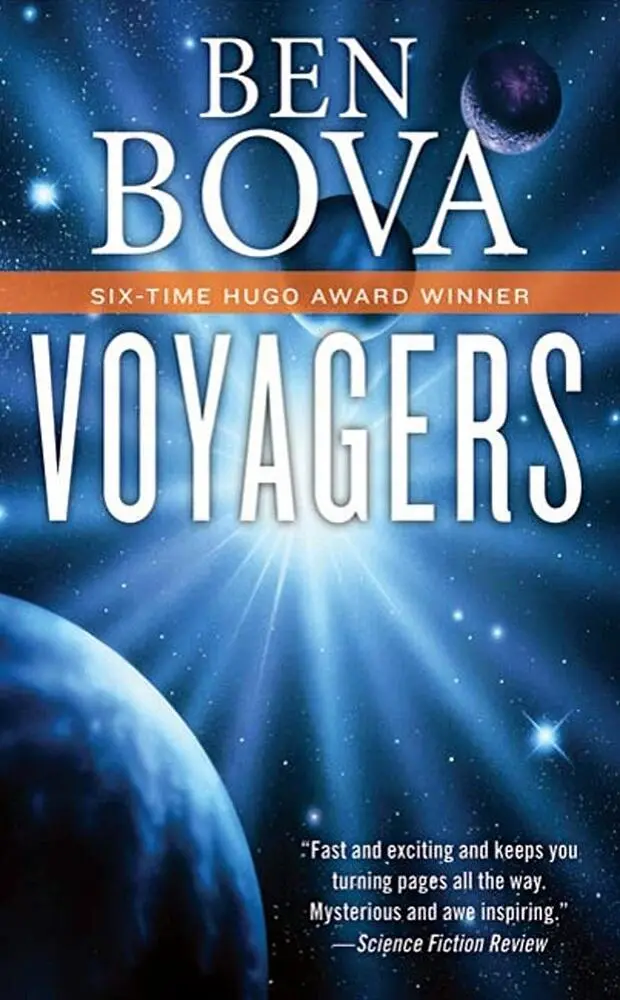
- Название:Voyagers
- Автор:
- Издательство:Tor
- Жанр:
- Год:2010
- ISBN:978-0-765-36365-7
- Рейтинг книги:5 / 5. Голосов: 1
-
Избранное:Добавить в избранное
- Отзывы:
-
Ваша оценка:
Voyagers: краткое содержание, описание и аннотация
Предлагаем к чтению аннотацию, описание, краткое содержание или предисловие (зависит от того, что написал сам автор книги «Voyagers»). Если вы не нашли необходимую информацию о книге — напишите в комментариях, мы постараемся отыскать её.
the signal that his research station is receiving from space is not random. Whatever it is, it’s real.
And it’s headed straight for Earth.
He’ll do anything to be the first man to go out to confront this enigma. Even lose the only woman he’s ever really loved.
And maybe start a world war.
Voyagers — читать онлайн бесплатно полную книгу (весь текст) целиком
Ниже представлен текст книги, разбитый по страницам. Система сохранения места последней прочитанной страницы, позволяет с удобством читать онлайн бесплатно книгу «Voyagers», без необходимости каждый раз заново искать на чём Вы остановились. Поставьте закладку, и сможете в любой момент перейти на страницу, на которой закончили чтение.
Интервал:
Закладка:
He pictured Sonya Vlasov’s face in his mind’s eye and wondered what she was doing now, in Kharkov, in a tractor factory. How she would have loved to come here! Markov realized. There must be something I can do to help her, some way I can get Maria to remove the blot she’s placed on her record.
He glanced back at his wife as the plane lurched into its final approach. The landing gear went down, filling the cabin with a rushing, roaring sound that startled the old man drowsing across the aisle from them into a wide-eyed, frightened awakening.
She says that she will not let me out of her sight for a moment, Markov thought. Very well. I will be the perfect husband. I will charm her as she’s never been charmed before.
But the look on Maria’s face did nothing to encourage him. She was staring straight ahead, stolidly refusing to show fear as the plane shuddered and slewed through the gusting cross winds on its approach to the airstrip. Waves rushed by outside the window.
Markov remembered those furious few moments back in their apartment, the triumphant look on Maria’s face when she announced Sonya’s fall from favor, her loss of her student’s status, her transfer to a factory.
And he remembered the stark hatred he felt in his own heart. It won’t be easy to woo her, he told himself. But it must be done; that girl shouldn’t suffer on my account.
A blur of palm fronds startled Markov and then the plane’s wheels screeched on the cement runway, bounced sickeningly, hit again and rolled the length of the airstrip. The engines roared with thrust reversers out and all flaps extended full.
As the plane slowed and trundled off the runway, heading toward the single building of the airport’s terminal, the color began to come back to Maria’s cheeks.
Turning to Markov, she whispered, “You remember the American who wrote to you, Stoner?”
He nodded.
“You must find him and befriend him. He trusts you.”
“And I am to betray his trust. Is that it?”
Maria scowled at him, her old self again. “You are to do what is necessary, whatever that may be.”
Markov sighed and knew he would do what she told him to. That’s a surer way of wooing her than plying her with kisses, he realized.
Yukon Territory
George Umaniak stowed his rifle under the blankets in the back of the skimobile. Even though he had not even seen a caribou, the white policemen would give him a hassle if they discovered he had been out with a hunting gun.
The wind was picking up, coming down in a cold moaning sigh from the frozen mountains. The sky was dark again, and the wind spoke of ghosts and the dance of the dead. George pulled up the hood of his parka, shivering.
The damned skimobile was slow to start. He twisted the ignition key hard, several times, but the motor refused to catch. George swore to himself. It couldn’t be the battery, he had checked it just the day before.
A flicker of light across the growing darkness caught at the corner of his eye. George looked up and saw the aurora shimmering over the mountains. Green, palest pink, ghostly yellow, the Northern Lights danced over the mountaintops in rhythm with the moaning wind.
George swallowed hard and finally got the motor to cough itself to life. He opened the throttle all the way and raced homeward. This was no night to be out in the cold and dark.
Chapter 20
The lecture hall was about half filled. It had originally been a movie theater for the military personnel of Kwajalein, and Stoner found himself hoping they would show films in it again. But this evening it was a lecture hall, a gathering place, a social focus for the scientists and technicians of Project JOVE.
Nearly a hundred and fifty men and women sat uncomfortably on the government-issue metal folding chairs. Jeff Thompson sat next to Stoner, in one of the rearmost rows. Jo Camerata was nowhere in sight. Big Mac and Tuttle were down in the front row, within one step and a hop of the speaker’s podium.
The buzzing of scores of conversations died away as McDermott climbed heavily up onto the little platform at the front of the hall. Cavendish stepped spryly up alongside him, carrying his own chair. He opened it and sat down behind McDermott, who leaned ponderously on the shaky little podium. An older Russian came up alongside Cavendish and took the chair that had already been placed there.
“Good evening, ladies and gentlemen.” Big Mac’s rasping lecture-hall voice was met by a shrill scream of feedback from the microphone.
He glared at the audio technician sitting off to one side of the room behind a deskful of black boxes, while everyone else winced at the loudspeakers set into the rafters of the hall’s wooden ceiling.
“Mac doesn’t need a microphone, for god’s sake,” Stoner muttered. Thompson grinned and nodded.
McDermott used the microphone anyway, which amplified his voice into a booming, echoing thunder that rattled the walls of the building. He introduced Academician Zworkin, the astronomer who headed the Russian team. The old man—gray thinning hair, grayer pallor to his face, rumpled gray suit despite the heat—got slowly to his feet and came to the podium. He pulled the goosenecked microphone down to his own level.
“Thank you, dear Professor McDermott,” he said in a high, thin, singsong voice. His English was quite good: the accent was from Oxford.
Addressing the seated crowd, Zworkin said, “Although I have attended two of the SETI conferences over recent years, I am far from being an expert on extraterrestrial intelligence. But then, who is?”
A polite murmur of laughter rippled through the audience.
“My own field of specialization is planetary astronomy. I am not an astrophysicist or an astrochemist. I am, if such a word is possible, an astro-geologist. I am not quite sure what I am doing here, among you, except that I was too old and slow to avoid being picked for this job.”
The audience laughed once again, but Stoner realized, He’s warning us not to expect any great ideas out of him. He’s beyond his depth here and he wants to get back home as soon as possible.
Zworkin then began introducing each of the fifteen Russian scientists. All but one of them were men, although several of them were accompanied by their wives. Who were pointedly not introduced.
A lanky, gangly Russian stood up, looking slightly flustered and boyish despite his scraggly, graying beard. Zworkin introduced him as Professor Kirill Markov, of the University of Moscow, a linguist.
He’s the one I wrote to! Stoner realized. I’ve got to talk with him.
The introductions finished, McDermott took over the podium again.
“We’re going to be working together on this project for some months,” he said in the tones of a high school football coach. “I’d like to ask Dr. Cavendish to summarize where we stand right now.”
Cavendish smiled his way to the podium.
“Right,” he said, like a ritual throat-clearing. “I haven’t prepared any slides or graphs…thought that we’d all be digging into the details quickly enough.” He hesitated a moment, as if gathering his thoughts. “The, ah …object that entered the solar system last summer and engaged in a rather lengthy flyby of Jupiter, is now approaching Earth. It has been accelerating as it comes toward us, and our current projection is that it will reach its nearest distance to Earth on or close to fifth July.”
“The acceleration,” one of the Russians asked, “is this normal—I mean, natural?”
“Quite. In essence, the object is falling freely as it comes closer to the Sun, you see, and the solar gravitational pull is accelerating it. No, it has not shown any signs of life or purpose since it left Jupiter’s vicinity and altered its course to head our way.”
Читать дальшеИнтервал:
Закладка:
Похожие книги на «Voyagers»
Представляем Вашему вниманию похожие книги на «Voyagers» списком для выбора. Мы отобрали схожую по названию и смыслу литературу в надежде предоставить читателям больше вариантов отыскать новые, интересные, ещё непрочитанные произведения.

Обсуждение, отзывы о книге «Voyagers» и просто собственные мнения читателей. Оставьте ваши комментарии, напишите, что Вы думаете о произведении, его смысле или главных героях. Укажите что конкретно понравилось, а что нет, и почему Вы так считаете.