Stephen King - Faithful
Здесь есть возможность читать онлайн «Stephen King - Faithful» весь текст электронной книги совершенно бесплатно (целиком полную версию без сокращений). В некоторых случаях можно слушать аудио, скачать через торрент в формате fb2 и присутствует краткое содержание. Город: New York, Год выпуска: 2004, ISBN: 2004, Издательство: Scribner, Жанр: Спорт, на английском языке. Описание произведения, (предисловие) а так же отзывы посетителей доступны на портале библиотеки ЛибКат.
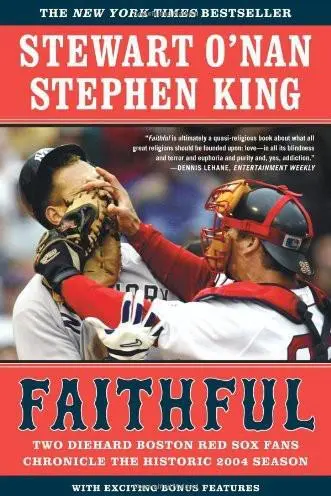
- Название:Faithful
- Автор:
- Издательство:Scribner
- Жанр:
- Год:2004
- Город:New York
- ISBN:978-0-7432-7244-5
- Рейтинг книги:4 / 5. Голосов: 1
-
Избранное:Добавить в избранное
- Отзывы:
-
Ваша оценка:
Faithful: краткое содержание, описание и аннотация
Предлагаем к чтению аннотацию, описание, краткое содержание или предисловие (зависит от того, что написал сам автор книги «Faithful»). Если вы не нашли необходимую информацию о книге — напишите в комментариях, мы постараемся отыскать её.
Amazon.com Review
Fans watching the 2004 baseball playoffs were often treated to shots of Stephen King sitting in the stands, notebook in hand. Given the bizarre events on the field, from the Red Sox’s unprecedented comeback against their most hated rivals to their ace pitcher’s bleeding, stitched-together ankle--not to mention the Sox’s first championship in 86 years--you could be forgiven for thinking King was writing the script as he went along, passing new plot twists down to the dugouts between innings.
What he was writing, though, along with his friend and fellow novelist Stewart O’Nan, was Faithful, a diary of the 2004 Red Sox season. Faithful is written not from inside the clubhouse or the press room, but from the outside, from the stands and the sofa in front of the TV, by two fans who, like the rest of New England, have lived and died (mostly died) with the Sox for decades. From opposite ends of Red Sox Nation, King in Maine and O’Nan at the border of Yankees country in Connecticut, they would meet in the middle at Fenway Park or trade emails from home about the games they’d both stayed up past midnight to watch. King (or, rather, “Steve”) is emotional, O’Nan (or “Stew”) is obsessively analytical. Steve, as the most famous Sox fan who didn’t star in Gigli, is a folk hero of sorts, trading high fives with doormen and enjoying box seats better than John Kerry’s, while Stew is an anonymous nomad, roving all over the park. (Although he’s such a shameless ballhound that he gains some minor celebrity as "Netman" when he brings a giant fishing net to hawk batting-practice flies from the top of the Green Monster.)
You won’t find any of the Roger Angell-style lyricism here that baseball, and the Sox in particular, seem to bring out in people. (King wouldn’t stand for it.) Instead, this is the voice of sports talk radio: two fans by turns hopeful, distraught, and elated, who assess every inside pitch and every waiver move as a personal affront or vindication. Full of daily play-by-play and a season’s rises and falls, Faithful isn’t self-reflective or flat-out funny enough to become a sports classic like Fever Pitch, Ball Four, or A Fan’s Notes, but like everything else associated with the Red Sox 2004 season, from the signing of Curt Schilling to Dave Roberts’s outstretched fingers, it carries the golden glow of destiny. And, of course, it’s got a heck of an ending. —Tom Nissley From Publishers Weekly
Of all the books that will examine the Boston Red Sox’s stunning come-from-behind 2004 ALCS win over the Yankees and subsequent World Series victory, none will have this book’s warmth, personality or depth. Beginning with an e-mail exchange in the summer of 2003, novelists King and O’Nan started keeping diaries chronicling the Red Sox’s season, from spring training to the Series’ final game. Although they attended some games together, the two did most of their conversing in electronic missives about the team’s players, the highs and lows of their performance on the field and the hated Yankees (“limousine longballers”). O’Nan acts as a play-by-play announcer, calling the details of every game (sometimes quite tediously), while King provides colorful commentary, making the games come alive by proffering his intense emotional reactions to them. When the Red Sox find themselves three games down during the ALCS, King reflects on the possibilities of a win in game four: “Yet still we are the faithful… we tell ourselves it’s just one game at a time. We tell ourselves the impossible can start tonight.” After the Sox win the Series, O’Nan delivers a fan’s thanks: “You believed in yourselves even more than we did. That’s why you’re World Champions, and why we’ll never forget you or this season. Wherever you go, any of you, you’ll always have a home here, in the heart of the Nation.” (At times, the authors’ language borders on the maudlin.) But King and O’Nan are, admittedly, more eloquent than average baseball fans (or average sportswriters, for that matter), and their book will provide Red Sox readers an opportunity to relive every nail-biting moment of a memorable season.
Copyright © Reed Business Information, a division of Reed Elsevier Inc. All rights reserved.
Faithful — читать онлайн бесплатно полную книгу (весь текст) целиком
Ниже представлен текст книги, разбитый по страницам. Система сохранения места последней прочитанной страницы, позволяет с удобством читать онлайн бесплатно книгу «Faithful», без необходимости каждый раз заново искать на чём Вы остановились. Поставьте закладку, и сможете в любой момент перейти на страницу, на которой закончили чтение.
Интервал:
Закладка:
I expect the Williams statue to be ringed by fans taking pictures or touching it for luck, the way they do in Pittsburgh with Clemente and Stargell (if you reach up you can balance a lucky penny on Willie’s elbow), but it’s just standing there alone while a line waits about thirty feet away for day-of-game tickets.
It’s uninspired and uninspiring, a tall man stooping to set his oversized cap on a little bronze kid’s head. It’s not that Ted didn’t love kids (his work with the Jimmy Fund is a great legacy), it’s just that I expected something more dynamic for the greatest hitter that ever lived. In Pittsburgh, Clemente’s just finished his swing and is about to toss the bat away and dig for first; he’s on his toes, caught in motion, and there’s a paradoxical lightness to the giant structure that conveys Clemente’s speed and grace. Stargell’s cocked and waiting for his pitch, his bat held high; you can almost see him waggling the barrel back and forth behind his head. This Williams is static and dull and carries none of The Kid’s personality. He could be any Norman Rockwell shmoo making nice with the little tyke.
I take a couple of pictures anyway, then head back to Gate E to wait for my friend Lowry. Before a big game like this, people are handing out all sorts of crummy free stuff, and I accept a Globe just to have something to read (okay, and for the poster of Nomar). I buy a bag of peanuts and lurk at the corrugated door, and when Lowry comes, we’re first in line and then the first in and the first to get a ball, tossed to me by David McCarty in left. I snag a grounder by Kapler, and later an errant warm-up throw by Yanks coach (and former Pirate prospect) Willie Randolph—picking the neat short-hop out of sheer reflex.
A-Rod comes out to warm, and the fans boo. Some migrate over from other sections just to holler at him while he plays long toss, chucking the ball from the third-base line out to deep right-center. “Hey, lend me a hundred bucks, huh?” “How you liking third?” “Hey, A-Rod, break a leg, and I mean that.”
We boo Jeter when he steps in to hit. And Giambi (“ Bal -co”) and Sheffield (“ Ballll -coooo”).
The rest of the Yanks are friendly enough. Jose Contreras and Kevin Brown banter with the fans; even hothead Jorge Posada jokes with us. When Mussina comes by and chats and smiles, someone calls, “You’re the good Yankee, Mike.”
Miguel Cairo, one of the last Yankees to bat, smokes a grounder down the line. It’s mine. I catch it off-center, and it bends the fingers of my mitt back. The ball knocks off the wall and rolls away, out of reach, gone forever. It’s a play I’ll make 99 times out of 100, even if it was hit hard.
“Hey,” Lowry says, “you’ve got three.”
Yeah, I say, I know, but it’s always the one that gets away that you remember.
We stop by El Tiante’s for an autographed picture, saying hey to Luis and picking up some Cuban sandwiches, then fight the crowd to reach our seats. The choke point’s right behind home, where the concourse narrows to feed the first ramp to the stands. The crush is worse than Opening Day, and I think they’ve got to fix it somehow before something very bad happens.
The tide of people separates us. I find Lowry at our seats just as the anthem begins. As always, I’m overwhelmed by how good these seats are. One section over, one row in front of us, is the governor of Massachusetts, Mitt Romney.
The Yanks send Kenny Lofton, Jeter and A-Rod to face Wake in the first. The boos grow louder with each at-bat, peaking with A-Rod, who gets a standing excoriation—something only Clemens has managed over the years. “Gay-Rod,” some wags are chanting. When Tim’s first pitch is a strike, the crowd explodes, as if we’ve won.
Johnny opens with a hopper to first that hits Giambi in the middle and gets through him for an E. “ Bal -co!” Vazquez has Bill Mueller 0-2, but gets impatient, aiming a fastball that Billy cranks into the Sox bullpen, and we’re up 2–0. Manny hits a slicing liner down the right-field line that disappears from view. The ump signals fair, then twirls one finger in the air for a homer. Somehow the Yanks are able to relay the ball in—they’re arguing that it never went out. We don’t get a replay. (Later, I hear that the ball hit the top of the wall and caromed back in off Sheffield, so it wasn’t a homer.) With two down and Ellis Burks on second, Doug Mirabelli grounds one to Jeter. It’s an easy play, but Jeter comes up and lets it through the five-hole and into left, and with two outs Burks scores easily.
Posada gets one back with a solo homer in the second. In the fourth, Mirabelli—who, like Wake, is only making his second start—takes Vazquez deep on the first pitch. 5–1.
A great moment in the sixth when the Yanks try a double steal (or is it a blown hit-and-run?). Sheffield doesn’t make contact, and A-Rod’s meat at third. The crowd taunts him into the dugout.
It’s 6–2 with two out in the eighth when Giambi lofts a fly to Manny in left. “Good inning,” I holler to Doug Mirabelli, heading off, and then I see the ball glance off Manny’s glove and bounce in the grass. He Charlie Browned it!
I look around to verify that this has actually happened. No one else can believe it either.
Things get a little shaky when Sheffield and Posada both work walks to load the bases. “A home run here and the game’s tied,” a neighbor says. I know where this is coming from, but come on, we’re up 6–2 with four outs to go. Have some faith.
Embree gets Matsui, and the Yanks never threaten again, and when Jeter makes the last out and the PA plays “Dirty Water,” all the different TV crews hustle to set up their tall director’s chairs for the postgame shows.
April 17th
Steve and I have been going back and forth about the Yankees’ place in our cosmos. I’ve been trying to argue that they’ve only gotten in our way a few times across our overall history. In the fifties and sixties (besides the Impossible Dream year), we were so bad that it didn’t matter. ’78’s a fluke, and people forget that after our big fold in August we came back and won our last eight to gain the tie for the division. The Winfield-Mattingly Yanks never gave us any problems; were, in fact, massive chokers, consistently finishing second to Toronto, Baltimore and us. In ’86 we stood in our own way (or Calvin Schiraldi did). In ’99, we were lucky to get by Cleveland, and last year we pulled a rabbit out of our hat to beat Oakland, and were playing on the road the whole time. Plus we took enough out of the Yanks that they had nothing left for the Marlins. We were their stumbling block, beating them twice at the Stadium, putting their weaknesses on display. All the Marlins had to do was mop them up.
SK:Your rationalizations can’t stand up to the killer graphics Fox put up on the screen last night. I’ll get the facts for my little Yankees-Sox piece (and no, it hasn’t always been the Yankees, just the Dent home run, the Boston Massacre, and last year…plus the Boston-Yankees all-time numbers, which are all New York). But while we’ve been starving, New York has been feasting. How many consecutive years have they gone to the postseason now? Twelve? Come on, ya gotta hate ’em! Fear ’em and hate ’em!
SO:You forget—my roots are in Pittsburgh, and Maz’s homer is our Excalibur. We not only slew the beast, we broke their damn hearts, and the Sox can do it too. Shoot, if we really wanted to win one, we could go the ’97 Marlins’ route, or the 2001 D-Backs’. We’re almost there but not quite. But that’s not an honorable way. That’s why all the Steinbrenner titles don’t count. The last time the Yanks really won anything was 1962.
Читать дальшеИнтервал:
Закладка:
Похожие книги на «Faithful»
Представляем Вашему вниманию похожие книги на «Faithful» списком для выбора. Мы отобрали схожую по названию и смыслу литературу в надежде предоставить читателям больше вариантов отыскать новые, интересные, ещё непрочитанные произведения.






Обсуждение, отзывы о книге «Faithful» и просто собственные мнения читателей. Оставьте ваши комментарии, напишите, что Вы думаете о произведении, его смысле или главных героях. Укажите что конкретно понравилось, а что нет, и почему Вы так считаете.