Рита Браун - Probable Claws
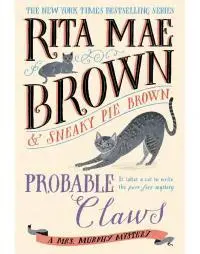
Здесь есть возможность читать онлайн «Рита Браун - Probable Claws» весь текст электронной книги совершенно бесплатно (целиком полную версию без сокращений). В некоторых случаях можно слушать аудио, скачать через торрент в формате fb2 и присутствует краткое содержание. Год выпуска: 2018, Жанр: Домашние животные, det_cozy, на английском языке. Описание произведения, (предисловие) а так же отзывы посетителей доступны на портале библиотеки ЛибКат.
- Название:Probable Claws
- Автор:
- Жанр:
- Год:2018
- ISBN:нет данных
- Рейтинг книги:3 / 5. Голосов: 1
-
Избранное:Добавить в избранное
- Отзывы:
-
Ваша оценка:
Probable Claws: краткое содержание, описание и аннотация
Предлагаем к чтению аннотацию, описание, краткое содержание или предисловие (зависит от того, что написал сам автор книги «Probable Claws»). Если вы не нашли необходимую информацию о книге — напишите в комментариях, мы постараемся отыскать её.
Mary Minor "Harry" Haristeen and her friends and animal companions pursue the threads of a mystery dating back to Virginia's post-Revolutionary past, when their 18th-century predecessors struggled with the challenges of the fledgling country. In the present day, Harry's new friendship with Marvella Lawson, doyenne of the Richmond art world, leads her to rediscover her own creative passions--and reveals evidence of an all too contemporary crime.
Probable Claws — читать онлайн бесплатно полную книгу (весь текст) целиком
Ниже представлен текст книги, разбитый по страницам. Система сохранения места последней прочитанной страницы, позволяет с удобством читать онлайн бесплатно книгу «Probable Claws», без необходимости каждый раз заново искать на чём Вы остановились. Поставьте закладку, и сможете в любой момент перейти на страницу, на которой закончили чтение.
Интервал:
Закладка:
“Was there resistance?” Harry’s curiosity awoke.
“On traffic problems, the time it will take to build the thing. A tax break for Cloudcroft for bringing business to Richmond has some people infuriated. They want tax breaks for themselves. We even have a group that is opposed to changing the Richmond skyline. I was unaware that there was one.” She slyly smiled.
“The Federal Reserve building.” Harry smiled back. “That really is about it. Take comfort in saving the tobacco warehouses.”
“I do, but they are rarely above two stories. I take that back, some were large, down by the river where the tobacco was held before being shipped out. I quite like them.”
“Save the skyline,” Harry mused, returning to the skyline complaint.
“Almost forgot. There is an environmental criticism but I don’t know their exact problem. I would think we’ve done all the environmental damage we can do.” Marvella laughed.
On and on they talked, bouncing between current events, the spiritual meanings of colors in medieval art, Marvella’s urging Harry to travel to other museums, perhaps even to once again take classes.
They became quite entranced by the thought of what perspective in art meant, how it changed painting, the movement of the eye.
After all this, Harry followed Marvella to the gorgeous, understated old home that she and Tinsdale owned right on Monument Avenue, where she picked up the thumb drive.
As Harry stood by the door to go home, Marvella encouraged her. “Now you call me the minute you see them. I must hear what you think.”
“I will. You’ve made me curious about Cloudcroft. A Z structure.”
Marvella waved her hand. “You’ll see for yourself. Next visit. If the weather’s good we’ll walk to the excavation. On the outside wall Rankin has painted the building’s exterior, the landscaping for the green spaces. The wall surrounds the big dig. Each side has a painting. One is the interior, a look at the glamorous lights. Another is the penthouse. The last one is the Richmond skyline with the Z lit up. That word again. Skyline.”
16
March 16, 1787
Friday
 Bleak, windy, raw, a typical March day kept Ewing inside, fire roaring in his library. Catherine, showing signs of her pregnancy, remained with him, sorting letters. Correspondence on the left, financial interests on the right.
She sat across from her father, her shawl loose around her shoulders. The warmth from the fire proved sufficient.
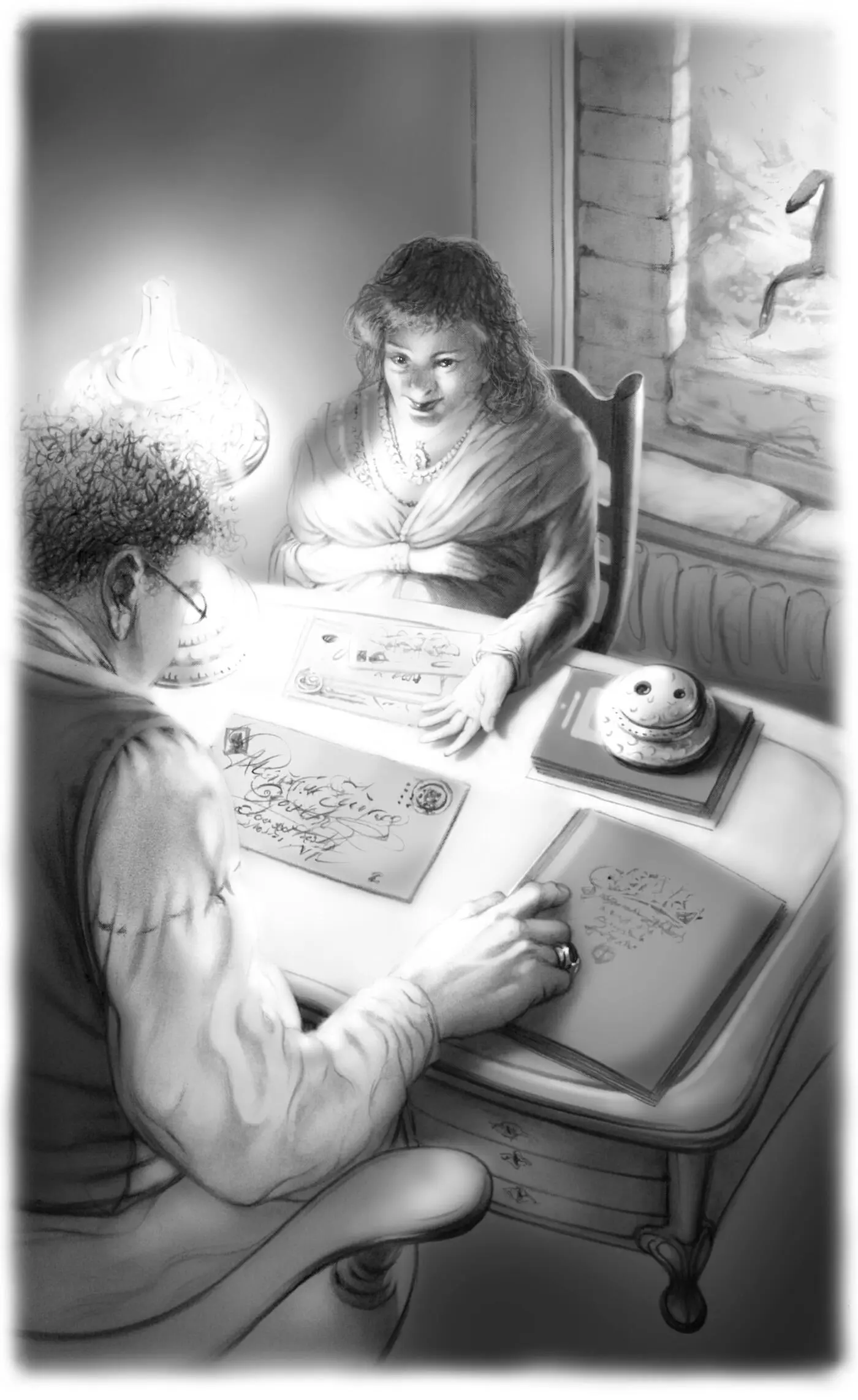
“You’ll want to read this one.” She handed him a letter, paper heavy, well laid, gorgeous handwriting on the envelope.
He reached, checked the front. “Ah, the baron. He’s in the middle of everything.”
When a young man on the Grand Tour of Europe, Ewing, in France, had met Baron Necker, also young, interested in the New World. The two men, eyes to the future, hopes high, became friends. Both became important in their nations. As for Baron Necker, he was born to it. Ewing made his own way, although his father gave him the advantage of a superior education and at his death bequeathed to him the tobacco lands south of the James. The baron would always compliment Ewing by saying that the Virginian had made his own way.
Perching his spectacles on his nose, Ewing read, gasped.
“What is it, Father?”
“The Comte de Vergennes has died. The powerful foreign minister. A bad time to take leave of France no matter what one thinks of him. The king has summoned the Assembly of Notables. Necker writes the hall of the king’s Menus-Plaisirs, not one empty seat. Those most powerful sit in the front, vigilant of their privileges. But listen, my dear. The Comptroller General of Finance, Charles-Alexandre de Calonne, began a speech insinuating that he, only he, wooed the king to call this assembly. Furthermore, he, again alone, has restored confidence in the nation’s finances, which when he was appointed in 1783 languished in a disastrous state.” He looked over the rim of his glasses. “That’s a broadside against Necker.”
“His predecessor?” Catherine did her best to keep abreast of events in England, France, and the various Germanies. As to Spain, rich though it was, Catherine considered it a shot bolt. She and her father would discuss these things, each finding reasons for the stagnation of Spain, the arrogance of England, the foolishness of France. Then they would examine the new nation in which they lived. The comparisons could be sobering.
“Well, Necker’s Account Rendered ultimately brought about his dismissal, but listen. This is fantastic. I cannot think of another word. The treasury collects four hundred seventy-five million livres a year. France spends six hundred million livres a year. At the end of 1786 the deficit was thirty-seven million livres, but, oh, this is shocking. Shocking.” He took a restorative breath. “By the end of 1786, twelve hundred and fifty million livres had been borrowed—twelve hundred and fifty million livres! Dear God. Furthermore, Calonne laid the financial abuses not just on the former Comptroller, my friend, but at the feet of the most privileged, who benefit from many special financial levies. Certain agricultural goods benefit some members, but not others. The purchase of salt. Good God, this is a most depressing list, but here is the insult, the outrageous insult.”
His face reddened. “The raving toady declares that France has given birth to America!” He slapped the letter on the desk. “Was their assistance invaluable? Yes. But the citizens of the colonies gave birth to this nation, not a gaggle of raving aristocrats and royals of questionable intellect. Just wait until I show this to my friends!”
Catherine picked up the letter, read quietly, then laughed. “Well, there is humor in Paris. The baron quotes from a pamphleteer or some form of writer. Now listen.” She raised her chin, glanced at her father, and began in her captivating, beguiling, cultivated rich alto: “ ‘Among the blessings attaching to this great age, France will soon be able to count the joy of embracing to its bosom the illustrious author of so many fine pamphlets against the Water Company.’ ” She laughed.
“That is an elegant humiliation.”
“The baron wishes you to know he did not inform you last year of Calonne’s pamphlets, thinking them of no interest to a man of the New World, as he puts it. And he wishes you to know that Calonne wrote those pamphlets. The Water Company. France was aware, forgive the pun, of screeds against the Water Company. A project for which Calonne was offered no livres under the table, which may have triggered his resentment.” She handed the letter back to her father.
“Something must be done over there, but each of those men at the Assembly will fight tooth and nail for his special privilege. And from this letter it appears the Comptroller has overplayed his hand.”
“I forgot to look, who wrote the scathing comment about the joy of embracing?”
Ewing scanned the strong handwriting. “Ah, here he tells us. Mirabeau. A man on the make, a man intelligent enough to make fools of the Assembly.” He again looked at his daughter. “That can be heady stuff but remember this is a country with a king. It is possible a man can lose his head. Not here.” Then he paused. “Not yet anyway.”
“Do you think we should call an assembly?”
“My dear, neither France nor we can go on. Should we add up all the war debts from the thirteen colonies, I don’t think it would touch the debt over there, but we are so new, our commerce small compared to theirs. We have some products the world desires. They have more ways to make money or coerce it out of others than we do. But do we need our own gathering?” He thought. “Sometimes putting men of education and wealth in a room is not a good idea. Leaven it with some military men, working men, still not such a good idea, but better. Fill it with lawyers and you are doomed, everlasting doom.”
Читать дальшеИнтервал:
Закладка:
Похожие книги на «Probable Claws»
Представляем Вашему вниманию похожие книги на «Probable Claws» списком для выбора. Мы отобрали схожую по названию и смыслу литературу в надежде предоставить читателям больше вариантов отыскать новые, интересные, ещё непрочитанные произведения.



Обсуждение, отзывы о книге «Probable Claws» и просто собственные мнения читателей. Оставьте ваши комментарии, напишите, что Вы думаете о произведении, его смысле или главных героях. Укажите что конкретно понравилось, а что нет, и почему Вы так считаете.