George Friedman - The Next Decade
Здесь есть возможность читать онлайн «George Friedman - The Next Decade» весь текст электронной книги совершенно бесплатно (целиком полную версию без сокращений). В некоторых случаях можно слушать аудио, скачать через торрент в формате fb2 и присутствует краткое содержание. Город: New York, Год выпуска: 2011, ISBN: 2011, Издательство: Doubleday, Жанр: Публицистика, Политика, на английском языке. Описание произведения, (предисловие) а так же отзывы посетителей доступны на портале библиотеки ЛибКат.

- Название:The Next Decade
- Автор:
- Издательство:Doubleday
- Жанр:
- Год:2011
- Город:New York
- ISBN:978-0-385-53295-2
- Рейтинг книги:5 / 5. Голосов: 1
-
Избранное:Добавить в избранное
- Отзывы:
-
Ваша оценка:
The Next Decade: краткое содержание, описание и аннотация
Предлагаем к чтению аннотацию, описание, краткое содержание или предисловие (зависит от того, что написал сам автор книги «The Next Decade»). Если вы не нашли необходимую информацию о книге — напишите в комментариях, мы постараемся отыскать её.
bestseller
now focuses his geopolitical forecasting acumen on the next decade and the imminent events and challenges that will test America and the world, specifically addressing the skills that will be required by the decade’s leaders. The next ten years will be a time of massive transition. The wars in the Islamic world will be subsiding, and terrorism will become something we learn to live with. China will be encountering its crisis. We will be moving from a time when financial crises dominate the world to a time when labor shortages will begin to dominate. The new century will be taking shape in the next decade.
In
, George Friedman offers readers a provocative and endlessly fascinating prognosis for the immediate future. Using Machiavelli’s
as a model, Friedman focuses on the world’s leaders—particularly the American president—and with his trusted geopolitical insight analyzes the complex chess game they will all have to play. The book also asks how to be a good president in a decade of extraordinary challenge, and puts the world’s leaders under a microscope to explain how they will arrive at the decisions they will make—and the consequences these actions will have for us all.
The Next Decade — читать онлайн бесплатно полную книгу (весь текст) целиком
Ниже представлен текст книги, разбитый по страницам. Система сохранения места последней прочитанной страницы, позволяет с удобством читать онлайн бесплатно книгу «The Next Decade», без необходимости каждый раз заново искать на чём Вы остановились. Поставьте закладку, и сможете в любой момент перейти на страницу, на которой закончили чтение.
Интервал:
Закладка:
Both world wars were launched according to a single scenario: Germany, insecure because of its geographical position, swept across France in a lightning attack. The goal in both cases was to defeat France quickly, then deal with Russia. In 1914, the Germans failed to defeat France quickly, the troops dug in, and the conflict became a protracted war. The Germans found themselves fighting France, Britain, and Russia simultaneously in both the east and the west. At the same time that it appeared the Bolshevik revolution would save Germany by taking Russia out of the war, the United States sent troops to Europe, playing its first major role on the world stage and blocking German ambitions.
In 1940 Germany succeeded in overrunning France, only to discover that it still could not defeat the Soviet Union. One reason for that was the second act of America’s dramatic emergence. The United States provided aid to the Soviets that kept them in the war until the Anglo-American invasion of France three years later could help destroy Germany for the second time in a quarter century.
Germany emerged from World War II humiliated by defeat but also morally humiliated by its unprecedented barbarism, having committed atrocities that had nothing to do with the necessities of geopolitics. Germany was divided and occupied by the victors.
Germany was physically devastated, but its actions had resulted in the devastation of something far more important. For five hundred years, Europe had dominated the world. Before the wave of self-destruction that began in August 1914, Europe directly controlled vast areas of Asia and Africa and indirectly dominated much of the rest of the planet. Tiny countries like Belgium and the Netherlands controlled areas as vast as the Congo or today’s Indonesia.
The wars that followed the creation of Germany destroyed these empires. In addition, the slaughter of the two wars, the destruction of generations of workers and extraordinary amounts of capital, left Europe exhausted. Its empires dissolved into fragments to be fought over by the only two countries that emerged from the conflict with the power and interest to compete for what was left, the United States and the Soviet Union. However, both primarily pursued the fragments of empire as a system of alliances and commercial relations rather than formal imperial domination.
Europe went from being the center of a world empire to being the potential battleground for a third world war. At the heart of the Cold War was the fear that the Soviets, having marched into the center of Germany, would seize the rest of the continent. For Western Europe, the danger was obvious. For the United States, the greatest threat was that Soviet manpower and resources would be combined with European industrialism and technology to create a power potentially greater than the U.S. Fearing the threat to its interests, the United States focused on containing the Soviet Union around its periphery, including Europe.
Two issues converged, setting the stage for the events that will be played out over the next ten years. The first was the question of Germany’s role in Europe, which ever since its nineteenth-century unification had been to trigger wars. The second was the shrinking of European power. By the end of the 1960s, not a single European country save the Soviet Union was genuinely global. All the rest had been reduced to regional powers, in a region where their collective power was dwarfed by the power of the Soviet Union and the United States. If Germany had to find a new place in Europe, Europe had to find its new place in the world.
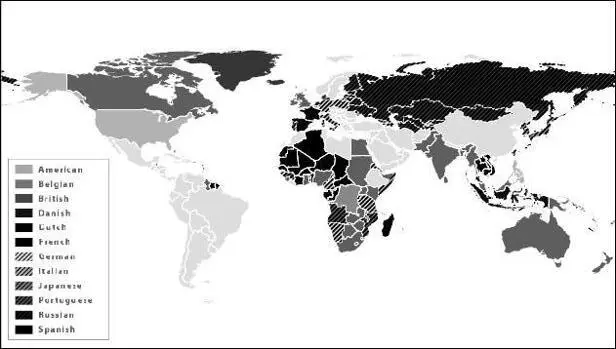
Empires—1900
The two World Wars and the dramatic reduction of status that followed had a profound psychological impact on Europe. Germany entered a period of deep self-loathing, and the rest of Europe seemed torn between nostalgia for its lost colonies and relief that the burdens of empire and even genuine sovereignty had been lifted from it. Along with European exhaustion came European weakness, but some of the trappings of great-power status remained, symbolized by permanent seats for Britain and France on the United Nations Security Council. But even the possession of nuclear weapons by some of these nations meant little. Europe was trapped in the force field created by the two superpowers.
The German response to its diminished position was in microcosm the European response: Germany recognized its fundamental problem as being that of an independent actor trapped between potentially hostile powers. The threat from the Soviet Union was fixed. However, if Germany could redefine its relationship with France, and through that with the rest of Europe, it would no longer be caught in the middle. For Germany, the solution was to become integrated with the rest of Europe, and particularly with France.
For Europe as a whole, integration was a foregone conclusion—in one sense imposed by the Soviet threat, in another by pressure from the United States. The American strategy for resisting the Soviets was to organize its European allies to defend themselves if necessary, all the while guaranteeing their security with troops already deployed to the continent. There was also the promise of more troops if war broke out, and ultimately the promise to use nuclear weapons if absolutely necessary. The nuclear weapons, however, would be kept under American control. Conventional forces would be organized into a joint command, within the North Atlantic Treaty Organization. This organization created a multilateral, unified defense force for Europe that was, in effect, controlled by the United States.
The Americans also had a vested interest in European prosperity. Through the Marshall Plan and other mechanisms, the United States created a favorable environment in which to revive the European economy while also creating the foundations for a European military capability. The more prosperity was generated through association with the United States, the more attractive membership in NATO became. The greater the contrast was between living conditions in the Soviet bloc and in Western Europe, the more likely that contrast was to generate unrest in the east. The United States believed ideologically and practically in free trade, but more than that, it wanted to see greater integration among the European economies, both for its own sake and to bind the potentially fractious alliance together.
The Americans saw a European economic union as a buttress for NATO. The Europeans saw it as a way not only to recover from the war but to find a place for themselves in a world that had reduced them to the status of regional powers at best. Power, if there was any to be regained, was to be found in some sort of federation. This was the only way to create a balance between Europe and the two superpowers. Such a federation would also solve the German problem by integrating Germany with Europe, making the extraordinary German economic machine a part of the European system. One of the key issues for the next ten years is whether the United States will continue to view European integration in the same way.
In 1992 the Maastricht Treaty established the European Union, but the concept was in fact an old European dream. Its antecedents reach back to the early 1950s and the European Steel and Coal Community, a narrowly focused entity whose leaders spoke of it even then as the foundation for a European federation.
It is coincidental but extremely important that while the EU idea originated during the Cold War, it emerged as a response to the Cold War’s end. In the west, the overwhelming presence of NATO and its controls over defense and foreign policy loosened dramatically. In the east, the fall of the Berlin Wall and the collapse of the Soviet Union found sovereign nations coming out of the shadows. It was at this point that Europe regained the sovereignty it had lost but that it is now struggling to define.
Читать дальшеИнтервал:
Закладка:
Похожие книги на «The Next Decade»
Представляем Вашему вниманию похожие книги на «The Next Decade» списком для выбора. Мы отобрали схожую по названию и смыслу литературу в надежде предоставить читателям больше вариантов отыскать новые, интересные, ещё непрочитанные произведения.



Обсуждение, отзывы о книге «The Next Decade» и просто собственные мнения читателей. Оставьте ваши комментарии, напишите, что Вы думаете о произведении, его смысле или главных героях. Укажите что конкретно понравилось, а что нет, и почему Вы так считаете.