Mark Steyn - America Alone
Здесь есть возможность читать онлайн «Mark Steyn - America Alone» весь текст электронной книги совершенно бесплатно (целиком полную версию без сокращений). В некоторых случаях можно слушать аудио, скачать через торрент в формате fb2 и присутствует краткое содержание. Город: Washington, D.C., Год выпуска: 2006, ISBN: 2006, Издательство: Regnery Publishing, Жанр: Публицистика, Политика, на английском языке. Описание произведения, (предисловие) а так же отзывы посетителей доступны на портале библиотеки ЛибКат.
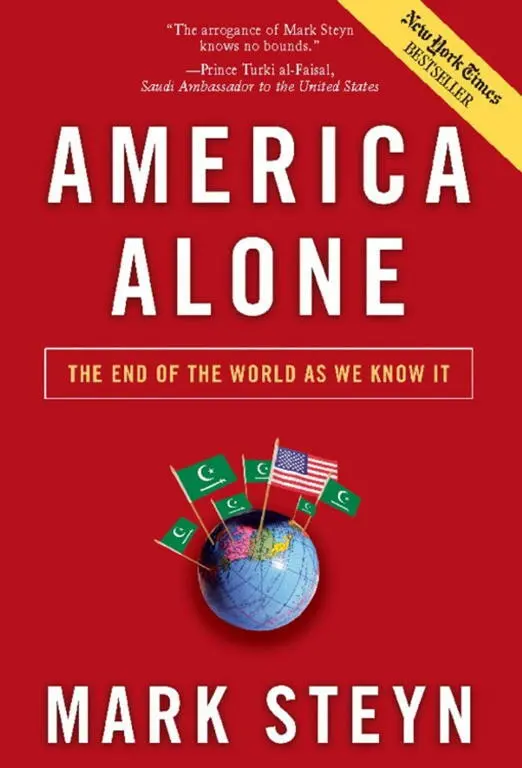
- Название:America Alone
- Автор:
- Издательство:Regnery Publishing
- Жанр:
- Год:2006
- Город:Washington, D.C.
- ISBN:978-0895260789
- Рейтинг книги:5 / 5. Голосов: 1
-
Избранное:Добавить в избранное
- Отзывы:
-
Ваша оценка:
America Alone: краткое содержание, описание и аннотация
Предлагаем к чтению аннотацию, описание, краткое содержание или предисловие (зависит от того, что написал сам автор книги «America Alone»). Если вы не нашли необходимую информацию о книге — напишите в комментариях, мы постараемся отыскать её.
It’s the end of the world as we know it…
Someday soon, you might wake up to the call to prayer from a muezzin. Europeans already are. And liberals will still tell you that “diversity is our strength” — while Talibanic enforcers cruise Greenwich Village burning books and barber shops, the Supreme Court decides sharia law doesn’t violate the “separation of church and state,” and the Hollywood Left decides to give up on gay rights in favor of the much safer charms of polygamy. If you think this can’t happen, you haven’t been paying attention, as the hilarious, provocative, and brilliant Mark Steyn — the most popular conservative columnist in the English-speaking world — shows to devastating effect. The future, as Steyn shows, belongs to the fecund and the confident. And the Islamists are both, while the West is looking ever more like the ruins of a civilization. But America can survive, prosper, and defend its freedom only if it continues to believe in itself, in the sturdier virtues of self-reliance (not government), in the centrality of family, and in the conviction that our country really is the world’s last best hope. Mark Steyn’s
is laugh-out-loud funny — but it will also change the way you look at the world.
[May contain tables.]
From the inside flap
America Alone — читать онлайн бесплатно полную книгу (весь текст) целиком
Ниже представлен текст книги, разбитый по страницам. Система сохранения места последней прочитанной страницы, позволяет с удобством читать онлайн бесплатно книгу «America Alone», без необходимости каждый раз заново искать на чём Вы остановились. Поставьте закладку, и сможете в любой момент перейти на страницу, на которой закончили чтение.
Интервал:
Закладка:
A while back, I found myself behind a car in Vermont that had a one-word bumper sticker containing the injunction “CO-EXIST.” It’s one of those sentiments beloved of Western progressives, one designed principally to flatter their sense of moral superiority, part of the multiculti mood music that makes lefty pieties one long soothing express elevator to cloud-cuckoo land. On this “CO-EXIST” sticker, the “C” was the Islamic crescent, the “0” was the hippy peace sign, the “X” was the Star of David and the “T” was the Christian cross. Very nice, hard to argue with. But the reality is that it’s the first of those symbols that has a problem with “co-existence.” Take the crescent out of the equation and you wouldn’t need a bumper sticker at all. Indeed, co-existence is what the Islamists are at war with — or, if you prefer, pluralism; the idea that different groups can rub along together within the same general neighborhood. And even those who nominally respect the idea tend, on closer examination, to mean by “pluralism” something closer to “subjugation.” Take one of those famous “moderate Muslims”: Imam Zaid Shakir, the subject of a flattering profile in the New York Times under the headline “U.S. Muslim Clerics Seek a Modern Middle Ground.” Good for them, but what does a “modern middle ground” mean? As Imam Shakir — who grew up as Ricky Mitchell in Georgia and Connecticut — says, “Every Muslim who is honest would say, I would like to see America become a Muslim country. I think it would help people, and if I didn’t believe that, I wouldn’t be a Muslim.” I think he’s right when he says honest Muslims want America to be a Muslim country. But they don’t mean it in quite the same sense Christians do when they speak of America as a Christian country. By a “Muslim country,” they don’t just foresee a country with a majority of Muslim inhabitants but a country whose civil institutions are Muslim. The Islamists incite jihad from American, Canadian, British, European, and Australian mosques, and they get away with it. The West’s elites lapse reflexively into twittering over insufficient “respect” and entirely fictional outbreaks of “Islamophobia.” The Mounties, the FBI, Scotland Yard, and others are reasonably efficient at breaking up cells and plots, but they’re the symptoms, not the disease. It’s the ideological pipeline that needs to be dismantled. Through their network of schools and mosques, the Saudis are attempting to make themselves into a Muslim Vatican — if not infallible, at any rate the most authoritative voice in the Islamic world. We might have responded to the Wahhabist challenge by distinguishing, as William Tayler did, between Sunni and Shia, Sufi and Salafi, and all the rest, and attempting to exploit the divisions. But, as proper Western multiculturalists, we celebrate diversity by lumping them all together as “Islam.”
So if the jihad has its war aims, maybe we should start thinking about ours. What would victory look like? As Fascism and Communism were in their day, Islamism is now the ideology of choice for the world’s grievance-mongers. That means we have to destroy the ideology, or at least its potency — not Islam per se, but at the very minimum the toxic strain of Wahhabism, which thanks to Saudi oil money has been transformed from a fetish of isolated desert derelicts into the most influential radicalizing force of our time. If the implausible mantra of Western politicians that Islam is a “religion of peace” had any strategic value against the head hackers and suicide bombers, it would be as a prelude to pointing out that, sadly, Wahhabism is an exception to this otherwise saintly character, that Wahhabism is a religion of pieces. But our lack of curiosity about which particular school of imam is setting up shop on Main Street is greatly facilitating the cause of pan-Islamism, a much better example of globalization than McDonald’s. In Bangladesh and Bosnia, it’s put indigenous localized Islams out of business and imposed a one-size-fits-all Wahhab-Mart version cooked up by some guy at head office in Riyadh. One way to reverse its gains would be with a kind of anti-trust approach designed to restore all the less threatening mom n’ pop Islams run out of town by the Saudis’ Burqa King version of global homogeneity. By contrast, the much reviled yet mostly mythical “American imperialism” is up on bricks and rusting in the back of the garage. Wearying of what he regards as the deluded idealism of the liberty-touting Bush doctrine, National Review’s John Derbyshire began promoting the slogan “Rubble Doesn’t Cause Trouble.” Cute, and I wish him well with the T-shirt sales. But, in arguing for a “realist” foreign policy of long-range bombing as necessary, he overlooks the very obvious point that rubble causes quite a lot of trouble: the rubble of Bosnia is directly responsible for radicalizing a generation of European Muslims, including Daniel Pearl’s executioner; the rubble of Afghanistan became an international terrorist training camp, whose alumni include the shoe-bomber Richard Reid, the millennium bomber Ahmed Ressam, and the September 11 plotters; the rubble of Grozny turned Chechen nationalists into pan-Islamist jihadi. Those correspondents of mine who send me e-mails headed “Nuke Mecca!” might like to ponder the bigger strategic impact on a billion Muslims from Indonesia to Yorkshire, for whom any fallout will be psychological rather than carcinogenic. Rubble is an insufficient solution, unless you’re also going to attend to the Muslim world’s real problem: its intellectual rubble.
Arab Muslims fought in Afghanistan, British Muslims took up arms in Bosnia, Pakistani Muslims have been killed in Chechnya. When you’re up against a globalized ideology, you need to globalize your own, not hunker down in Fortress America.
What’s the bigger threat? A globalization that exports cheeseburgers or a globalization that exports the harshest and most oppressive features of its culture? Far too many American conservatives still think the dragons are at the far fringes of the map — that in the twenty-first century the United States can be a nineteenth-century republic untroubled by the world’s pathogens because of its sheer distance from them. But, in an age of globalized proximity all of us in the modern multicultural West are like Lincoln on the steps of the Capitol that Saturday morning: the world is in the room with us. At the dawn of the twentyfirst century, Marshall McLuhan’s global village is finally within reach: the Yanks run the diner, the Chinese the health clinic, and the Saudis the church. From America’s point of view, that doesn’t seem the best deal.
Chapter Five
The Anything They’ll Believe In
CHURCH VS. STATE
Islam is not only a religion, it is a complete way of life. Islam guides Muslims from birth to grave. The Quran and prophet Muhammad’s words and practical application of Quran in life cannot be changed.
Islam is a guide for humanity, for all times, until the day of judgment. It is forbidden in Islam to convert to any other religion. The penalty is death. There is no disagreement about it. Islam is being embraced by people of other faiths all the time. They should know they can embrace Islam, but cannot get out. This rule is not made by Muslims; it is the supreme law of God.
Please do not ask us Muslims to pick some rules and disregard other rules. Muslims are supposed to embrace Islam in its totality.
NAZRA QURAISHI, KINDERGARTEN TEACHER, IN THE LANSING STATE JOURNAL (MICHIGAN), JULY 5. 2006What we still don’t know, as the years drift by since September 11, is how deep the psychoses of jihadism reach within Islam in general, and the West’s Muslim populations in particular. How many are revolted by the slaughter of those Beslan schoolchildren or the beheading of Daniel Pearl and other hostages, and how many are willing to rationalize it?
Читать дальшеИнтервал:
Закладка:
Похожие книги на «America Alone»
Представляем Вашему вниманию похожие книги на «America Alone» списком для выбора. Мы отобрали схожую по названию и смыслу литературу в надежде предоставить читателям больше вариантов отыскать новые, интересные, ещё непрочитанные произведения.









Обсуждение, отзывы о книге «America Alone» и просто собственные мнения читателей. Оставьте ваши комментарии, напишите, что Вы думаете о произведении, его смысле или главных героях. Укажите что конкретно понравилось, а что нет, и почему Вы так считаете.