Mark Steyn - America Alone
Здесь есть возможность читать онлайн «Mark Steyn - America Alone» весь текст электронной книги совершенно бесплатно (целиком полную версию без сокращений). В некоторых случаях можно слушать аудио, скачать через торрент в формате fb2 и присутствует краткое содержание. Город: Washington, D.C., Год выпуска: 2006, ISBN: 2006, Издательство: Regnery Publishing, Жанр: Публицистика, Политика, на английском языке. Описание произведения, (предисловие) а так же отзывы посетителей доступны на портале библиотеки ЛибКат.
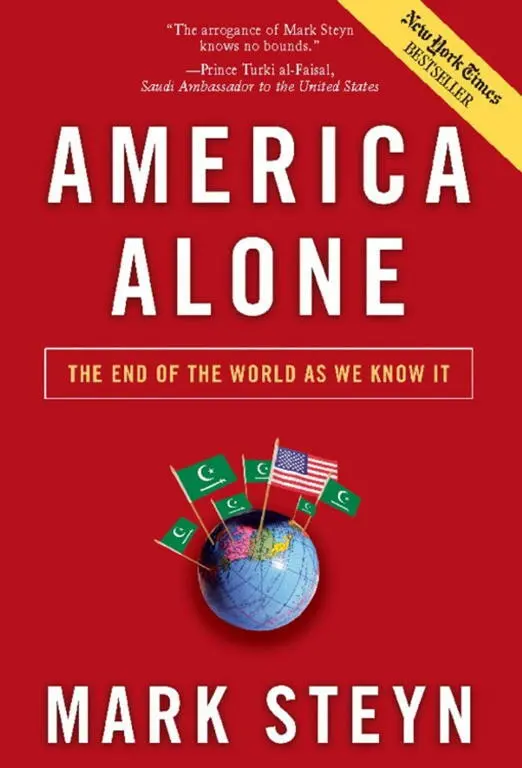
- Название:America Alone
- Автор:
- Издательство:Regnery Publishing
- Жанр:
- Год:2006
- Город:Washington, D.C.
- ISBN:978-0895260789
- Рейтинг книги:5 / 5. Голосов: 1
-
Избранное:Добавить в избранное
- Отзывы:
-
Ваша оценка:
America Alone: краткое содержание, описание и аннотация
Предлагаем к чтению аннотацию, описание, краткое содержание или предисловие (зависит от того, что написал сам автор книги «America Alone»). Если вы не нашли необходимую информацию о книге — напишите в комментариях, мы постараемся отыскать её.
It’s the end of the world as we know it…
Someday soon, you might wake up to the call to prayer from a muezzin. Europeans already are. And liberals will still tell you that “diversity is our strength” — while Talibanic enforcers cruise Greenwich Village burning books and barber shops, the Supreme Court decides sharia law doesn’t violate the “separation of church and state,” and the Hollywood Left decides to give up on gay rights in favor of the much safer charms of polygamy. If you think this can’t happen, you haven’t been paying attention, as the hilarious, provocative, and brilliant Mark Steyn — the most popular conservative columnist in the English-speaking world — shows to devastating effect. The future, as Steyn shows, belongs to the fecund and the confident. And the Islamists are both, while the West is looking ever more like the ruins of a civilization. But America can survive, prosper, and defend its freedom only if it continues to believe in itself, in the sturdier virtues of self-reliance (not government), in the centrality of family, and in the conviction that our country really is the world’s last best hope. Mark Steyn’s
is laugh-out-loud funny — but it will also change the way you look at the world.
[May contain tables.]
From the inside flap
America Alone — читать онлайн бесплатно полную книгу (весь текст) целиком
Ниже представлен текст книги, разбитый по страницам. Система сохранения места последней прочитанной страницы, позволяет с удобством читать онлайн бесплатно книгу «America Alone», без необходимости каждый раз заново искать на чём Вы остановились. Поставьте закладку, и сможете в любой момент перейти на страницу, на которой закончили чтение.
Интервал:
Закладка:
THE NON-VISIBLE MINORITY
Still, as we always say, the “vast majority” of Muslims oppose “extremism.” These are the so-called “moderate Muslims.” One is tempted to update the old joke: a ten-dollar bill is in the center of the crossroads. To the north, there’s Santa Claus. To the west, the Tooth Fairy. To the east, a radical Muslim. To the south, a moderate Muslim. Who reaches the ten-dollar bill first?
Answer: the radical Muslim. All the others are mythical creatures. The “moderate Muslim” is not entirely fictional. But it would be more accurate to call them quiescent Muslims. In the 1930s, there were plenty of “moderate Germans,” and a fat lot of good they did us or them. Today, the “moderate Muslim” is a unique contributor to cultural diversity: unlike all the visible minorities, he’s a non-visible one — or, at any rate, non-audible. But that doesn’t mean we can’t speak up on his behalf. So, for example, EU officials have produced new “guidelines” for discussing the, ah, current unpleasantness. The phrase “Islamic terrorism” is out. Instead, the EU bureaucrats have replaced it with the expression “terrorists who abusively invoke Islam.”
Who’s some white-bread Belgian to say whether Johnny bin Jihad is “abusively” invoking Islam? There seem to be plenty of Muslim scholars and imams who would disagree. We know, because Western politicians and religious leaders tell us so incessantly, that the “vast majority” of Muslims do not support terrorism? Yet how vast is the minority that does? One percent? Ten percent? Here are a couple of examples that suggest it might be rather more. Dr. Mahfooz Kanwar, a sociology professor at Mount Royal College in Calgary, went along to a funeral at the city’s largest mosque and was discombobulated when the man who led the prayers — in Urdu — said, “Oh, God, protect us from the infidels, who pollute us with their vile ways.” Dr. Kanwar said, “How dare you attack my country,” and pointed out to the crowd that he’d known this man for thirty years, most of which time he’d been living on welfare and thus the food on his table came courtesy of the taxes of the hardworking infidels. As Licia Corbella wrote in the Calgary Sun: “Guess which of the two men is no longer welcome at the Sarcee Trail mosque?”
Final score: Radical Islam 1, Moderate Muslims 0.
Here’s another example: Souleiman Ghali was born in Palestine and, as he put it, raised to hate “Shiites, Christians — and especially Jews.” After emigrating to America, he found himself rethinking these old prejudices and in 1993 helped found a mosque in San Francisco. As Mr. Ghali’s website states: “Our vision is the emergence of an American Muslim identity founded on compassion, respect, dignity, and love.” That’s hard work, especially given the supply of imams. In 2002, Mr. Ghali fired an imam who urged California Muslims to follow the sterling example of Palestinian suicide bombers. Safwat Morsy is Egyptian and speaks barely any English, but he knew enough to sue Mr. Ghali’s mosque for wrongful dismissal and was awarded $400,000.
So far, so typical. But the part of the story that matters is that the firebrand imams had a popular following, and Mr. Morsy’s firing was the final straw. Mr. Ghali was forced off the board and out of any role in the mosque he founded. And, as the Wall Street Journal reported, Safwat Morsy — a man who thinks American Muslims should be waddling around in Semtex belts — is doing a roaring trade: “His mosque is looking to buy a building to accommodate the capacity crowds coming these days for Friday prayers.” That’s Radical Islam 2, Moderate Muslims 0.
What proportion of mosques is “extreme”? And what proportion of “worshippers” is jihadist? Twenty percent? Two percent? Point-two percent? Nobody knows — because we (and most Western legal systems) see them as analogous to Catholic churches or Congregationalist meeting-houses.
At this point it’s time to throw in another round of “of courses”: of course most Western Muslims aren’t terrorists and of course most have no desire to be terrorists. One gathers anecdotally that they’re secure enough in their Muslim identity to dismiss the fire-breathing imam down the street as a kind of vulgar novelty act for the kids — in the same way that middle-class suburban white parents sigh and roll their eyes when Junior comes home with “Slap Up My Bitch” or “I’m Gonna Shoot That Cop Right After I F-His Ho” or whatever the latest popular vocal ditty is. But, aside from the few brave but marginalized men like Mr. Ghali, one can’t help noticing that the most prominent “moderate Muslims” would seem to be more accurately designated as apostate or ex-Muslims, like the feminist lesbian Canadian Irshad Manji and the California academic Wafa Sultan. It seems likely that the beliefs of Mohammed Atta are closer to the thinking of most Muslims than those of Ms. Manji are. The pseudonymous apostate Ibn Warraq makes an important distinction: there are moderate Muslims, but no moderate Islam. Millions of Muslims just want to get on with their lives, and there are — or were — remote corners of the world where, far from Mecca, Muslim practices reached accommodation with local customs. But all of the official schools of Islamic jurisprudence commend sharia and violent jihad. So a “moderate Muslim” can find no formal authority to support his moderation. And to be a “moderate Muslim” publicly means standing up to the leaders of your community, to men like Shaker Elsayed, leader of the Dar al Hijrah, one of America’s largest mosques, who has told his core-ligionists in blunt terms: “The call to reform Islam is an alien call.”
And even if you’re truly a “moderate” Muslim, why should you be expected to take on the most powerful men in Islam when the West’s media and political class merely pander to them? What kind of support does the culture give to those who speak out against the Islamists? The Iranians declared a fatwa on Salman Rushdie and he had to go into hiding for more than a decade while his government and others continued fawning on the regime that issued the death sentence. The Dutch filmmaker Theo van Gogh spoke out and was murdered, and the poseur dissenters of Hollywood were too busy congratulating themselves on their courage and bravery in standing up to Bush even to mention their poor dead colleague in the weepy Oscar montage of the year’s deceased. To speak out against the Islamists means to live in hiding and under armed security in the heart of the so-called “free world.”
Meanwhile, Yale offers a place on its campus to a former ambassador-at-large for the murderous Taliban regime.
When you look at the syncretist forms of Islam that endured for many years in Mecca’s remoter outposts — from the Balkans to Central Asia to Indonesia — they derived their “moderate” nature not from any particular school of Islam itself but from the character of the surrounding culture; Soviet regimes, a Chinese mercantile class, European imperialism all successfully tempered the more extreme forms of Islam. It’s no surprise that, with the loss of Western confidence, the free world’s Muslim populations are growing more radical with each generation.
So within the ever larger Muslim population is an ever larger Western Muslim population and within that ever larger Western Muslim population is an ever more radicalized Western Muslim population. And when you penetrate through all the various layers, there is a very profound challenge at the heart of the Islamic question. It was embodied by Abdul Rahman, a man on trial for his life in post-Taliban Afghanistan because he had committed the crime of converting to Christianity. “We will not allow God to be humiliated. This man must die,” said Abdul Raoulf of the nation’s principal Muslim body, the Afghan Ulama Council. “Cut off his head! We will call on the people to pull him into pieces so there’s nothing left.” Needless to say, Imam Raoulf is one of Afghanistan’s leading “moderate” clerics. “Even if the government does not sentence him to death, then the people of Afghanistan will kill him,” declared Maulavi Enayatullah Baligh, a lecturer in Islamic “law” at Kabul University, but evidently one who likes to take his work home with him and practice it ad hoc with the local lynch mob.
Читать дальшеИнтервал:
Закладка:
Похожие книги на «America Alone»
Представляем Вашему вниманию похожие книги на «America Alone» списком для выбора. Мы отобрали схожую по названию и смыслу литературу в надежде предоставить читателям больше вариантов отыскать новые, интересные, ещё непрочитанные произведения.










Обсуждение, отзывы о книге «America Alone» и просто собственные мнения читателей. Оставьте ваши комментарии, напишите, что Вы думаете о произведении, его смысле или главных героях. Укажите что конкретно понравилось, а что нет, и почему Вы так считаете.