Mark Steyn - America Alone
Здесь есть возможность читать онлайн «Mark Steyn - America Alone» весь текст электронной книги совершенно бесплатно (целиком полную версию без сокращений). В некоторых случаях можно слушать аудио, скачать через торрент в формате fb2 и присутствует краткое содержание. Город: Washington, D.C., Год выпуска: 2006, ISBN: 2006, Издательство: Regnery Publishing, Жанр: Публицистика, Политика, на английском языке. Описание произведения, (предисловие) а так же отзывы посетителей доступны на портале библиотеки ЛибКат.
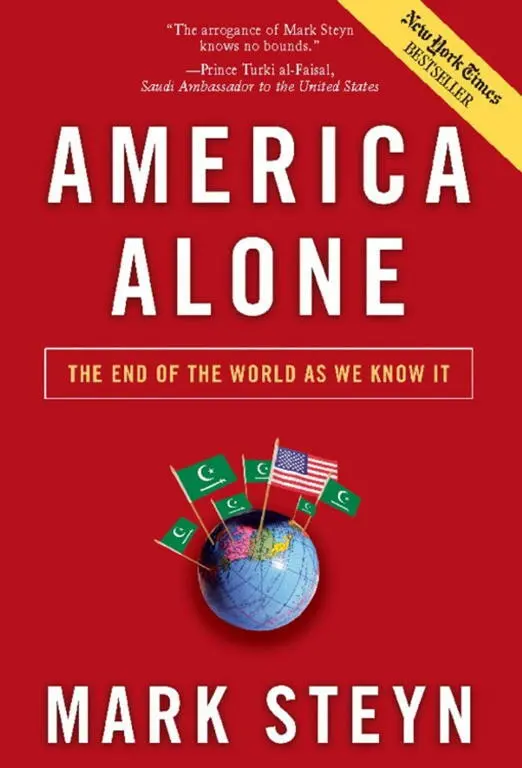
- Название:America Alone
- Автор:
- Издательство:Regnery Publishing
- Жанр:
- Год:2006
- Город:Washington, D.C.
- ISBN:978-0895260789
- Рейтинг книги:5 / 5. Голосов: 1
-
Избранное:Добавить в избранное
- Отзывы:
-
Ваша оценка:
America Alone: краткое содержание, описание и аннотация
Предлагаем к чтению аннотацию, описание, краткое содержание или предисловие (зависит от того, что написал сам автор книги «America Alone»). Если вы не нашли необходимую информацию о книге — напишите в комментариях, мы постараемся отыскать её.
It’s the end of the world as we know it…
Someday soon, you might wake up to the call to prayer from a muezzin. Europeans already are. And liberals will still tell you that “diversity is our strength” — while Talibanic enforcers cruise Greenwich Village burning books and barber shops, the Supreme Court decides sharia law doesn’t violate the “separation of church and state,” and the Hollywood Left decides to give up on gay rights in favor of the much safer charms of polygamy. If you think this can’t happen, you haven’t been paying attention, as the hilarious, provocative, and brilliant Mark Steyn — the most popular conservative columnist in the English-speaking world — shows to devastating effect. The future, as Steyn shows, belongs to the fecund and the confident. And the Islamists are both, while the West is looking ever more like the ruins of a civilization. But America can survive, prosper, and defend its freedom only if it continues to believe in itself, in the sturdier virtues of self-reliance (not government), in the centrality of family, and in the conviction that our country really is the world’s last best hope. Mark Steyn’s
is laugh-out-loud funny — but it will also change the way you look at the world.
[May contain tables.]
From the inside flap
America Alone — читать онлайн бесплатно полную книгу (весь текст) целиком
Ниже представлен текст книги, разбитый по страницам. Система сохранения места последней прочитанной страницы, позволяет с удобством читать онлайн бесплатно книгу «America Alone», без необходимости каждый раз заново искать на чём Вы остановились. Поставьте закладку, и сможете в любой момент перейти на страницу, на которой закончили чтение.
Интервал:
Закладка:
GLOBAL TAKE-OUT
Which globalization is shaping the world? The movies or the madrassas? Burger King or Burqa King? Big Macs or Big Mo? A friend of mine recalled a Londoner asking him, a few weeks before the first McDonald’s opened in Britain, what exactly one of these American
“fast-food restaurants” was. So my chum explained. “You eat the hamburger out of a polystyrene carton?” marveled the Englishman. “Good grief, they’ll lose their shirts. That’s never going to catch on.” Americans think nothing of changing the world’s dining habits or entertainment tastes but recoil at the notion that cultural imperialism might cut a little deeper, and extend to, say, theories of government and liberty. Whether or not you can “give” people freedom, all over the world Middle Eastern Islamists have given millions of Asians and Africans and Europeans (and, yes, North Americans) an ideology and identity that hitherto they never knew they wanted. And it’s hard to argue it kinda snuck up on us. In 1871, John Norman, the acting chief justice of India, was stabbed to death by a Wahhabi called Abdullah. The following year, the viceroy, Lord Mayo, was also fatally stabbed, by a Wahhabi named Shere Ali. He declared that Allah was his “shereek” (accomplice) and, at the gallows, was reciting verses from the Koran as the trap fell.
After the Sepoy Mutiny of 1857, William Tayler wrote:
With the Soonnees the Wahabees are on terms of tolerable agreement, though differing on certain points, but from the Sheahs, they differ radically, and their hatred, like all religious hatred, is bitter and intolerant. But the most striking characteristic of the Wahabee sect, and that which principally concerns this narrative, is the entire subservience which they yield to the Peer, or spiritual guide.
Mr. Tayler, a minor civil servant in Bengal, was a genuine “multiculturalist.” Although he regarded his own culture as superior, he was engaged enough by the ways of others to study the differences between them. By contrast, contemporary multiculturalism absolves one from knowing anything about other cultures as long as one feels warm and fluffy toward them. After all, if it’s grossly judgmental to say one culture’s better than another, why bother learning about the differences? “Celebrate diversity” with a uniformity of ignorance. Had William Tayler been around when the Islamification of the West got under way and you’d said to him there was a mosque opening down the street, he’d have wanted to know: What kind of mosque? Who’s the imam? What branch of, Islam? Old-school imperialists could never get away with the feel-good condescension of PC progressives. Here’s Tayler again: “The tenets originally professed by the Wahabees have been described as a Mahomedan Puritanism joined to a Bedouin Phylarchy, in which the great chief is both the political and religious leader of the nation.” Too right. In 1946, Colonel William Eddy, the first United States minister to Saudi Arabia, was told by the country’s founder, Ibn Saud, “We will use your iron, but you will leave our faith alone.”
Had William Tayler been on hand, he might have questioned whether that was such a great deal. American “iron” — money and technology invested in the oil industry — transformed Saudi Arabia’s financial fortunes while leaving its faith and everything else alone. In 1974, the oil industry accounted for 91 percent of Saudi exports. In 2000, it accounted for 91.4 percent. Two trillion dollars poured into the House of Saud’s treasury, and what did they do with it? Diversify the economy? Launch new industries? Open up the tourism sector? Not a thing. The country remained the same desert, literally and psychologically, it was a quarter century earlier. So where did all that money go? From the seventies onward, Saudi Arabia used their Yanqui dollars to export their faith even more widely than the oil. Instead of diversifying their industrial exports, they honed their ideological one, financing Islamic centers, mosques, and schools in Morocco, Uzbekistan, Indonesia, Bosnia, Nigeria, Britain, and America. In 2005, a twenty-three-year-old American citizen named Ahmed Omar Abu Ali was charged with plotting to assassinate the president. Like that photograph of Lincoln and Booth, Mr. Abu Ali was closer than you might think: according to the Associated Press report in the New York Times, he “was born in Houston and moved to Falls Church, Va., where he was valedictorian of his high school class.”
High school valedictorian from northern Virginia, huh? Was he in that year’s production of Bye Bye Birdie? Not exactly. Neither the Times nor the AP had space to mention that the typical Virginia high school Mr. Abu Ali attended was the Islamic Saudi Academy, funded by the Kingdom of Saudi Arabia. It’s on American soil but it describes itself as “subject to the government of the Kingdom of Saudi Arabia” and its classes are based on “the curriculum, syllabus, and materials established by the Saudi Ministry of Education.” So what does it teach? No room for American history, but that’s not so unusual in Virginia high schools these days. Instead, the school concentrates on Wahhabi history and “Islamic values and the Arabic language and culture,” plus “the superiority of jihad.” By the eleventh grade, students are taught that on the Day of Judgment Muslims will fight and kill the Jews, who will find that the very trees they’re hiding behind will betray them by saying, “Oh Muslim, oh servant of God, here is a Jew hiding behind me. Come here and kill him.” Beats climate change and gay outreach, or whatever they do in the regular Falls Church high school. Here is a standard Saudi Ministry of Education exercise, as taught in the first grade at that Virginia academy and at other Saudi-funded schools in the Western world:
Fill in the blanks with the appropriate words:
Every religion other than ___________ is false.
Whoever dies outside of Islam enters ____________.
Correct answers: Islam, hellfire.
And what do America’s president and the secretary of state and the deputy secretary of this and the undersecretary of that say in return?
The Saudis are our ____________.
Fiends? Whoops, sorry, friends. The Saudis are our friends. No matter how many of us they kill.
The Germans and Japanese had to make do with Lord Haw-Haw and Tokyo Rose. If only they could have had Third Reich Academies in every English city and Hirohito Highs from Alaska to Florida and St. Adolf’s Parish Church in every medium-sized town around the world. Of all the many examples of how our multiculti mainstream ushers the extremists from the dark fringe to the center of Western life, there is no more emblematic tale than a famous 2004 court victory won by an adolescent schoolgirl called Shabina Begum. Had the verdict not been overturned on appeal in 2006, all British schools would have had to permit students to wear the full “jilbab” — Muslim garb that covers the entire body except the eyes and hands. This triumph over the school dress code was achieved with the professional support of both Cherie Booth, the wife of Tony Blair, and of Hizb ut-Tahrir, a group that advocates violence in support of a worldwide caliphate and which (according to the BBC) “urges Muslims to kill Jewish people.” What does an “extremist” have to do to be too extreme for the, wife of the British prime minister?
Ms. Booth hailed her initial court win as “a victory for all Muslims who wish to preserve their identity and values despite prejudice and bigotry.” It seems almost too banal to observe that such an extreme preservation of young Shabina Begum’s Muslim identity must perforce be at the expense of any British identity. Is it “bigoted” to argue that the jilbab is a barrier to acquiring the common culture necessary to any functioning society? Is it “prejudiced” to suggest that in Britain a Muslim woman ought to reach the same sartorial compromise as, say, a female doctor in Bahrain?
Читать дальшеИнтервал:
Закладка:
Похожие книги на «America Alone»
Представляем Вашему вниманию похожие книги на «America Alone» списком для выбора. Мы отобрали схожую по названию и смыслу литературу в надежде предоставить читателям больше вариантов отыскать новые, интересные, ещё непрочитанные произведения.










Обсуждение, отзывы о книге «America Alone» и просто собственные мнения читателей. Оставьте ваши комментарии, напишите, что Вы думаете о произведении, его смысле или главных героях. Укажите что конкретно понравилось, а что нет, и почему Вы так считаете.