Mary Roach - Grunt
Здесь есть возможность читать онлайн «Mary Roach - Grunt» весь текст электронной книги совершенно бесплатно (целиком полную версию без сокращений). В некоторых случаях можно слушать аудио, скачать через торрент в формате fb2 и присутствует краткое содержание. Город: New York, Год выпуска: 2016, ISBN: 2016, Издательство: W. W. Norton, Жанр: nonf_military, sci_popular, на английском языке. Описание произведения, (предисловие) а так же отзывы посетителей доступны на портале библиотеки ЛибКат.
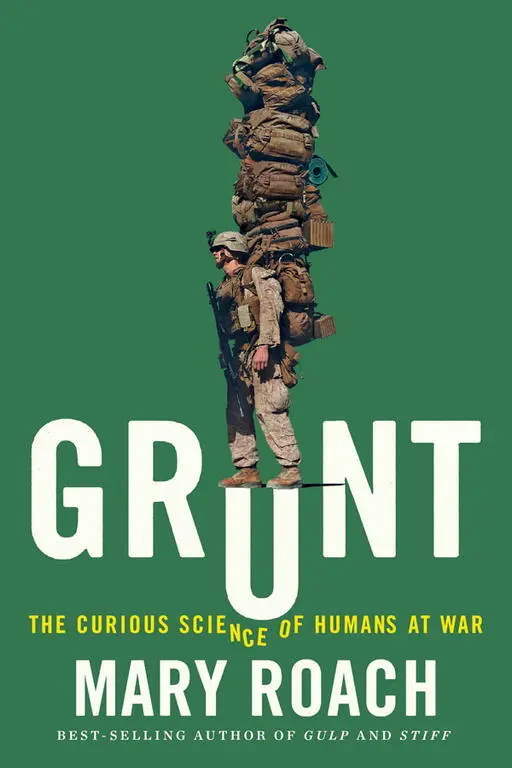
- Название:Grunt
- Автор:
- Издательство:W. W. Norton
- Жанр:
- Год:2016
- Город:New York
- ISBN:978-0-393-24544-8
- Рейтинг книги:3 / 5. Голосов: 1
-
Избранное:Добавить в избранное
- Отзывы:
-
Ваша оценка:
Grunt: краткое содержание, описание и аннотация
Предлагаем к чтению аннотацию, описание, краткое содержание или предисловие (зависит от того, что написал сам автор книги «Grunt»). Если вы не нашли необходимую информацию о книге — напишите в комментариях, мы постараемся отыскать её.
Grunt
Tennessee
An Amazon Best Book of June 2016:
Amazon.com Review It takes a special kind of writer to make topics ranging from death to our gastrointestinal tract interesting (sometimes hilariously so), and pop science writer Mary Roach is always up to the task. In her latest book,
, she explores how our soldiers combat their non-gun-wielding opponents—panic, heat exhaustion, the runs, and more. It will give you a new appreciation not only for our men and women in uniform (and by the way, one of the innumerable things you’ll learn is how and why they choose the fabric for those uniforms), but for the unsung scientist-soldiers tasked with coming up with ways to keep the “grunts” alive and well. If you are at all familiar with Roach’s oeuvre, you know her enthusiasm for her subjects is palpable and infectious. This latest offering is no exception.
—Erin Kodicek,
“A mirthful, informative peek behind the curtain of military science.” (Washington Post)
“From the ever-illuminating author of
and
comes an examination of the science behind war. Even the tiniest minutiae count on the battlefield, and Roach leads us through her discoveries in her inimitable style.” (Elle)
“Mary Roach is one of the best in the business of science writing… She takes readers on a tour of the scientists who attempt to conquer the panic, exhaustion, heat, and noise that plague modern soldiers.” (Brooklyn Magazine)
“Extremely likable … and quick with a quip…. [Roach’s] skill is to draw out the good humor and honesty of both the subjects and practitioners of these white arts among the dark arts of war.” (San Francisco Chronicle)
“Nobody does weird science quite like [Roach], and this time, she takes on war. Though all her books look at the human body in extreme situations (sex! space! death!), this isn’t simply a blood-drenched affair. Instead, Roach looks at the unexpected things that take place behind the scenes.” (Wired)
“Brilliant.” (Science)
“Roach … applies her tenacious reporting and quirky point of view to efforts by scientists to conquer some of the soldier’s worst enemies.” (Seattle Times)
“Covering these topics and more, Roach has done a fascinating job of portraying unexpected, creative sides of military science.” (New York Post)
“Having investigated sex, death, and preparing for space travel,
best-selling Roach applies her thorough—and thoroughly entertaining—techniques to the sobering subject of keeping soldiers not just alive but alert and healthy of mind and body during warfare.” (Library Journal)
“A rare literary bird, a best selling science writer … Roach avidly and impishly infiltrates the world of military science…. Roach is exuberantly and imaginatively informative and irreverently funny, but she is also in awe of the accomplished and committed military people she meets.” (Booklist (starred review))
Grunt — читать онлайн бесплатно полную книгу (весь текст) целиком
Ниже представлен текст книги, разбитый по страницам. Система сохранения места последней прочитанной страницы, позволяет с удобством читать онлайн бесплатно книгу «Grunt», без необходимости каждый раз заново искать на чём Вы остановились. Поставьте закладку, и сможете в любой момент перейти на страницу, на которой закончили чтение.
Интервал:
Закладка:
From deep in the pockets of the OSS came Harold Coolidge’s reply: Try Peru. “Don’t be discouraged,” he wrote. “Shark hunting is not unlike tiger hunting. You remember how plentiful tigers are in various parts of French Indo-China until you reach the point when you want to shoot one and have only two or three weeks at your disposal.” You got the sense, leafing through these letters, that a career in natural history was little more than a way for well-connected gentlemen to finance far-flung safaris and fishing expeditions in the name of science. The title of Douglas Burden’s memoir nicely summed the job: Hunting in Many Lands.
The expedition eventually located some sharks, off the coast of Guayaquil, Ecuador. More discouraging words followed. Nothing worked. They tried combining the ammonium acetate and the copper sulfate, and that compound (copper acetate) seemed effective. Unfortunately, two or three pounds of it, in the form of a slowly dissolving cake (think urinal, not birthday), would be needed for one day’s protection. This would not do. The Navy wanted something small enough and light enough—six ounces at most—to seal in a packet and attach to a life belt. The life belt, a precursor to the flotation vest, was a deflated rubber tube worn around the waist at all times and inflated in an emergency. Like any part of a serviceman’s uniform, the belts developed holes from wear and tear. The last thing a seaman needed on top of a leaky life belt was a three-pound anchor of questionably effective shark repellent.
The Navy was losing patience. A hundred thousand dollars—$1.5 million in today’s currency—had been spent, and they were no closer to having a practical, effective shark repellent than they’d been a year ago. The OSS was edged out, and the project taken over by the Office of Naval Research and the Naval Research Laboratory (NRL). The first thing the Navy did was to make the field tests more realistic. Springer and Burden had been baiting lone meandering specimens—“casual sharks”—using hunks of mullet as their man-in-life-belt stand-ins. The NRL wanted a better approximation of the thrashing aftermath of a downed ship or plane and the “large schools of frenzied sharks” that that scenario was thought to attract and inspire. The so-called feeding frenzy was a state of mind in which, it was speculated, olfaction took a back seat to the “mob impulse.” In August 1943, copper acetate was brought on board a shrimp trawler off Biloxi, Mississippi, and tested for its ability to protect “trash fish”—flailing, panicked specimens tossed off the back because they weren’t shrimp. Guess what? Even five to six pounds of copper acetate per bushel of trash fish “did not by any means” interrupt the het-up mob trailing the boat. “The sharks hardly paused.”
The final slap in the face of Project 374 would come in the form of a paper by Navy Captain H. David Baldridge Jr.: “Analytic Indication of the Impracticability of Incapacitating an Attacking Shark by Exposure to Waterborne Drugs.” By plotting the speed of a closing shark against the speed of dilution and the concentration needed to put the creature out of commission, Baldridge showed that such a large quantity of drug would be needed that it “does not appear to be at all reasonable as an approach to the control of predaceous shark behavior.” As one of Burden’s colleagues put it: “You can’t do much with a pint of liquid in an ocean.”
Taking a cue from the octopus, Navy researchers next looked into using clouds of inky dye as a way to hide crewmen from potential predators. Under those same “mob psychology” conditions, all feeding activity was stopped until the dye had diluted to the point at which it no longer obscured the prey. Production began at once. Shark Chaser’s active ingredients: 80 percent black dye and 20 percent pink pill—a little copper acetate having been added to the pot [51] You may have heard stories about how Julia Child’s first recipe was for shark repellent. Her OSS employment file shows that she indeed worked for the head of the shark repellent project, Harold Coolidge, in the Office of Emergency Rescue Equipment in 1944. However, her title was Senior Clerk, and her name appears nowhere in the OSS shark files. Child herself made no claim to have come up with the recipe for Shark Chaser but said merely that she followed it, mixing the ingredients “in a bathtub.” This seems odd, as none of the other repellent prototypes were produced or tested at OSS headquarters. Leading me to wonder: Did she cook up Shark Chaser, or just a good story?
for some false peace of mind. From 1945 all the way through to the Vietnam War, packets were available for the emergency survival supplies of lifeboats, life rafts, and life jackets on military vessels and planes. Even the post-splashdown survival kits of the Mercury astronauts were stocked with Shark Chaser.
Through all of it, there’d been skeptics among the Navy brass. Rear Admiral Ross T. McIntire, Chief of the Navy’s Bureau of Medicine and Surgery, made the eminently reasonable point that a package labeled SHARK CHASER in bold capital letters might in fact lower, not raise, morale, planting, as it would, the seed of terror in minds that had been, until that moment, occupied by the real threats of ocean survival: dehydration, starvation, drowning, heat, cold. Especially given the “negligible danger,” to use McIntire’s words, that sharks posed to Navy personnel.
How negligible? Opinions varied, but at one point in the proceedings, the Commander of the South Pacific Fleet issued a memo to all naval bases and hospital ships soliciting “authentic cases of injury to personnel from attack by sharks.” With all hands reporting, the final count was two cases. (One additional attack was later determined to have been a “vicious eel.”) The OSS responded in time-honored intelligence-agency style: They disappeared the report. “The report on shark attacks has been destroyed, as you requested,” reads an interoffice memo to Harold Coolidge from a staffer in December 1943.
It was another stink bomb for the OSS. They’d set out to develop a shark repellent based on one man’s experience and another’s political connections, with no solid data to support a need. If you look back at the Ecuador incident—the original impetus for all this—it really wasn’t a testament to the danger or ferocity of sharks. If anything, it was a testament to the disinterest and/or shyness of sharks. The flight officer was adrift in a life jacket for thirty-one hours, yet he emerged from the ocean unmauled by the retinue of sharks that followed him most of the way to shore.
If you wanted to preserve morale, the better approach would have been to share these reassuring facts and statistics. “Correct information,” wrote McIntire, “would be more universally operative in alleviating those fears than any repellent that could be devised.” Beginning in 1944, that is what the Navy did. Their Aviation Training Division distributed copies of a pamphlet called Shark Sense to all future fliers: 22 pages of comforting facts, illustrated with comic drawings of cringing, perspiring, fleeing (“HALP!”) sharks.
And it proved true. In a review of 2,500 aviators’ accounts of survival at sea during World War II, there were just 38 shark sightings, only 12 of which resulted in injuries or death.
As reassuring as it was, Shark Sense failed to address the most urgent questions on the minds of men afloat in the bedlam of a disaster at sea. Is it true that a shark can smell a drop of human blood in an ocean of seawater? Does noise arouse a shark’s curiosity, or scare it away? What about movement? Some accounts—including that of the swimming Ecuadorian—indicated that thrashing scared a shark away; others suggested it sparked their interest. No one really knew.
Читать дальшеИнтервал:
Закладка:
Похожие книги на «Grunt»
Представляем Вашему вниманию похожие книги на «Grunt» списком для выбора. Мы отобрали схожую по названию и смыслу литературу в надежде предоставить читателям больше вариантов отыскать новые, интересные, ещё непрочитанные произведения.











Обсуждение, отзывы о книге «Grunt» и просто собственные мнения читателей. Оставьте ваши комментарии, напишите, что Вы думаете о произведении, его смысле или главных героях. Укажите что конкретно понравилось, а что нет, и почему Вы так считаете.