John Barron - MiG Pilot
Здесь есть возможность читать онлайн «John Barron - MiG Pilot» весь текст электронной книги совершенно бесплатно (целиком полную версию без сокращений). В некоторых случаях можно слушать аудио, скачать через торрент в формате fb2 и присутствует краткое содержание. Город: New York, Год выпуска: 1983, ISBN: 1983, Издательство: Avon Books, Жанр: nonf_military, на английском языке. Описание произведения, (предисловие) а так же отзывы посетителей доступны на портале библиотеки ЛибКат.
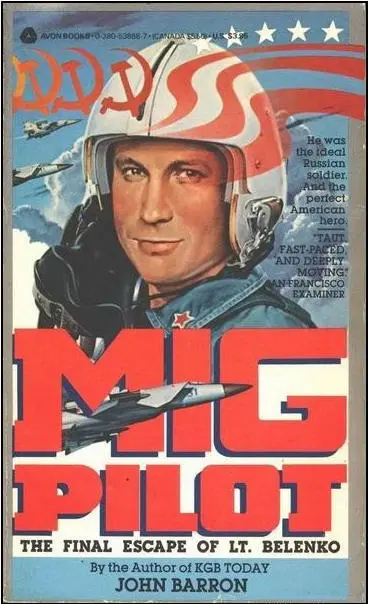
- Название:MiG Pilot
- Автор:
- Издательство:Avon Books
- Жанр:
- Год:1983
- Город:New York
- ISBN:978-0380538683
- Рейтинг книги:4 / 5. Голосов: 1
-
Избранное:Добавить в избранное
- Отзывы:
-
Ваша оценка:
MiG Pilot: краткое содержание, описание и аннотация
Предлагаем к чтению аннотацию, описание, краткое содержание или предисловие (зависит от того, что написал сам автор книги «MiG Pilot»). Если вы не нашли необходимую информацию о книге — напишите в комментариях, мы постараемся отыскать её.
MiG Pilot Viktor is not only a first class pilot, he is also a true hero.
Don’t lend this book to anyone and expect to get it back.
MiG Pilot — читать онлайн бесплатно полную книгу (весь текст) целиком
Ниже представлен текст книги, разбитый по страницам. Система сохранения места последней прочитанной страницы, позволяет с удобством читать онлайн бесплатно книгу «MiG Pilot», без необходимости каждый раз заново искать на чём Вы остановились. Поставьте закладку, и сможете в любой момент перейти на страницу, на которой закончили чтение.
Интервал:
Закладка:
“How old are you?”
“Forty-seven.”
“Are you married?”
“Oh, yes. She spent eight years in the camps. She’s also from the Ukraine. Her relatives were exiled. They’ve all died now, and there’s just the two of us. We thought about children, but we were afraid we couldn’t take care of them. It’s not easy to get a good job if you’re an exile. You know how life is.”
“What did you do? Did you kill someone?”
“No, I gave bread to the men from the forest.”**
What can he do, that poor man, to our country? Look at him. He hardly has any teeth; he won’t live much longer. What kind of enemy is he? What kind of criminal? Whatever he did, ten years are punishment enough. Why not let him go back to his home and die? Why be so hateful? What kind of freedom do we have here?
Belenko was sent to a training center near Moscow for a few weeks’ intensive study of the MiG-25, and when he returned in Mid-June, a state of emergency existed in Chuguyevka. A dysentery epidemic had disabled fully 40 percent of the regiment, two soldiers had committed suicide, at least twenty had deserted, there had been more hunger strikes, and the enlisted men now were verging on open mutiny. Fuel shortages had prevented pilots from flying as much as they needed to master their new aircraft. American reconnaissance planes, SR-71s, were prowling off the coast, staying just outside Soviet airspace but photographing terrain hundreds of miles inland with side-angle cameras. They taunted and toyed with the MiG-25s sent up to intercept them, scooping up to altitudes the Soviet planes could not reach, and circling leisurely above them or dashing off at speeds the Russians could not match. Moscow was incensed, and Commandant Shevsov lived in terror of an investigation. Already they had been notified that the regional political officer was flying in next week to lecture all officers of the regiment.
Shevsov announced that a pilot from each squadron would have to speak at the scheduled assembly, present an assessment of the regiment’s problems, and propose solutions. He instructed his political officer to pick those likely to create the most favorable impression. The regimental political officer was not from the political directorate of the armed forces; rather, he was a pilot who in the frenzied formation of the regiment just happened to be saddled with the job. He thought as a pilot, and he was the only popular political officer Belenko ever knew. When asked, Belenko told him bluntly and in detail what he thought was wrong and what should be done.
“Well, I agree. You will speak for your squadron. If you say just what you said to me, maybe it will shock them into letting us do something.”
The regional political officer, a corpulent, perfumed man with bags under his eyes, appeared in a resplendent uniform bedecked wtih medals that made the pilots smile at each other because they knew that no political officer had ever participated in battle, except perhaps at a bar.
“Comrade Officers, your regiment is in a serious situation, a desperate situation.
“Around us the SR-71 is flying, spying on us, watching us in the day and in the night.
“The Chinese are a day’s walk away from us. We should not let the Chinese frighten us. We can massacre them anytime we want. They have a few nuclear bombs, but they can deliver them only by donkey. Their planes are so old we can wipe them out of the sky. But we cannot underestimate the Chinese because there are so many of them, and they are fanatical, mad. If we kill a million of them a day, we still will have three years of work ahead of us.
“So the Party requires that you increase your vigilance, your readiness, your discipline in order to defend our Mother Country. You have been given our country’s best interceptor. It has the highest speed and the highest altitude of any plane we have. It is a very good weapon. Yet your regiment is in such disgraceful condition that you cannot use this weapon properly. Your soldiers and, yes, some officers, too, are drinking the alcohol for the planes, and your regiment is too drunk to defend our Mother Country.”
We know all that. We’ve heard all that. It’s as if they sent us a recording instead of a man.
Belenko was the fifth member of the regiment to speak, following Shevsov, the deputy regimental commander, and two other pilots.
“We must consider our problems in light of the principles of Marxism/Leninism and the science of communism,” he began. “These principles teach us that man is a product of his environment. If we examine the environment in which we have placed our men, we can see the origins of our problems and perhaps, in the origins some solutions.
“On the kolkhoz I have seen livestock housed better than our men are housed. I have seen pigs fed better than our men are fed. There is no place for our men to wash themselves. That and the filthy mess hall are why we have so much dysentery. There is no place for our men to play, and they are forbidden to do almost anything that a normal young man would want to do. We have created for them an environment from which any normal person would want to escape, so they try to escape through alcohol.
“We must change that environment. First of all, we must build decent barracks, a decent mess hall, a decent latrine, and a bathhouse with fire for hot water. There are nearly eight hundred of us here. If we all went to work, officers, sergeants, soldiers, we could do that in a month. If there is not enough money, let us go into the forest and cut the logs ourselves. If every officer would contribute 30 rubles from his salary, we would have more than six thousand rubles to buy other materials.
“We should organize social parties at the base and invite students so that our men can meet nice girls in a normal way. It is unnatural and unhealthy to try to keep our men from seeing girls.
“The forests and streams are full of deer, elk, rabbits, ducks, geese, quail, and fish. We should take our men to hunt and fish. It would be enjoyable for them, and the game would enrich their diet. We should start our own garden and plant our own potatoes right here on the base.
“Each weekend officers should be appointed to take groups of men on the train into Vladivostok and let them just walk around the city. We can ride the tram free, and we can sleep in the station, and we can take up a collection among the officers to buy them some sausage and beer instead of vodka. It will give them something to look forward to. It will show that we care about them.
“When we can, we should build a football field and a library so the men can improve their professional skills and education. And if they want to read detective stories, why not let them? That’s better than having them drink alcohol.
“If we demonstrate to our men that we are loyal to them, that we respect them, then they will be loyal and respect us and obey us. If we given them alternatives to alcohol, most will take those alternatives.
“Comrade Colonel, I have spoken frankly in the hope that my views will be of use to our regiment and our Mother Country.”
As Belenko sat down, the officers clapped their hands, whistled, stomped their feet, pounded the table until Shevsov stood and silenced them.
The visiting political officer, who had been taking notes, rose, his face fixed with a waxen smile.
“Comrade Officers, this has been a productive gathering. I find some merit in what each of you has said. I find that underneath, this regiment is imbued with determination to eliminate drunkenness, to enforce discipline, and to serve our Mother Country. That is what I shall report.
“But to you, Comrade Belenko, I must say a few words frankly, just as you spoke frankly. You do not ask, ‘What may I give to the Party?’ You ask the Party to give, give, give; give me Utopia, now. You show that you lack the imagination to grasp the magnitude of the problem, much less the difficulty of solving it. You do not understand that our country cannot build complex aircraft, modern airfields, and barracks all at the same tune, and your priorities are exactly the reverse of what they should be. You spoke of the principles of Marxism/Leninism. I urge you to restudy these principles until you understand that the Party and the people are one and that, therefore, the needs of the Party always must be first. We will do everything in time, step by step, and the Party wisely has decided which steps must be taken first, threatened as we are by the Chinese and the Dark Forces of the West.”
Читать дальшеИнтервал:
Закладка:
Похожие книги на «MiG Pilot»
Представляем Вашему вниманию похожие книги на «MiG Pilot» списком для выбора. Мы отобрали схожую по названию и смыслу литературу в надежде предоставить читателям больше вариантов отыскать новые, интересные, ещё непрочитанные произведения.








Обсуждение, отзывы о книге «MiG Pilot» и просто собственные мнения читателей. Оставьте ваши комментарии, напишите, что Вы думаете о произведении, его смысле или главных героях. Укажите что конкретно понравилось, а что нет, и почему Вы так считаете.