Walker Percy - Lost in the Cosmos
Здесь есть возможность читать онлайн «Walker Percy - Lost in the Cosmos» весь текст электронной книги совершенно бесплатно (целиком полную версию без сокращений). В некоторых случаях можно слушать аудио, скачать через торрент в формате fb2 и присутствует краткое содержание. Год выпуска: 2011, Издательство: Open Road Media, Жанр: Критика, История, Философия, на английском языке. Описание произведения, (предисловие) а так же отзывы посетителей доступны на портале библиотеки ЛибКат.
- Название:Lost in the Cosmos
- Автор:
- Издательство:Open Road Media
- Жанр:
- Год:2011
- ISBN:нет данных
- Рейтинг книги:5 / 5. Голосов: 1
-
Избранное:Добавить в избранное
- Отзывы:
-
Ваша оценка:
Lost in the Cosmos: краткое содержание, описание и аннотация
Предлагаем к чтению аннотацию, описание, краткое содержание или предисловие (зависит от того, что написал сам автор книги «Lost in the Cosmos»). Если вы не нашли необходимую информацию о книге — напишите в комментариях, мы постараемся отыскать её.
is Percy’s unforgettable riff on the trend that swept the nation. Filled with quizzes, essays, short stories, and diagrams,
is a laugh-out-loud spin on a familiar genre that also pushes readers to serious contemplation of life’s biggest questions. One part parody and two parts philosophy,
is an enlightening guide to the dilemmas of human existence, and an unrivaled spin on self-help manuals by one of modern America’s greatest literary masters.
Lost in the Cosmos — читать онлайн бесплатно полную книгу (весь текст) целиком
Ниже представлен текст книги, разбитый по страницам. Система сохранения места последней прочитанной страницы, позволяет с удобством читать онлайн бесплатно книгу «Lost in the Cosmos», без необходимости каждый раз заново искать на чём Вы остановились. Поставьте закладку, и сможете в любой момент перейти на страницу, на которой закончили чтение.
Интервал:
Закладка:
The signal-using organism has an environment.
The sign-user has an environment, but it also has a world.
The environment of an organism is those elements of the Cosmos which affect the organism significantly (Saturn does not) and to which the organism either is genetically coded to respond or has learned to respond. There are many gaps in an environment, i.e., there are elements which are without significant effect. A honey bee takes account of the bee dance of another bee indicating the direction and distance of a nectar source, but not of a grouse dance.
The sign-user has a world.
The world is segmented and named by language. All perceived objects and actions and qualities are named. Even the gaps are named — by the word gaps. An African Bushman has hundreds of names for plants which are either noxious or medicinally beneficial. But he also has a word bush to name all other plants. The Cosmos is accounted for willy-nilly, rightly or wrongly, mythically or scientifically, its past, present, and future. All men in all cultures know what is under the earth, what is above the earth, and where the Cosmos came from.
The sign Canada is part of the world of most sign-users. It can signify whatever lies at hand to be signified, either a place and a people one knows or a large pink place on a map transected by longitudes and latitudes.
If there is an unknown territory in the heart of Africa, it is labeled as such on maps and known to sign-users as “unknown territory.”
A cat has no myths and names no real or imaginary beings. It responds to the Cosmos exactly as it has learned or been programmed to respond.
For the sign-user, a world is imposed upon the Cosmos — to which he still responds like any other organism.
For example, he still responds to signals, to heat, light, hunger, sudden noises, perhaps also to female pheromones, perhaps even to the magnetic field of the earth and the gravitational attraction of the moon. But there are other segments of the Cosmos to which he does not respond, even though astrologers say he does.
The environment has gaps. But the world of the sign-user is a totality. The Cosmos is totally construed by signs, whether the signs be the myth of Tiamat, Newtonian cosmology, or through the auspices of such popular signifiers as “outer space,” “out there,” “the heavens,” “the sky,” “stars,” and so on.
Not all items of an environment are part of the world. A noxious element — say, an increase in ultraviolet radiation — is a significant environmental factor and may cause skin cancer. But it is unknown to the patient and not part of his world. But the signs unicorn and boogerman may be very much a part of a person’s world and yet have no known counterpart in the Cosmos.
The Strange World of the Triadic Creature
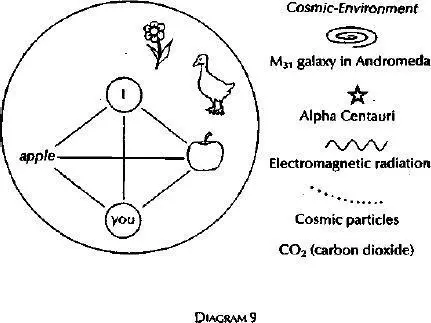
Note some odd things about the self’s world. One is that it is not the same as the Cosmos-environment. The planet Venus may be a sign in the self’s world as the evening star or the morning star, but the galaxy M31 may not be present at all. Another oddity is that the self’s world contains things which have no counterpart in the Cosmos, such as centaurs, Big Foot, détente, World War I (which is past), World War III (which may not occur). Yet another odd thing is that the word apple which you utter is part of my world but it is not a singular thing like an individual apple. It is in fact understandable only insofar as it conforms to a rule for uttering apples. But the oddest thing of all is your status in my world. You — Betty, Dick — are like other items in my world — cats, dogs, and apples. But you have a unique property. You are also co-namer, co-discoverer, co-sustainer of my world — whether you are Kafka whom I read or Betty who reads this. Without you — Franz, Betty — I would have no world.
VII
The world of the sign-user is a world of signs.
The sign, as Saussure said, is a union of signifier (the sound-image of a word) and signified (the concept of an object, action, quality).
If you protest that your world does not consist of signs but rather of apples and trees and people and stars and walking and yellow, Saussure might reply that you don’t know any of these things but only a sensory input which your brain encodes as a percept, then abstracts as a concept which is in turn encoded and “known” under the auspices of language.
Take the sign apple. It consists both of the sound-image apple and also of a kind of general impression of apples you have known, embodying qualities of roundedness, redness, shine, texture, and sound of apple flesh at bite and pop of apple-skin against teeth, tart-tang taste, and so on. *
One’s world is thus segmented by an almost unlimited number of signs, signifying not only here-and-now things and qualities and actions but also real and imaginary objects in the past and future. If I wish to catalogue my world, I could begin with a free association which could go on for months: desk, pencil, writing, itch, Saussure, Belgian, minority, war, the end of the world, Superman, Birmingham, flying, slithy toves, General Grant, the 1984 Olympics, Lilliput, Mozart, Don Giovanni, The Grateful Dead, backing and filling, say it isn’t so, dreaming …
The nearest thing to a recorded world of signs is the world of H. C. Earwicker in Joyce’s Finnegans Wake.
VIII
In a sign, the signifier and the signified are interpenetrated so that the signifier becomes, in a sense, transformed by the signified.
Saussure gave a formal analysis of the dual nature of the sign. It remained for Werner and Kaplan and other writers to describe the dynamic process by which the signifier and signified are interpenetrated and the former transformed.
If you do not believe that the word apple has been transformed by the percept apple, do this experiment: repeat the word apple aloud fifty times. Somewhere along the way, it will suddenly lose its magic transformation into appleness and like Cinderella at midnight become the drab little vocable it really is.
Further evidence of the interpenetration of signifier and signified is false onomatopoeia.
Words like boom, pow, tick-tock are said to be onomatopoetic. But what about these words: spatter, slice, brittle, limber, blue, yellow, high, low, rattle? Many people would say that there is some resemblance between these words and the things they signify. Blue sounds more like blue than yellow. Brittle sounds brittler than limber. But there is no such resemblance. Or rather, what resemblance there is, is far more remote and problematical than it appears. The resemblance occurs because the signifier and signified have been interpenetrated through use by the sign-user.
Slimy does not sound slimy to a German speaker.
IX
Signs undergo an evolution, or rather a devolution. *
At first, the signifier serves as the discovery vehicle through which the signified is known, e.g., Helen Keller discovering water through water —or any two-year-old learning the name of a new object — Peirce’s example:
BOY: What is that?
FATHER: That is a balloon.
Note that when a child hears a new name, he will repeat it; his lips will move silently while he frowns and muses as he considers how this round inflated object can be fitted into this peculiar utterance, balloon.
Next, the signifier becomes transformed by the signified: the signifier balloon becomes informed by the distention, the stretched-rubber, light, uptending, squinch-sound-against-fingers signified.
Читать дальшеИнтервал:
Закладка:
Похожие книги на «Lost in the Cosmos»
Представляем Вашему вниманию похожие книги на «Lost in the Cosmos» списком для выбора. Мы отобрали схожую по названию и смыслу литературу в надежде предоставить читателям больше вариантов отыскать новые, интересные, ещё непрочитанные произведения.







Обсуждение, отзывы о книге «Lost in the Cosmos» и просто собственные мнения читателей. Оставьте ваши комментарии, напишите, что Вы думаете о произведении, его смысле или главных героях. Укажите что конкретно понравилось, а что нет, и почему Вы так считаете.