Shakespeare
Здесь есть возможность читать онлайн «Shakespeare» весь текст электронной книги совершенно бесплатно (целиком полную версию без сокращений). В некоторых случаях можно слушать аудио, скачать через торрент в формате fb2 и присутствует краткое содержание. Год выпуска: 2005, ISBN: 2005, Жанр: Биографии и Мемуары, на английском языке. Описание произведения, (предисловие) а так же отзывы посетителей доступны на портале библиотеки ЛибКат.
- Название:Shakespeare
- Автор:
- Жанр:
- Год:2005
- ISBN:978-0-307-49082-7
- Рейтинг книги:5 / 5. Голосов: 1
-
Избранное:Добавить в избранное
- Отзывы:
-
Ваша оценка:
Shakespeare: краткое содержание, описание и аннотация
Предлагаем к чтению аннотацию, описание, краткое содержание или предисловие (зависит от того, что написал сам автор книги «Shakespeare»). Если вы не нашли необходимую информацию о книге — напишите в комментариях, мы постараемся отыскать её.
Shakespeare — читать онлайн бесплатно полную книгу (весь текст) целиком
Ниже представлен текст книги, разбитый по страницам. Система сохранения места последней прочитанной страницы, позволяет с удобством читать онлайн бесплатно книгу «Shakespeare», без необходимости каждый раз заново искать на чём Вы остановились. Поставьте закладку, и сможете в любой момент перейти на страницу, на которой закончили чтение.
Интервал:
Закладка:
In the years between 1604 and 1608 Wilkins wrote other works of a popular nature, among them plays and prose narratives. The King’s Men had performed his The Miseries of Inforst Mariage in the year before, so the connection between him and Shakespeare was already there. Wilkins wrote the first sections of Pericles , and parts of the other acts, while Shakespeare wrote the rest. It should also be noted here, given the fact that Pericles has often been considered to be a “Catholic” play, that Wilkins himself adhered to the old faith.
It might be wondered why the older and much more famous dramatist would condescend to work with a tyro. But Shakespeare was a man of the theatre. He was competent and practical, no doubt ready to work with anyone for the good of the company. It is not at all likely that the collaborators sat down together with their principal sources, Gower’s Confessio Amantis and Laurence Twine’s The Patterne of Painefulle Aduentures , before sharing out the plot of Pericles . It is much more likely that Wilkins suggested the idea of the play and himself devised the plot. His earlier venture with the King’s Men had been relatively successful, and he was already trying his hand at prose romances. The company might have considered him to be a promising dramatist. After essaying a first version of Pericles , however, he may have discovered himself to be unequal to the task. He may have been in trouble with the authorities, or even briefly imprisoned. He may simply have run out of invention. So the work was handed to Shakespeare for completion. Shakespeare could on occasions act as a superior “play doctor” bringing together all the themes and strands of a plot. His imagination seems, in fact, to have been quickened by the last sections of Pericles , in which the restoration of Marina and the resolution of family loss are the important motifs. He added significantly to these scenes, and tended to leave the earlier stage business as it was. Since the play was extraordinarily popular, he made the right decision.
The prospect of Wilkins being arrested or imprisoned is no biographical fantasy. George Wilkins was a tavern-keeper and brothel-owner whose establishment was on the corner of Turnmill Street and Cow Cross Street. At the beginning of the twenty-first century, the site is still that of a flourishing public house. Wilkins had a reputation for violence and was regularly cited in the proceedings of Middlesex sessions court, particularly for assaults against the young female prostitutes whom he employed. He was accused, for example, of “kikkinge a woman on the Belly which was then greate with childe.” 7One of the guarantors of Wilkins on this occasion was Henry Gosson, of St. Lawrence Pountney; it was Gosson who issued the play of Pericles in quarto form. It seems probable that Wilkins obtained the play for him from the King’s Men. Since he had written much of it, he may have had some claim to proprietorship. It might be added that, at a later date, Wilkins was convicted of being a thief and of harbouring criminals in his inn.
Shakespeare may also have been acquainted with Wilkins’s father, a poet and well-known Londoner, who had died of the plague five years before. But it is also likely that Shakespeare encountered Wilkins through the agency of the Mountjoys; when the daughter of the house married one of the apprentices, Stephen Belott, the young couple became tenants of Wilkins at his inn on the corner of Turnmill Street. Belott himself had been well acquainted with Wilkins, and had eaten meals at his establishment. It was the most notorious of all London quarters, filled with brothels and cheap taverns, but it was also one of the most interesting. This was the world in which Shakespeare encountered his collaborator. It is not unusual to find Shakespeare in what might be called “low” company – he has been discovered before with the landladies of Southwark in an affray – and it is not even occasion for surprise. Even when wealthy and successful, he fitted himself to any kind of society.
PART IX Blackfriars
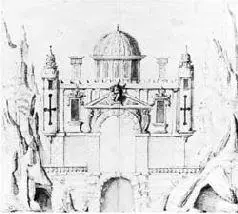
Ben Jonson’s Oberon, the Fairy Prince (1611): designs by Inigo Jones. The style and staging of plays changed with the move to “indoors” theatres such as Blackfriars.
CHAPTER 82. As in a Theatre the Eies of Men
Since the doors of the playhouses were shut for eighteen months, from the summer of 1608, it may seem a strange time for the King’s Men to be engaged in a very expensive theatrical speculation. Nevertheless at the beginning of August 1608, just when the theatres had closed down, Shakespeare and six of his colleagues leased the Blackfriars Theatre for a period of twenty-one years. The Children of the Chapel Royal had been disbanded, after a particularly contentious production that had scandalised the French Ambassador, and so their venue was available for hire.
Each “sharer” among the King’s Men paid a seventh part of the annual rent of £40 to Cuthbert Burbage. There was also the cost of necessary repairs. Very little had been done during the last years of the childrens’ occupancy, and the playhouse “ran far into decay for want of reparations.” 1It may have seemed a tempting prospect, but the King’s Men must also have had great faith in the long-term financial health of the London drama. It may be that they were also trying to circumvent the ban on public playing at a time of plague by using a “private” playhouse; there is a note of a reward from the king in January 1609 “for their private practise in the time of infeccon.” 2This suggests that they did perform plays, under the cover that they were rehearsing for the court dramas of the Christmas season.
Their purchase is in any case a measure of the supremacy of the King’s Men in the London theatre. No adult company had ever leased an indoors theatre, and no adult company had ever before played within the walls of the city. The playhouse was in a wealthy and respectable neighbourhood, too, close to the playgoing members of the Inns of Court. Ben Jonson lived here as did Shakespeare’s friend, Richard Field; it was also a haven of painters’ studios and the workshops of feather-makers. It is also worth observing that no other company had ever boasted the proprietorship of two theatres, or extended itself to the purchase of an indoors “winter” theatre and an outdoors “summer” theatre. As it turned out, the financial gamble of the new “sharers” paid off, and their profit at the Blackfriars playhouse was almost twice that of their profit from the Globe.
The cost of a token at the Blackfriars playhouse was 6 pence for the gallery, contrasted with a penny or 2 pence for the Globe. A shilling purchased a bench in the pit, closer to the level of the stage, and a half-crown bought a box. Gallants and devotees could hire a stool and sit upon the stage for 2 shillings; this was a habit apparently detested by the actors themselves, for obvious reasons, but it seems to have made economic sense. There was no standing room. Yet the Blackfriars Theatre had attractions of its own. Its use of music, in a closed space, was more elaborate. It had indoor illumination, with candles or torches, and was much more appropriate for formal and masque-like effects. The candles were hung from candelabra which could be lowered for “mending” or trimming, but for afternoon performances the windows allowed natural light to enter the proceedings. There was no curtain and there were no “footlights”; the auditorium was as brightly illuminated as the stage.
It has often been suggested that Shakespeare’s dramaturgy changed after the removal to the Blackfriars Theatre, and that he increased the spectacular and the ritual elements of his drama. It is an interesting supposition but of course his use of Blackfriars postdates the highly ritualistic Pericles , which was performed at the Globe; it should also be remembered that in subsequent years his drama was to be seen at the Globe as well as at Blackfriars. There was no sudden or wholesale change in his art. Yet he was a skilful and professional man of the stage, and he made some alterations for the production of his plays in the private theatre. It is even possible that he added songs and music to old “favourites” such as Macbeth . The intimacy of the new theatre, which held some seven hundred spectators instead of the thousands at the Globe, may also have prompted him to make some changes in action and in dialogue. Many of these changes were not noted in the published versions of the plays, and are thus irrecoverable.
Читать дальшеИнтервал:
Закладка:
Похожие книги на «Shakespeare»
Представляем Вашему вниманию похожие книги на «Shakespeare» списком для выбора. Мы отобрали схожую по названию и смыслу литературу в надежде предоставить читателям больше вариантов отыскать новые, интересные, ещё непрочитанные произведения.








Обсуждение, отзывы о книге «Shakespeare» и просто собственные мнения читателей. Оставьте ваши комментарии, напишите, что Вы думаете о произведении, его смысле или главных героях. Укажите что конкретно понравилось, а что нет, и почему Вы так считаете.