Shakespeare
Здесь есть возможность читать онлайн «Shakespeare» весь текст электронной книги совершенно бесплатно (целиком полную версию без сокращений). В некоторых случаях можно слушать аудио, скачать через торрент в формате fb2 и присутствует краткое содержание. Год выпуска: 2005, ISBN: 2005, Жанр: Биографии и Мемуары, на английском языке. Описание произведения, (предисловие) а так же отзывы посетителей доступны на портале библиотеки ЛибКат.
- Название:Shakespeare
- Автор:
- Жанр:
- Год:2005
- ISBN:978-0-307-49082-7
- Рейтинг книги:5 / 5. Голосов: 1
-
Избранное:Добавить в избранное
- Отзывы:
-
Ваша оценка:
Shakespeare: краткое содержание, описание и аннотация
Предлагаем к чтению аннотацию, описание, краткое содержание или предисловие (зависит от того, что написал сам автор книги «Shakespeare»). Если вы не нашли необходимую информацию о книге — напишите в комментариях, мы постараемся отыскать её.
Shakespeare — читать онлайн бесплатно полную книгу (весь текст) целиком
Ниже представлен текст книги, разбитый по страницам. Система сохранения места последней прочитанной страницы, позволяет с удобством читать онлайн бесплатно книгу «Shakespeare», без необходимости каждый раз заново искать на чём Вы остановились. Поставьте закладку, и сможете в любой момент перейти на страницу, на которой закончили чтение.
Интервал:
Закладка:
He was clearly aiming for local respectability as well as prosperity. The corporation of Stratford, however, were not necessarily sympathetic to the sources of his wealth. At the end of this year they formally forbade the performance of plays or interludes in the guildhall. It was a manifestation of the regional Puritanism that affected other districts of the country. The fact that he began to spend more time, and money, in Stratford suggests that he was not much concerned about such matters. His life as dramatist, and his life as townsman, were separate and not to be confused.
Part VIII. The King’s Men
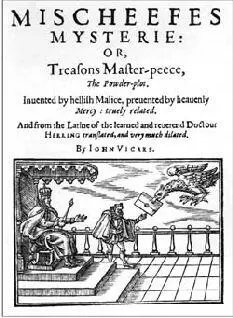
James I depicted on the title page of Mischeefes Mysterie
or Treasons Master-peece, the Powder-plot . Shakespeare’s Macbeth
was written during the aftermath of the attempt by
Robert Catesby with Guy Fawkes and other conspirators
to blow up king and parliament.
CHAPTER 74. Hee Is Something Peeuish That Way
Shakespeare was on stage their last parts before the ageing queen. They performed at Whitehall on 26 December 1602 and at Richmond on 7 February 1603. Six weeks later Elizabeth was dead, worn out by age and power. In the last stages of her life she had refused to lie down and rest but had stood for days, her finger in her mouth, pondering upon the fate of sovereigns. The theatres had been closed five days before her death, since plays were not appropriate in the dying time.
By many, including the imprisoned Southampton, she was considered to be a tyrant who had exercised power for too long. Shakespeare was at the time criticised for writing no encomium on the dead queen – not one “sable teare” dropped from his “honied muse” as part of the national exequies. He had been asked to sing the “Rape” of Elizabeth “done by that Tarquin, Death,” 1with reference to his earlier Rape of Lucrece , but he declined the honour. There was a ballad of the moment exhorting “you poets all” 2to lament the queen. Shakespeare was at the head of the list of the poets invoked, among them Ben Jonson, but he made no response. In truth he had no real reason to mourn the queen’s passing. She had beheaded Essex and several members of Essex’s affinity whom Shakespeare knew very well.
Yet he was not altogether silent. He did produce in this period one work that cogently reflects the somewhat rancid and fearful atmosphere at the court of the dying queen. It was not an exequy, but a play entitled Troilus and Cressida in which all the certainties and pieties of court life are treated as material for jest and black humour. It has been surmised that the failure of the Essex rebellion in 1601 helped to create the atmosphere of gloom and discomfiture that pervades the play. It has even been suggested that there are allusions to the Earl of Essex within the text, where he is to be seen as Achilles skulking in his tent. There have been traced parallels among the other Greeks with various members of Elizabeth’s ancien régime such as Cecil and Walsingham – but one hypocritical and self-serving courtier looks very much like another.
It is unlikely that the censor would have forbidden publication of the play, in any case, since it is set in the ancient and mythical period surrounding the fall of Troy. It was a period favoured by Elizabethan poets and dramatists, and only four years before George Chapman’s translation of seven books of Homer’s Iliad had been published. Yet the publisher of Troilus and Cressida in the Stationers’ Register, James Roberts, is given the right to print “when he hath gotten sufficient aucthority for yt,” an unusual phrase that suggests some problem with its licensing.
The legend of Troy was one of the most popular of all the classical stories that circulated in Elizabethan England; it was the stuff of Homer and of Virgil. London itself was considered by many antiquarians to be New Troy, “Troynovaunt,” founded by the lineage of the refugees from the fallen city. Yet in Troilus and Cressida Shakespeare sets out deliberately to subvert the legends. It is a play in which the orthodox pieties of Trojan courage and Greek valour are quite overturned, revealing a callous, brutal and hypocritical reality underlying the acts of both sides. There are no values except those that are traded by time and fashion; traded is here the operative word, since every value is a commodity to be bought and sold in the market-place. This may indeed be a form of displaced patriotism. Shakespeare was prohibited from lamenting the condition of his own country on the London stage, but the presentation of the ancient world was treated with considerable leniency by the censors. What could be more natural than to vent his conservative fury in a safer context?
Troilus and Cressida is a savage and satirical comedy upon the themes of love and war, treating them both as false and fickle. The love between Troilus and Cressida is exposed as counterfeit, or temporary, when Cressida is seduced by a Greek warrior. It is in part Shakespeare’s revision of Chaucer’s poem Troilus and Criseyde , in which he supplants medieval grace and good humour with the language and vocabulary of a harsh and unsettled time. The diction itself is highly Latinised, with many “hard” words as well as an odd or convoluted syntax. As in Julius Caesar Shakespeare wished to give the verbal impression of an alien and classical world, and it is not too much to speculate that in Troilus and Cressida he tried to make English resemble what he considered to be Greek. He may also have been trying to rival Chapman’s translations of Homer. It has been remarked that his was an envious muse. He had to outdo Chaucer as well as Chapman, to rewrite the heroic myth of the Greeks and the Romans.
But in Troilus and Cressida the pertinence of satire and sarcasm, raillery and buffoonery, cannot be doubted. It is unlikely to have been performed in the queen’s presence, but it was played at the Globe. The entry in the Stationers’ Register states that the play will be “as yt is acted by my Lord Chamberlens Men” and the printed version, published some six years later, declares that this is the play “as it was acted by the Kings Maiesties seruants at the Globe.” So Troilus and Cressida was played during the reign of Elizabeth, and during the succeeding reign of James I. This suggests that it was a popular play, perhaps pandering to the popular dislike of the Greeks as opposed to the Trojans who were the presumed ancestors of Londoners. It has been argued that at some point it was performed at one of the Inns of Court. 3A prologue and an epilogue were composed for that occasion, the latter of which has a private air of salaciousness. This would account for an “epistle” written for the quarto version in which the play is described as “a new play, neuer stal’d with the Stage, neuer clapper-clawd with the palmes of the vulgar” or “the smoaky breath of the multitude.” If Shakespeare had revised the play for the particular delectation of a legal audience, then it could pass by convenient fiction as a “new play”.
Nevertheless it remains Shakespeare’s most savage drama, with the possible exception of Timon of Athens , and has prompted more romantic biographers into assuming that the dramatist suffered some kind of “nervous breakdown” in the middle of composition. Nothing could be further from the truth. He was never more sharp-eyed. There is a slight confusion among his publishers, however. The quarto edition describes it as a “Historie” but the “epistle” to that quarto refers to it as a comedy; in turn the later Folio version refers to it as a “Tragedie.” This suggests some uncertainty concerning its final or ultimate tone.
Читать дальшеИнтервал:
Закладка:
Похожие книги на «Shakespeare»
Представляем Вашему вниманию похожие книги на «Shakespeare» списком для выбора. Мы отобрали схожую по названию и смыслу литературу в надежде предоставить читателям больше вариантов отыскать новые, интересные, ещё непрочитанные произведения.






Обсуждение, отзывы о книге «Shakespeare» и просто собственные мнения читателей. Оставьте ваши комментарии, напишите, что Вы думаете о произведении, его смысле или главных героях. Укажите что конкретно понравилось, а что нет, и почему Вы так считаете.