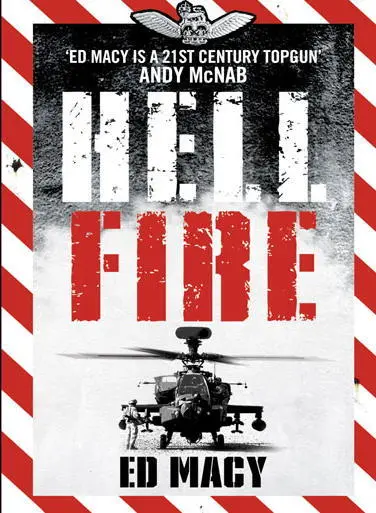
Ed Macy - Hellfire
Здесь есть возможность читать онлайн «Ed Macy - Hellfire» — ознакомительный отрывок электронной книги совершенно бесплатно, а после прочтения отрывка купить полную версию. В некоторых случаях можно слушать аудио, скачать через торрент в формате fb2 и присутствует краткое содержание. Город: London, Год выпуска: 2009, ISBN: 2009, Издательство: HarperPress, Жанр: Биографии и Мемуары, nonf_military, на английском языке. Описание произведения, (предисловие) а так же отзывы посетителей доступны на портале библиотеки ЛибКат.
- Название:Hellfire
- Автор:
- Издательство:HarperPress
- Жанр:
- Год:2009
- Город:London
- ISBN:978-0-007-34292-1
- Рейтинг книги:3 / 5. Голосов: 1
-
Избранное:Добавить в избранное
- Отзывы:
-
Ваша оценка:
Hellfire: краткое содержание, описание и аннотация
Предлагаем к чтению аннотацию, описание, краткое содержание или предисловие (зависит от того, что написал сам автор книги «Hellfire»). Если вы не нашли необходимую информацию о книге — напишите в комментариях, мы постараемся отыскать её.
Ed Macy bent every rule in the book to get to where he wanted to be: on Ops in the stinking heat of the Afghan summer, with the world’s greatest weapons system at his fingertips. It’s 2006 and he is part of an elite group of pilots assigned to the controversial Apache AH Mk1 gunship programme. So far, though, the monstrously expensive Apache has done little to disprove its detractors. For the first month ‘in action’ Ed sees little more from his cockpit than the back end of a Chinook.
But everything changes in the skies over Now Zad. Under fire and out of options, Ed has one chance to save his own skin and those of the men on the ground. Though the Apache bristles with awesome weaponry, its fearsome Hellfire missile has never been fired in combat. Then, in the blistering heat of the firefight, the trigger is pulled.
It’s a split-second decision that forever changes the course of the Afghan war, as overnight the gunship is transformed from being an expensive liability to the British Army’s greatest asset. From that moment on, Ed and his squadron mates will face the steepest learning curve of their lives – fighting an endless series of high-octane missions against a cunning and constantly evolving enemy. Ed himself will have to risk everything to fly, fight and survive in the most hostile place on earth.
http://www.youtube.com/watch?v=LNP1lbLNKqA
Hellfire — читать онлайн ознакомительный отрывок
Ниже представлен текст книги, разбитый по страницам. Система сохранения места последней прочитанной страницы, позволяет с удобством читать онлайн бесплатно книгу «Hellfire», без необходимости каждый раз заново искать на чём Вы остановились. Поставьте закладку, и сможете в любой момент перейти на страницу, на которой закончили чтение.
Интервал:
Закладка:
All threat data were processed by a central computer which, having computed the type, range and bearing of the threat, would then decide the best countermeasure to defeat it. There were three switch settings in the cockpit – manual, semi-automatic and automatic – which allowed the pilot to decide what level of autonomy he wanted to confer on the system. We were assured, however, that it worked extremely effectively in automatic mode and that, by and large, it was best to leave the system, not the pilot, to decide what kind of countermeasures to dispense and when.
Like HAL, the computer in 2001: A Space Odyssey , the HIDAS’s (female) Voice Warning System (VWS) would alert the crew to any given threat. The information would also be displayed on one of the two multi-purpose displays; there were two MPDs in each cockpit – TV screens used to display flight, critical mission data and targeting images. Imminent threats – prioritised at any given moment – were displayed in positions relative to the aircraft.
It was probably inevitable that the VWS had already earned herself a nickname: Bitchin’ Betty.
Before I could ‘graduate’ from the course, I had to take an exam – and it wasn’t your average GCSE. We were to mount a national evacuation operation from an island – whose geography resembled Sicily-embroiled in civil unrest. Some Brits had been taken hostage. I was the commander of a force tasked to fly in, free them and fly them out.
Using the knowledge I’d amassed over the previous few months, I decided to mount an operation using Apaches, EA-6Bs, a B-2 Stealth Bomber and a C-130.
I jammed the island’s surveillance radars with the EA-6Bs and sent in the Apaches to take out the coastal radars. The B-2, so stealthy that it was largely invisible to radar anyway, then dropped a stick of satellite-guided 2,000-lb Joint Direct Attack Munition (JDAM) bombs on the command centres. Amidst the chaos, Special Forces were airdropped in to rescue the hostages. Once they had safely ex-filtrated the danger zone, I sent in the C-130 low level over the sea, chaperoned by Apaches, to airlift them out.
I now had an intuitive feel for how EW could master the battlefield. Although it wasn’t a dedicated EW platform – unlike the EA-6B – the Apache was stuffed with so much electronic wizardry that it would enable the Army Air Corps to do things with helicopters it had never dreamed of before.
I did my EW instructor’s course in early 2001. With the arrival of the first Apaches in-country, there was a buzz about our quantum leap in capability. Even though I’d only ever sat in one once, nearly ten years earlier, I felt I was really beginning to know this machine, to understand how it worked.
I began a war of attrition on 3 Regiment’s Adjutant to get posted 200 miles further north, to Dishforth in North Yorkshire, the future home of the Apache. He wasn’t up for it and neither were the pen-pushers in Glasgow, but bull-headed perseverance finally got me within reach of the man I’d last crossed swords with during the finale of BATUS, Lieutenant Colonel Iain Thomson.
On the day of my interview, I popped in to pay my respects to the commander of 656 Squadron, who tipped me the wink that Tommo was in ebullient mood; he was still riding high on the news that his regiment had been selected to receive the most important piece of kit the army had procured in years. But while CO’s interviews were scheduled to last twenty minutes, I’d be lucky to get ten.
I knocked on his office door. There was a growl from within and I entered. Tommo barely glanced up as I snapped a salute.
‘Sit down, Mr Macy,’ he said. ‘Still bending the rules, are we?’
I said nothing, just prayed he wasn’t going to fob me off with a Lynx conversion course.
Tommo got up from behind his desk and strolled over to the window, hands behind his back. This was it: Win or lose time. I had to make every shot count.
I took a deep breath and told him what I’d been up to in the months since I’d last seen him, what I’d learned at every level of my recent training, and the ideas I’d developed about Air Combat Tactics.
There were moments when he responded as if I was talking Swahili, but when I finally shut up his eyes shone. A week later I was making a PowerPoint presentation to the boss of Joint Helicopter Command (JHC), an amalgam of all the helicopter activity undertaken by the British Army, the Royal Navy and the Royal Air Force. Three days after that I ran through the presentation again for the Director of Army Aviation.
We ended up with a plan to establish a ‘purple’ ACT Instructor’s course; a course with a dual objective – to teach pilots of unarmed helicopters like the Gazelle and Chinook how to get into a furball and survive, and to teach gunship pilots the new world order.
THE HUNTER
At the end of 2001, Tommo fired out a questionnaire to all pilots in 9 Regiment: who didn’t want to do the Apache course and why? Surprisingly, not everybody was keen. I guess some thought, why do I want to go and learn all this new stuff, when I’m already at the top of the tree? The money’s coming in, the wife’s happy…
Not me. I couldn’t wait.
The first Apache arrived at Middle Wallop in the summer of 2002 and the list of those selected for the Apache Conversion To Type (CTT) course number one was posted in Regimental Headquarters. My name was on it. There were twenty-one pilots earmarked for CTT1, one of whom would be the new CO, Lieutenant Colonel Richard Felton. So that left twenty operational pilots for 656 Squadron’s eight Apaches, enough for five flights: HQ Flight with the boss, Ops Officer and two QHIs, and four more, each manned by a flight commander, a specialist and two others.
With two seats in each bird, the minimum they needed was sixteen; in other words, not all of us would make it.
I knew that ten years’ flying experience didn’t mean I was a shoe-in. The Apache was an immensely complex machine to master; I needed to make myself indispensable. I had ticked the EW Officer box, but I had my eye on the Weapons Officer’s course. It could lead to the sexiest job in Army aviation: Squadron Weapons Officer – guns, rockets and missiles; right up my street – and the more I learned now, the better.
Three of us from 656 were assigned to a bespoke Apache Weapons Officer’s course. My old mate Scottie would be there; he was going to become the Weapons Instructor for 673 Apache Training Squadron at Middle Wallop. It was billed as the most in-depth course we had ever attempted. If we managed to jump through every hoop, we’d end up advising on Apache weapons tactics to senior officers, teaching weapons and firing techniques to Apache aircrew, planning and running Apache live firing ranges, and designing and running Apache weapons missions in the Boeing simulators.
Captain Paul Mason started the first day as he meant to go on-grilling us on what we knew. I’d learned shit-loads and was keen to show him. There was no pass mark, thank God; we realised we actually knew jack-shit. I think I got my name right and that was about it.
Paul was the Apache weapons guru. A good-looking lad from the north-east, he wasn’t physically imposing, but boy, did he walk tall. He’d studied weapons, sights and sensors in the USA and decided there and then to rewrite the rulebook. This horrendously complex course was his baby.
It sounded as though it would take us half a lifetime to develop sufficient understanding to even come within reach of the hardware. He left us in no doubt that to become a weapons, sights and sensors instructor on this aircraft we would need a level of knowledge so comprehensive our brains would feel like they were about to explode. I immersed myself totally and quickly discovered what he meant.
Читать дальшеИнтервал:
Закладка:
Похожие книги на «Hellfire»
Представляем Вашему вниманию похожие книги на «Hellfire» списком для выбора. Мы отобрали схожую по названию и смыслу литературу в надежде предоставить читателям больше вариантов отыскать новые, интересные, ещё непрочитанные произведения.




Обсуждение, отзывы о книге «Hellfire» и просто собственные мнения читателей. Оставьте ваши комментарии, напишите, что Вы думаете о произведении, его смысле или главных героях. Укажите что конкретно понравилось, а что нет, и почему Вы так считаете.