Robert Mason - Chickenhawk
Здесь есть возможность читать онлайн «Robert Mason - Chickenhawk» весь текст электронной книги совершенно бесплатно (целиком полную версию без сокращений). В некоторых случаях можно слушать аудио, скачать через торрент в формате fb2 и присутствует краткое содержание. Город: New York, Год выпуска: 2005, ISBN: 2005, Издательство: Penguin Books, Жанр: Биографии и Мемуары, nonf_military, на английском языке. Описание произведения, (предисловие) а так же отзывы посетителей доступны на портале библиотеки ЛибКат.
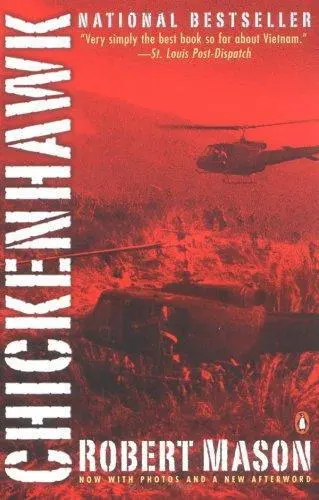
- Название:Chickenhawk
- Автор:
- Издательство:Penguin Books
- Жанр:
- Год:2005
- Город:New York
- ISBN:9780143035718
- Рейтинг книги:4 / 5. Голосов: 1
-
Избранное:Добавить в избранное
- Отзывы:
-
Ваша оценка:
Chickenhawk: краткое содержание, описание и аннотация
Предлагаем к чтению аннотацию, описание, краткое содержание или предисловие (зависит от того, что написал сам автор книги «Chickenhawk»). Если вы не нашли необходимую информацию о книге — напишите в комментариях, мы постараемся отыскать её.
have been sold since it was first published in 1983. Now with a new afterword by the author and photographs taken by him during the conflict, this straight-from-the-shoulder account tells the electrifying truth about the helicopter war in Vietnam. This is Robert Mason’s astounding personal story of men at war. A veteran of more than one thousand combat missions, Mason gives staggering descriptions that cut to the heart of the combat experience: the fear and belligerence, the quiet insights and raging madness, the lasting friendships and sudden death—the extreme emotions of a “chickenhawk” in constant danger.
Robert Mason enlisted in the army in 1964 and flew more than 1,000 helicopter combat missions before being discharged in 1968. [
]’s vertical plunge into the thickets of madness will stun readers.
(
) Mason’s gripping memoir… proves again that reality is more interesting, and often more terrifying, than fiction.
(
) Very simply the best book so far out of Vietnam.
(
)
Chickenhawk — читать онлайн бесплатно полную книгу (весь текст) целиком
Ниже представлен текст книги, разбитый по страницам. Система сохранения места последней прочитанной страницы, позволяет с удобством читать онлайн бесплатно книгу «Chickenhawk», без необходимости каждый раз заново искать на чём Вы остановились. Поставьте закладку, и сможете в любой момент перейти на страницу, на которой закончили чтение.
Интервал:
Закладка:
We wanted to climb to 3000 feet, but during the thirty-mile flight I got no higher than half that altitude. As we lumbered along, I realized we were so heavily loaded that an autorotation would be a lot rougher than anyone would like when carrying more than a ton of high explosives.
The one factor that was actually improving as we la bored along was that we were burning a bunch of fuel. The ship would be lighter for the running landing I was prepared to make at our destination.
At the camp we were going to, the commander had left the job of picking the landing spot to a sergeant especially schooled in the workings of the aviation branch. However, this sergeant was not around, so the job of picking the spot had passed to his assistant, who, although he looked as though he knew what he was doing, didn’t.
We made a long, very gentle descent toward the camp.
I spotted the assistant. He had his arms held high, indicating the grassy strip near the forward edge of the camp. It looked as though the spot he was pointing to was just outside the stretched-out coil of concertina-wire fence that ran between the perimeter of the camp and the nearby trees. There was enough room to land, so I didn’t question his judgment.
As I got closer, lower, and slower, I brought in the power. It would take all we had just to cushion the impact.
I crossed the small wall of trees that ringed the camp, and flared. I was six feet over the grass outside the fence when I heard a panicky voice in my earphones.
“Don’t land there!” the voice screamed. “That’s a mine field!”
“Minefield!” Even Leese was impressed.
If Leese was impressed, I was petrified. The Huey was mushing inexorably toward the ground. I was too low to extend my landing beyond the fence. I pulled the collective to my armpit and waited for the noise. The Huey, God bless it, came to a shuddering, engine-wrenching hover just inches from the ground. The low-rpm warning siren blared in my ears, and for a few horrible seconds I wondered if it could hold the hover. The engine was bogging down with the strain. I had to reduce the power or lose it, so I reduced the collective a bit to let the ship drift down closer and give the turbine a chance to wind up a little. When the skids almost touched the grass, the siren stopped and the rpm slowly returned. When it finally stabilized, I hauled it slowly back up to about six inches above the minefield.
Reacher’s illegal tune-up had just saved us, but we still had a problem. The four-foot fence in front of us was too high to get over, and the trees behind us blocked any retreat.
“Well, at least we can stay off the ground,” said Leese.
We were, from my point of view, 2500 pounds of high explosives tearing at the air to stay away from the high explosives under us.
We could just stay there, hanging, until we got lighter, but there was the problem of getting shot at near the edge of the camp, and neither of us knew how long the Huey—even Reacher’s Huey—could grind away like this at full power. And we couldn’t dump the cargo.
I pulled in more power, and the Huey climbed another foot, but when it got that much farther out of the ground cushion, the engine strained and the ship settled back down toward the grass. I tried it a few more times and discovered that while it settled back down from the climb, I could milk a few more rpm out of the engine. In this way, I figured I could use the little extra power gained on the way down to pull it a little higher on the next try. I did this over and over, floating a little higher each time.
This technique, and the fact that we were getting lighter by burning fuel, finally allowed me to get the skids fence-high. But when I tried to cross the fence from the top of a bounce, the Huey sank too fast. By moving forward, I had moved out of the ground cushion.
What now? I had Reacher look behind us. He said there was another row of concertina wire about fifty feet behind us. I hadn’t even noticed that. My hope was that by backing up a little, I could get some room for a forward run to clear the hurdle. So I backed up as far as Reacher could clear me, and went for it. No good. I was within a foot of making it, but I had to flare to a stop before I tangled up in the wire. I drifted backward to resume my low hover over the mines.
Leese said, “Try a right-pedal turn.”
Perfect. That’s why Leese had lived to fly through two wars. He understood his machines. The pedals control the anti-torque rotor, the tail rotor. Turning to the right—with the torque—would make more power available to the main rotors.
So I backed up again. Instead of charging straight ahead, I hovered parallel to the fence for a few feet and then banked hard right toward it. It worked! This was the extra boost I needed to clear the trap.
I kept turning as I crossed the fence and landed sideways on the other side. Drenched with sweat, I felt as though I had just flown the Atlantic with my arms.
“Not bad,” said Leese as we landed on the safe side of the concertina wire. “Now, I hope that this has taught you a lesson.” His voice was calm.
“Lesson?” I said weakly. “What lesson?”
“Never trust a grunt,” he said.
That night at the Turkey Farm we were not allowed to go into the village. Somebody had been stealing from the adviser compound again. There were complaints about a missing refrigerator.
After my first night in that miserable tent, I moved to the Big Top, where I built a kind of bunk—a shelf, really—to sleep on. I used the wood from some old ammo crates. I put my leaky air mattress on top and set it in a corner of the airy tent. Several other guys did the same; it was cooler and drier than the tents we had with us.
Since we couldn’t go to town, we sat at a long wooden table in the Big Top, playing chess and listening to the radio. We were listening to Hanoi radio, the best music on the dial. Every night the news was broadcast on this station by Hanoi Hanna. There was more than one woman who announced the news, but we called them all by one name. We wanted to believe she was another Tokyo Rose.
Hanna, for the first time in nearly three months, mentioned our unit by name. She said that it was too bad about us, poor guys, but we were going to get mortared at midnight.
We all looked at each other and laughed. Bullshit. Heh heh heh.
“Hey, I was thinking of digging a hole anyway. Weren’t you?”
Minutes after her announcement, digging foxholes became a popular pastime. Dirt flew. The rule that forbade the digging of holes that would ruin the grass was ignored. The men inside the Camp Holloway compound slept behind sandbag walls and had bunkers to duck into if the mortars came. But camped out in their front yard, so to speak, we suddenly felt very exposed.
The red ground at our campsite was so dry and hard that the holes weren’t even waist deep by midnight. When the predicted hour came and went without incident, the digging slowed down. I dug mine near the end of my bunk, and it was one of the deepest.
Mortars came, not at the Turkey Farm, but at our refueling depot at the Tea Plantation. Of all the mortars that hit in that attack, one lousy little mortar landed right in the middle of the tent where our refueling crew slept. Seven people, including three privates from our company, were killed. We comforted ourselves by saying that they never knew what hit them.
The next morning at our briefing, we learned that the French owner of the real tea plantation next door had complained.
“To the VC?” Connors asked from the back of our crowd of forty pilots assembled in the Big Top.
“No, not to the VC, to us,” said Williams. “He says that our being so close to his farm is going to cause him damage. He wants us to move the refueling depot and the troops.”
Читать дальшеИнтервал:
Закладка:
Похожие книги на «Chickenhawk»
Представляем Вашему вниманию похожие книги на «Chickenhawk» списком для выбора. Мы отобрали схожую по названию и смыслу литературу в надежде предоставить читателям больше вариантов отыскать новые, интересные, ещё непрочитанные произведения.









Обсуждение, отзывы о книге «Chickenhawk» и просто собственные мнения читателей. Оставьте ваши комментарии, напишите, что Вы думаете о произведении, его смысле или главных героях. Укажите что конкретно понравилось, а что нет, и почему Вы так считаете.