Wesley Gray - Embedded
Здесь есть возможность читать онлайн «Wesley Gray - Embedded» весь текст электронной книги совершенно бесплатно (целиком полную версию без сокращений). В некоторых случаях можно слушать аудио, скачать через торрент в формате fb2 и присутствует краткое содержание. Город: Annapolis, MD, Год выпуска: 2009, ISBN: 2009, Издательство: Naval Institute Press, Жанр: Биографии и Мемуары, nonf_military, на английском языке. Описание произведения, (предисловие) а так же отзывы посетителей доступны на портале библиотеки ЛибКат.
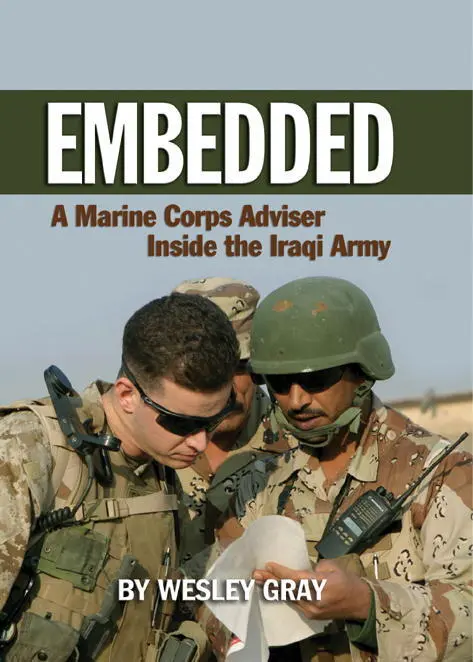
- Название:Embedded
- Автор:
- Издательство:Naval Institute Press
- Жанр:
- Год:2009
- Город:Annapolis, MD
- ISBN:978-1-61251-406-2
- Рейтинг книги:5 / 5. Голосов: 1
-
Избранное:Добавить в избранное
- Отзывы:
-
Ваша оценка:
Embedded: краткое содержание, описание и аннотация
Предлагаем к чтению аннотацию, описание, краткое содержание или предисловие (зависит от того, что написал сам автор книги «Embedded»). Если вы не нашли необходимую информацию о книге — напишите в комментариях, мы постараемся отыскать её.
What he encountered was an insurgent fire pit recently traumatized by the infamous “Haditha Massacre,” in which 24 Iraqi civilians—men, women and children—were shot at close range by U.S. Marines at close range in retaliation for the death of a Marine lance corporal in a roadside bombing. Despite the tensions triggered by the shootings, Gray was able to form a bond with the Iraqi soldiers because he had an edge that very few U.S. service members possess ¾ the ability to communicate because of his proficiency in Iraqi Arabic. His language skills and deep understanding of Iraqi culture were quickly recognized by the Iraqi soldiers who considered him an Arab brother and fondly named him “Jamal.”
By the end of his advisor tour, he was a legend within the Iraqi Army. During his time in Iraq, Wes kept a detailed record of his observations, experiences, and interviews with Iraqi citizens and soldiers in vivid and brutally honest detail. Ranging from tension filled skirmishes against the insurgents to insights into the dichotomy between American and Iraqi cultures, he offers a comprehensive portrait of Iraq and the struggles of its people and soldiers to stand up and make their country a nation once again. His book is a Marine intelligence officer’s compelling report about the status and prospects of America’s strategy for success in Iraq.
Embedded — читать онлайн бесплатно полную книгу (весь текст) целиком
Ниже представлен текст книги, разбитый по страницам. Система сохранения места последней прочитанной страницы, позволяет с удобством читать онлайн бесплатно книгу «Embedded», без необходимости каждый раз заново искать на чём Вы остановились. Поставьте закладку, и сможете в любой момент перейти на страницу, на которой закончили чтение.
Интервал:
Закладка:
Unfortunately, coalition forces have little to no Arabic-speaking capability. I also had a solution for this problem. I planned to translate various communications templates the Marines use, such as IED nine-line reports and enemy contact reports (SALUTE report). When the Iraqis needed support, they would fill out their template and send the message in Arabic back to the Iraqi COC. The terps would translate this message and hand it off to a Marine adviser, who would call on support from the Marines.
I pitched the plan to nearly everyone who would listen. I spent weeks going to every Iraqi officer’s swahut to get advice on how to make the plan better. All of them were extremely enthusiastic about the opportunity to actually be free men and lead their own battalion versus being micromanaged by our MiTT. Everyone on the adviser team was enthusiastic with the plan as well. Sadly, the only person who had a problem with the idea was the boss—the one person we needed on board to make this work.
While I was not able to convince the boss, I had a good idea: Maj. Gen. Rick Zilmer, the Multi-National Forces West commander, agreed to help me out. The newest guidance required us to “make all efforts and accept more risk in order to ensure Iraqis are being given the chance to take the lead on operations.” After seeing the general’s new guidance, the boss gave me approval to kick my plan into gear.
The next day I woke up around 0630 after sleeping a few hours. Despite being tired, I was super motivated. I planned to sit down with Lieutenant Ahmed, the acting S3 operations officer, and start working on the convoy transition plan. This would be my chance to change the direction of our MiTT and do something that helped the Iraqis become an independent organization so we could get the hell out of this country.
Ahmed and I had an outstanding relationship. I sat down with him for about three hours discussing how we could implement the convoy transition plan. We accomplished in three hours what MiTT teams had been trying to accomplish over the past two years—transition security operations duties over to the Iraqis. We both felt like we had accomplished something. I took his ideas, he took mine, and in the end we had something that would make the Iraqi army more capable. At the end of our meeting I smiled at Ahmed and said, “We should be on a military advising brochure—that was too easy.” Ahmed replied, “No Jamal, you make it easy. You understand how we operate.”
It’s amazing how critically important personal relationships are in Iraq. With good relationships you can manipulate an Iraqi to give you his only daughter; with poor relationships you would be hard-pressed to get an Iraqi to let you wash his dirty underwear. The system is a bit difficult to maneuver, but if you master it, the world is yours.
I am still on the fence as to whether I like the Iraqi system of relationships better than I like ours. On the one hand the Western system of friendship is much more efficient, timely, and facilitates our society’s ability to have a great economy and get things done. On the other hand the Iraqi system, while arguably less efficient and more time consuming, is more user friendly. Iraqis are better at developing relationships that actually mean something. In Iraqi society you run into either “brothers” or people you have never met before; there are no “contacts.” I respect the recondite friendships Iraqis develop. There is not that much to love about Iraqi culture, but every so often these people surprise me.
Release the Hounds
We finally cut the leash on the Iraqis. Lieutenant Abdulredha, a competent Iraqi officer, presented his convoy order brief flawlessly. We rehearsed the brief at 0600 so he would have confidence in front of his men. At the end of the brief Major Pyle was stunned. “Gentlemen,” he said, “that was the best brief I have ever seen from the Iraqis. I am excited to see what you can do.” I was even more impressed; I thought the brief rivaled some of the best briefs I had ever seen—Marine or Iraqi.
At the conclusion of Abdulredha’s order to his men, I walked in front of the group of Iraqi warriors and addressed them in the best Arabic I could muster. “My brothers, this is your opportunity to lead the Iraqi army. We all know it is difficult to work with our MiTT, because many of the Marines want you to do everything their way. This time is different. You now have the chance to do it your way if you can prove to Major Pyle that you have the ability. I have confidence in all of you. I know you can operate independently.” I paused, looking from face to face, before going on. “Gentlemen, I want to see my wife and family soon. I want the Iraqi army leading this country. I do not want the Americans leading your country. The next time I visit I do not want to be in a uniform but in my civilian clothes visiting you and your families in Najaf. I have great confidence in Lieutenant Adulredha and he has great confidence in you. Let’s make this happen!” There was a roar of excitement in the room. I had given T. E. Lawrence a run for his money.
Lieutenant Abdulredha continued to motivate the jundi . Major Pyle leaned over and asked for an interpretation of what I told the Iraqis. I responded, “Sir, I just told them that this is their chance to operate independently and that they needed to prove themselves.” Abdulredha released the jundi to go set up the convoy. As the jundi exited they showered me with hugs, kisses, and high-fives. Khalis hollered, “Mulazim Jamal, il Jeysh Iraqi ihebbek!” (Lieutenant Jamal, the Iraqi army loves you!)
The Iraqis were excited to be leading their convoy. While in the convoy staging area between the MiTT camp and the swahuts, jundi approached me and asked, “Why are the Marine Humvees in the rear of the convoy?” I responded with delight, “Because the Iraqis are leading now!” (see photo 16).
Things were off to an excellent start. The orders brief was good, the jundi were motivated, and the convoy was squared away. All we needed next was solid execution of the actual mission. And Lieutenant Abdulredha gave us just that flawless execution. His actions were so proficient that the MiTT was getting bored sitting in the back of the convoy watching the jundi run the show. But they were about to be tested.
“Holy shit! Did you guys feel that?” Martin yelled. The 2/3 convoy half a mile in front of us was engulfed in smoke. They had been struck by a thunderous IED. I whispered to myself, “Oh God, why did this have to happen on the Iraqis’ first time out the gate?” As the adviser convoy commander I immediately ordered the two MiTT vehicles to the front of the convoy so we could maintain better communications with the 2/3 convoy in case they needed our help. I said, “Koa, this is Shadow, what is your status? Over.” The 2/3 convoy commander replied, “We are good to go. No casualties. The IED missed its target. Stand by for further word, over.” I radioed, “Roger, Koa, Shadow standing by. Out.”
While stationary, the Iraqis spotted a motorcycle buzzing along the palm groves near the river. Instinctively, Lieutenant Abdulredha ordered his lead Iraqi Humvees to chase the motorcycle. They were in hunter-killer mode. After an intense chase, the two Iraqi Humvees returned empty-handed. Abdulredha sprinted to my Humvee, out of breath. “Jamal, I’m sorry we had to run off like that without telling you. We tried to capture those guys, but they were too far away. What are we going to do next?” I responded, “Abdulredha, no problem. By the way, that was great leadership!” I paused to let him catch his breath then continued. “You don’t need approval from me to do anything if you feel it is the right thing to do. The Iraqis are leading this convoy, not us—remember?” Abdulredha put out his arm with a balled fist and I met it midair with my fist. He said, “Ziiieeen!” (Great!)
Читать дальшеИнтервал:
Закладка:
Похожие книги на «Embedded»
Представляем Вашему вниманию похожие книги на «Embedded» списком для выбора. Мы отобрали схожую по названию и смыслу литературу в надежде предоставить читателям больше вариантов отыскать новые, интересные, ещё непрочитанные произведения.










Обсуждение, отзывы о книге «Embedded» и просто собственные мнения читателей. Оставьте ваши комментарии, напишите, что Вы думаете о произведении, его смысле или главных героях. Укажите что конкретно понравилось, а что нет, и почему Вы так считаете.