Ed Macy - Apache
Здесь есть возможность читать онлайн «Ed Macy - Apache» — ознакомительный отрывок электронной книги совершенно бесплатно, а после прочтения отрывка купить полную версию. В некоторых случаях можно слушать аудио, скачать через торрент в формате fb2 и присутствует краткое содержание. Город: London, Год выпуска: 2008, ISBN: 2008, Издательство: HarperPress, Жанр: Биографии и Мемуары, nonf_military, на английском языке. Описание произведения, (предисловие) а так же отзывы посетителей доступны на портале библиотеки ЛибКат.
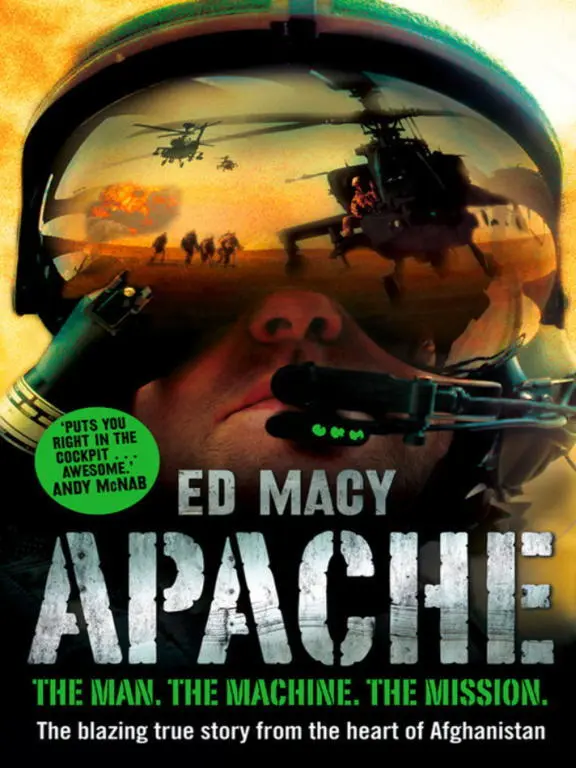
- Название:Apache
- Автор:
- Издательство:HarperPress
- Жанр:
- Год:2008
- Город:London
- ISBN:978-0007307470
- Рейтинг книги:5 / 5. Голосов: 1
-
Избранное:Добавить в избранное
- Отзывы:
-
Ваша оценка:
Apache: краткое содержание, описание и аннотация
Предлагаем к чтению аннотацию, описание, краткое содержание или предисловие (зависит от того, что написал сам автор книги «Apache»). Если вы не нашли необходимую информацию о книге — напишите в комментариях, мы постараемся отыскать её.
http://www.harperplus.com/apache
Apache — читать онлайн ознакомительный отрывок
Ниже представлен текст книги, разбитый по страницам. Система сохранения места последней прочитанной страницы, позволяет с удобством читать онлайн бесплатно книгу «Apache», без необходимости каждый раз заново искать на чём Вы остановились. Поставьте закладку, и сможете в любой момент перейти на страницу, на которой закончили чтение.
Интервал:
Закладка:
We were sitting in the loading bays midway through the 30-mm upload when an urgent voice came online from the Ops Room.
‘Ugly Five One Flight, Zero. Rearm as quickly as possible. Do not close down. You are going back down to Garmsir immediately.’
We didn’t want to clutter up the Apache net by asking why. We’d find out when we needed to. A more detailed order followed as we taxied onto the runway.
‘Ugly Five Zero, Ugly Five One; you are to escort a CH47, callsign Doorman Two Six, on a Casevac to collect a T1 and a T3. Then remain in support of Widow Eight Three, who is receiving very effective enemy fire.’
A T1, a T3 and they were still getting nasty incoming? Jesus. Carl didn’t want to speculate over the radio so he sent a text.
WHAT WENT WRONG… ALL CALM WHEN WE LEFT…
A casualty was given one of four initial gradings by the medics on the ground. It allowed the recovery chain to know how best to prioritise their resources in response. T1 meant the casualty’s life was in grave danger; he had to be recovered by air immediately. Get him to the operating theatre at Camp Bastion’s field hospital within an hour and his chances of survival were significantly increased. It was what we called the golden hour. T2 meant the casualty could be stabilised but was in a serious condition and needed to get to hospital before he ran the risk of becoming T1. T3 was commonly referred to as the walking wounded – every other conceivable injury that was not life-threatening within twenty-four hours and required extraction. T4 was the least time-pressing, because T4 meant he was dead. It was hard-nosed military risk management – designed to send a clear signal about whether the recovery chopper should risk jeopardising its crew, surgeons and medics to pick up our injured.
The mighty Chinook’s blades began to turn.
We still couldn’t make sense of it. When we’d left, the Taliban were in disarray and it was a turkey shoot for the marines. How could the tables have turned so quickly?
MUST HAVE BEEN A LUCKY MORTAR BOMB… BOSS
OR VERY UNLUCKY… BILLY
There was no other way the Taliban could have got through the marines’ arcs of fire.
We escorted Doorman down. The Chinook tanked it, low level at top speed, the quickest line from A to B. It landed in the cover of a berm north-west of the Garmsir bridge as we scoured the approaches. The two casualties were loaded on board and Doorman lifted again less than thirty seconds later. We checked in with Widow Eight Three.
‘Ugly, Widow, we are being engaged heavily from the east–west treeline, the original limit of our exploitation.’ The treeline? Wasn’t that where the marines were?
‘Copied. Send friendly forces’ positions.’
‘Friendly forces are falling back from the treeline towards the main road now.’ He gave us their grids.
‘Also, confirm you can see an oval-shaped series of compounds on the western side of the farmland, halfway between the treeline and the main road.’
‘Affirm, I see friendlies.’
‘That is the location of the tactical headquarters. That’s where we were hit and took the casualties.’
The casualties in the tactical HQ seemed to have brought a swift end to the scorched earth artillery plan. If the marines now thought the Taliban had accurate grids to mortar them, they needed to move out of there fast. As they exfiltrated, the initiative inevitably swung back to the enemy.
The Boss and Billy swept the treeline with their TADSs, pouring long bursts of cannon at any glimpse of Taliban. They could see very little; these people were good. They used the trees and bushes over the irrigation ditches to follow-up unseen. The marines reported one new firing position after another as they withdrew; the Taliban had infiltrated the whole of the kilometre-long treeline and were harassing them all the way back to the main road.
It called for some scorched earth tactics of our own. As soon as we were satisfied all the marines had pulled back far enough, we put pair after pair of Flechette rockets into the trees. The two Apaches took it in turns to run in, again and again, following up each time with cannon. We saw the Flechette darts strip through the higher branches, but the undergrowth was so thick we couldn’t see where they landed. It was impossible to confirm any kills.
After half an hour of our bombardment, Widow Eight Three reported the two companies of marines had reached the relative safety of the main road without any further casualties. Our suppression seemed to have worked, and we were released to return to base.
They would like to have stayed out for longer, but the marines had achieved all they could in the circumstances. The attack hadn’t been a failure by its own standards – despite the complete lack of territorial gain. It had been bitter and bloody stuff, with every metre of ground passionately contested then handed right back to the enemy. But this was business as usual in the hell that was Garmsir.
It is extremely hard to measure success when we take casualties. Their aim was to clear the ground to the treeline and flatten the firing points that the Taliban used beyond it. This was achieved but at a high cost. This was technological warfare on a par with World War One: Tommy over the top after the guns and Tommy falling back to his original trench. It did allow Magowan to test the resolve of the Taliban and they were most certainly up for the fight. They were strong, well armed, well trained and ferocious. It was a costly but vital mission to know where the Taliban routes were, and where their firing points in the treeline were. It would now give the marines some breathing space in the DC whilst Magowan concentrated on the big plan.
Six hours after we climbed into our cockpits, the four of us made our weary way into the JHF for the usual debrief. Alice’s expression told us an already bad day was about to get a whole lot worse.
‘Just so you know, it looks as though we’ve got a blue-on-blue situation down in Garmsir. Nothing to do with anything you put down; it was when you were on your way back to refuel. We think the F18 strafed the marines’ command post, and that’s what gave us the T1 and T3.’
My heart sank. A blue-on-blue. Fuck . Suddenly it all made sense. The Taliban hadn’t managed to strike back at the marines after all. Our own aircraft had done that for them. Just when the guys were really nailing the bastards who were making their lives a misery, they got a smack from one of their own.
‘The Special Investigations Branch guys have already been in,’ Alice said. ‘They asked if you could hang around the JOC for them.’
Every friendly fire was acutely investigated. Statements had to be taken from everyone who had been operating in the area. The SIB examined the circumstances in case of negligence then the Board of Inquiry tried to learn lessons for the future. The process often took years.
We knew then that only two things could have caused it. The F18 would have been tasked onto its targets by Widow Eight Three or another JTAC, just as we had been onto ours. Either the US pilot had been given the wrong grid or he had mistaken the marines’ compound for the Taliban’s.
Blue-on-blues from the air were nothing new. For every offensive aircrew, intiating fire on friendly troops was the worst nightmare of all. That day in Garmsir, the American pilot had been trying to save Coalition lives. But close air support was a dangerous and complex business, supplied in circumstances of great pressure for both ground troops and pilots. It was often very fucking close. The tiniest mistake – a number on a grid reference, the briefest lapse in concentration pulling the trigger, or the slightest movement of the TADS – meant the difference between hitting your enemy and your friend.
Читать дальшеИнтервал:
Закладка:
Похожие книги на «Apache»
Представляем Вашему вниманию похожие книги на «Apache» списком для выбора. Мы отобрали схожую по названию и смыслу литературу в надежде предоставить читателям больше вариантов отыскать новые, интересные, ещё непрочитанные произведения.







Обсуждение, отзывы о книге «Apache» и просто собственные мнения читателей. Оставьте ваши комментарии, напишите, что Вы думаете о произведении, его смысле или главных героях. Укажите что конкретно понравилось, а что нет, и почему Вы так считаете.