Ed Macy - Apache
Здесь есть возможность читать онлайн «Ed Macy - Apache» — ознакомительный отрывок электронной книги совершенно бесплатно, а после прочтения отрывка купить полную версию. В некоторых случаях можно слушать аудио, скачать через торрент в формате fb2 и присутствует краткое содержание. Город: London, Год выпуска: 2008, ISBN: 2008, Издательство: HarperPress, Жанр: Биографии и Мемуары, nonf_military, на английском языке. Описание произведения, (предисловие) а так же отзывы посетителей доступны на портале библиотеки ЛибКат.
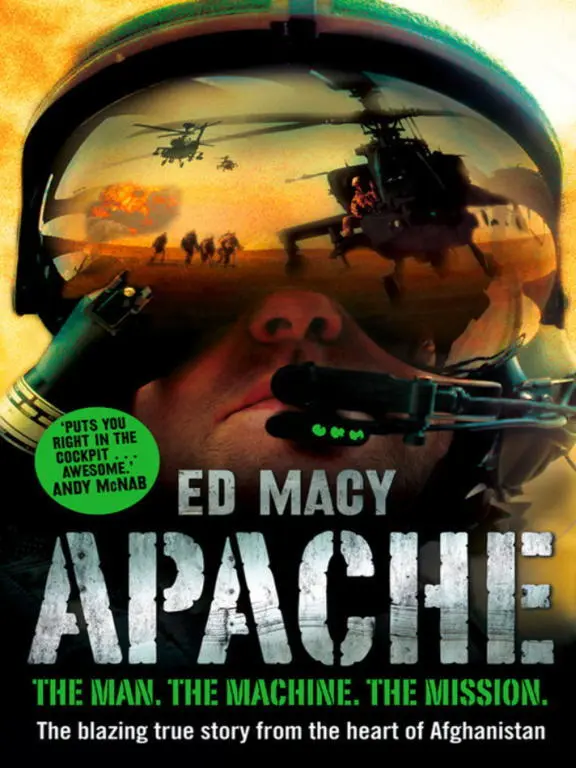
- Название:Apache
- Автор:
- Издательство:HarperPress
- Жанр:
- Год:2008
- Город:London
- ISBN:978-0007307470
- Рейтинг книги:5 / 5. Голосов: 1
-
Избранное:Добавить в избранное
- Отзывы:
-
Ваша оценка:
Apache: краткое содержание, описание и аннотация
Предлагаем к чтению аннотацию, описание, краткое содержание или предисловие (зависит от того, что написал сам автор книги «Apache»). Если вы не нашли необходимую информацию о книге — напишите в комментариях, мы постараемся отыскать её.
http://www.harperplus.com/apache
Apache — читать онлайн ознакомительный отрывок
Ниже представлен текст книги, разбитый по страницам. Система сохранения места последней прочитанной страницы, позволяет с удобством читать онлайн бесплатно книгу «Apache», без необходимости каждый раз заново искать на чём Вы остановились. Поставьте закладку, и сможете в любой момент перейти на страницу, на которой закончили чтение.
Интервал:
Закладка:
‘See? He’s left a heat source. Look at the size of his foot and look at the size of the heat source. Same length. Now if you zoom in on the other men, a fiver says you’ll find they’ve all left similar length heat sources.’
We began to feel more than a little stupid.
‘Gentlemen, you have captured top secret footage of an Afghan communal shit. It’s a tradition; they do it for mutual protection at night. Now I’m going for one too. But don’t worry, you can stay here.’

9. THE BOBS AND STEVE-O
The Taliban were watching us too.
A company of infantry soldiers was responsible for Camp Bastion’s security, manning the sangers on its perimeter fences, and fanning out to protect the C130 runway when a Hercules came in. The soldiers’ most time-consuming job by far was manning the camp’s most vulnerable point, its front gate.
An almost permanent line of local trucks and lorries queued outside it, delivering a never-ending mountain of supplies to feed and equip the garrison. Most of the vehicles came from Kandahar air base, where the bulk of our supplies arrived in long-range heavy-transport planes like the RAF’s C17s or chartered Russian made Antonovs. The local vehicles were held back 200 metres behind a chicane of Hesco Bastion bollards, the guards’ protection against suicide bombers. They were called forward cautiously, one by one, and searched from tip to toe before being allowed in.
One night, a sharp-eyed sentry spotted a driver climb onto his cab and get on his mobile phone as soon as a pair of Apaches clattered overhead. A covert watch was set up on all the waiting lorries.
We discovered that it wasn’t just one driver. Almost all of them were climbing onto their roofs to get a better mobile phone signal whenever we took off. In Northern Ireland, we used to call it ‘dicking’. At some stage of their journey from Kandahar, the Taliban had got to the drivers and employed – or forced – them to report on our movements.
We’d had a nagging feeling in the weeks prior to the discovery that the enemy seemed to know we were coming. Now we knew why. Once they’d been given the nod from Bastion, they’d set a stopwatch for our reaction times to specific locations, and packed up attacking the marine patrols minutes before we arrived.
Dicking was a threat to both our safety and that of the troops on the ground. Trigger and Billy drew up new drills to try to counter it. From then onwards, Apaches never flew over the main gate, we kept all the lights off at night, and we always set off in a different direction to the one we were really headed. That was a pain too, because flying a few klicks out of our way just to fox the dickers added a minute or two to the time it took us to reach the guys. But it was crucial to try to keep ahead of the Taliban’s learning curve.
They learned, we learned; then we had to learn again. It was known as the caterpillar – one end moved first, the rest caught up. And the Afghan caterpillar never stopped moving. The longer the Helmand campaign went on, the more complex the battlespace became.
While the diligent reconnaissance for Operation Glacier continued, the huge demand for Apache support elsewhere kept us frantically busy. It came from all over the province. So much so, at least one of the squadron’s flights was now firing in anger in some arena every single day. We were putting stuff down at a phenomenal rate – far more than we’d ever done before. Whether it was the change in the Rules of Engagement, the increased flying hours, or the enemy’s ever more dogged persistence – or a combination of the three – it was hard to tell. Sometimes, we used our weapons systems as they were originally designed to be used. Others, we just had to improvise – like the day Soggy Arm Field got its name.
We were on a deliberate operation with the marines up in Kajaki one afternoon, covering them as they fought a clearance patrol onto the Shrine and then through the Taliban-held village to its west. The enemy were putting up strong resistance, gritty compound-to-compound stuff.
We trapped six of them out in the open on our arrival and nailed them with cannon. But two of their more dogged companions, firing from the far end of the village, had pinned down a section of marines. A Joint Terminal Attack Controller climbed to the top of Falcon to direct our fire. The JTAC talked us onto the pair’s grid.
We found them by stealth, heading for home and doubling back, coming out of the clouds four kilometres behind them. They were in full white dishdashes, crouched a metre apart at the edge of a track behind someone’s freshly painted white house.
‘That’s them,’ confirmed the JTAC. ‘I’ve had eyes on them since their last engagement. Remove them as soon as possible, by any means.’
They were a challenging target. The village was inhabited; it was crawling with mopeds and animals and we had no idea who was in the house behind them. Rockets and cannon would have peppered its wall and roof, and probably gone straight through them. Due to the Rules of Engagement there was only one option.
‘It’s got to be a Hellfire,’ Trigger said. ‘ROE is simple – but the proportionality bothers me. You’re my weapons guru; can we really chuck a missile into a civilian village?’
‘Positive ID, ROE and clearance to engage doesn’t give us a choice, Boss, but collateral damage and the family in that lovely house does. We wait till we’re closer and use the gun, or kick off to the right and hit them with the Hellfire so the blast disperses into that field. If we get closer they’ll bolt for the house and the family will have Terry Taliban as lodgers…’
A .5-inch calibre sniper rifle would have been ideal for the job. But Hellfire was the only point weapon system we had. It was proportionate in this instance.
‘Okay, Mr Macy. Set me up.’
‘I’ll set you up all right. Set you up to make Apache history.’
The Boss glanced at me in his mirror, lined the crosshairs up perfectly on the ground between the two fighters, and let rip from six kilometres. The Hellfire had not been used on personnel before. We watched the missile rise, fall to its usual angle and impact right on target. When the smoke cleared, all that was left was a two-metre-wide hole in the ground.
‘Delta Hotel,’ the JTAC reported.
The freshly painted wall got one final coat – toffee brown – but on the flip side, the washing was still clean and the house itself completely untouched. It took an age to figure out the battle damage but the JTAC summed up the situation perfectly. ‘I think your targets may have vaporised.’
That night, after the battle, the marines on Falcon watched as the locals came out to collect their dead. The next time we went up to Kajaki, the JTAC relayed their story.
‘The Taliban had a really good look around the crater area for your two guys, but they couldn’t find a thing. Then one of them went about thirty metres into the next field and came back holding a soggy arm. That’s why it’s now called “Soggy Arm Field”.’
The Special Boat Service had done a fair bit of work all over southern Afghanistan with the US Apaches co-located with them in Kandahar. But every now and then they came to us. Our first request from the Special Forces Group arrived six weeks into the tour.
The JHF was just told that it was an op in the notorious Panjwayi Valley – a Taliban hotbed west of Kandahar city. We would be briefed on everything else by the SBS themselves in Kandahar on the night. They’d asked for permanent cover as they expected it to go on a bit. So two flights went over that morning: 3 Flight’s Nick, Charlotte, Darwin and FOG, and the four of us.
Читать дальшеИнтервал:
Закладка:
Похожие книги на «Apache»
Представляем Вашему вниманию похожие книги на «Apache» списком для выбора. Мы отобрали схожую по названию и смыслу литературу в надежде предоставить читателям больше вариантов отыскать новые, интересные, ещё непрочитанные произведения.







Обсуждение, отзывы о книге «Apache» и просто собственные мнения читателей. Оставьте ваши комментарии, напишите, что Вы думаете о произведении, его смысле или главных героях. Укажите что конкретно понравилось, а что нет, и почему Вы так считаете.