Ed Macy - Apache
Здесь есть возможность читать онлайн «Ed Macy - Apache» — ознакомительный отрывок электронной книги совершенно бесплатно, а после прочтения отрывка купить полную версию. В некоторых случаях можно слушать аудио, скачать через торрент в формате fb2 и присутствует краткое содержание. Город: London, Год выпуска: 2008, ISBN: 2008, Издательство: HarperPress, Жанр: Биографии и Мемуары, nonf_military, на английском языке. Описание произведения, (предисловие) а так же отзывы посетителей доступны на портале библиотеки ЛибКат.
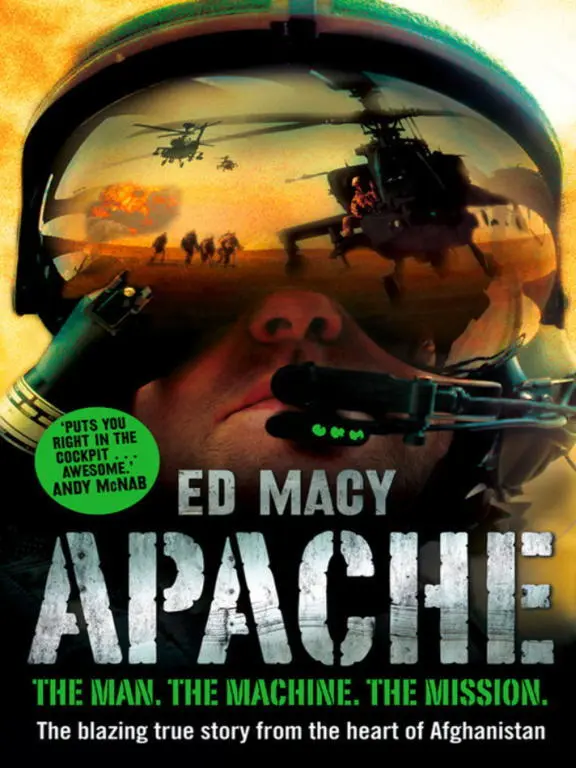
- Название:Apache
- Автор:
- Издательство:HarperPress
- Жанр:
- Год:2008
- Город:London
- ISBN:978-0007307470
- Рейтинг книги:5 / 5. Голосов: 1
-
Избранное:Добавить в избранное
- Отзывы:
-
Ваша оценка:
Apache: краткое содержание, описание и аннотация
Предлагаем к чтению аннотацию, описание, краткое содержание или предисловие (зависит от того, что написал сам автор книги «Apache»). Если вы не нашли необходимую информацию о книге — напишите в комментариях, мы постараемся отыскать её.
http://www.harperplus.com/apache
Apache — читать онлайн ознакомительный отрывок
Ниже представлен текст книги, разбитый по страницам. Система сохранения места последней прочитанной страницы, позволяет с удобством читать онлайн бесплатно книгу «Apache», без необходимости каждый раз заново искать на чём Вы остановились. Поставьте закладку, и сможете в любой момент перейти на страницу, на которой закончили чтение.
Интервал:
Закладка:
8. OP GLACIER BEGINS
Smashing the Taliban’s supply chain to smithereens was 3 Commando Brigade’s first objective with Operation Glacier. Five days into December, we had a ringside seat at the second.
Things in Garmsir had gone from bad to worse. The Taliban still believed they could dislodge the Brits, as they had done before. And they were giving it their all. The fighting had deteriorated at times to hand to hand combat; it was like something out of the Zulu War.
The marines’ every movement in or out of the DC compound drew withering sniper fire. The Taliban also launched daily attacks on the commandos’ lookout post on a neighbouring hill to the south.
The compound was at the edge of the town. Its western flank was protected by the north–south running Helmand River and the Green Zone narrowed to a funnel point to the north, so the Taliban hit it from the east – from the cover of Garmsir’s five-or six-street grid – and, even more vigorously, from the farmland to the south. The fields and orchards offered the enemy excellent natural cover. With its regular treelines and deep irrigation ditches, they could move with impunity to within 100 metres of the British compound, then open up with AK47s and RPGs, supported by WOMBATs and mortars.
Barricaded inside the DC and on the top of JTAC Hill (as they’d christened it), the marines replied with air strikes, heavy machine guns and 105-mm artillery called in from a gun line set up for them in the desert. Every enemy shooting position in the few square kilometres around them had been pummelled five times over.
Garmsir used to boast a busy high street and bustling bazaar, but all the locals had moved out to escape the Taliban regime. After the schools were closed and rebellious farmers beheaded, its shabby streets were deserted. Skeletal buildings lay derelict amongst the debris. Whenever the shooting lapsed, an eerie silence fell. ‘Even the birds have left,’ its defenders said.
Every so often, when Colonel Magowan’s southern battlegroup could cobble together the resources, the marines would push the Taliban back from their ramparts. And that’s where we came in. HQ Flight was rostered on Deliberate Taskings, so the job of giving close air support to one such counter-attack fell to us. It was the best kind of mission; going in dirty, shoulder to shoulder with the troops, was what made flying an Apache such a joy.
The objective of the attack was to clear a square kilometre of farmland to the DC’s immediate south, up to a long east–west treeline. The marines couldn’t hold the ground; they didn’t have the spare men. But in the process they’d learn about the enemy’s routes of approach, kill those who were well entrenched, destroy their fortified positions, and perhaps buy the garrison a few days’ breathing space.
Two Royal Marine companies were moved in covertly overnight, and the objective area was heavily bombed and shelled. At 10am, the two companies stretched along the main road and advanced slowly south. An RAF Harrier was on station to give them initial air cover. We were tasked to arrive forty-five minutes later.
Trigger hogged the front seat of our Apache again. I didn’t put up a fuss. He was enjoying himself so much I didn’t want to take the smile off his face. We checked in with their JTAC, Widow Eight Three, and he told us it was going well. The enemy were not standing and fighting. Caught out by the size of the marine contingent and with no time to reinforce, they were falling back, offering only sporadic ‘shoot and scoot’ fire as they did so. The JTAC gave us the positions of all the friendly forces.
‘Ugly callsigns, we believe Taliban might be infiltrating a large compound 300 metres to the south of our limit of exploitation. I would like you to fix them there and destroy them.’
I took us three klicks straight south on the western side of the river, and banked hard left to hook us in behind the target.
‘Okay, I’ve got five Taliban entering the compound now.’
The Boss started to get excited again. ‘Looks like they’re trying to get into cover before the marines reach the treeline and catch them in the open.’
‘Weapons?’
The Boss zoomed in his TADS.
‘Yes. The last bloke’s got an RPG. And they’re running.’
I looked down at the MPD by my right knee. All five were now running diagonally through an orchard within the compound’s outer wall. They must have heard our rotor blades; we were only 1,500 metres off. Sunlight glinted off the working parts of their AK47s.
‘Affirm boss. They’re enemy all right. Get ’em.’
‘Five One, firing with thirty Mike Mike.’
Trigger put three bursts of twenty rounds into the group. The RPG man and the guy in front of him were torn apart by the shrapnel, but the three leaders made it into a reinforced adobe hut in the south-east corner. The Boss put another two bursts onto the front wall, gouging great chunks off it, but these things were built to last and we weren’t sure how much was getting through.
Billy had come round from the north. ‘Five Zero, I saw men running in the direction of that hut before you engaged the orchard. I reckon there could be quite a few of them in there.’
‘Copied, thanks. Let’s get a bomb on it.’
Topman, the Harrier pilot, said it would be a few minutes before he could set up a run, so the Boss delivered a Hellfire through its letterbox whilst Billy pinned the Taliban inside it with harassing cannon fire. The missile collapsed half the roof, and we got the Harrier to stick a 500-lb GBU in there for good measure. By the time we’d finished, there wasn’t anything left of it.
The marines had reached the treeline, clearing all enemy from the target area. Widow Eight Three told us to look into a few more isolated compounds south of them for any enemy movement. There was none. True to form, the Taliban had gone to ground in a plethora of well-prepared hiding places.
‘Ugly callsigns, come north-east of the treeline and hold there. We’re going to drop all the compounds with 105-mm.’
Salvo after salvo of artillery rounds would dislodge the Taliban from their hideouts. They’d break for better cover and the fast air and Apaches could bomb the merry hell out of them; good old-fashioned scorched earth tactics – as effective for the marines today as they were for the Carthaginians 2,200 years earlier.
There wasn’t a civilian within ten miles of the place; we could see that ourselves from the unkempt state of the fields – so the marines were keen to make the most of the firepower they had that day, and give the Taliban a licking they wouldn’t forget. I checked our fuel level. Ten minutes left on station.
‘Boss, we’re not that far off chicken. Might be a good time to RTB for a suck of gas, and to bomb up the aircraft again…’ Going chicken meant you only had enough fuel to get back to base within the legal limit. The marines were under good cover in the irrigation ditches, and it would take an hour or two to bring in all the artillery fire missions they wanted. The Harrier was pulling off, to be replaced by a US F18 Hornet, and an A10 had just come on station too. It was a perfect time for us to break off.
Widow Eight Three agreed. ‘The commander wants all ground callsigns to go firm for a few hours while we fix as many enemy as we can. Can you come back down to cover their withdrawal?’
We agreed with the JTAC that we’d stay on thirty minutes’ notice for his call to return. We’d go back to Camp Bastion, refuel and rearm, and wait in the JHF for his shout.
The boys in Garmsir deserved to get the chance to give the Taliban what for. Until today they’d been in a living hell, just like the Paras had in Sangin during the summer. Siege warfare: their sole aim was survivability; pounded, probed, shot and wounded day in, day out, night in and night out. I smiled as I looked out of the window and saw them in the long treeline whacking the Taliban. It was a pleasure to help.
Читать дальшеИнтервал:
Закладка:
Похожие книги на «Apache»
Представляем Вашему вниманию похожие книги на «Apache» списком для выбора. Мы отобрали схожую по названию и смыслу литературу в надежде предоставить читателям больше вариантов отыскать новые, интересные, ещё непрочитанные произведения.







Обсуждение, отзывы о книге «Apache» и просто собственные мнения читателей. Оставьте ваши комментарии, напишите, что Вы думаете о произведении, его смысле или главных героях. Укажите что конкретно понравилось, а что нет, и почему Вы так считаете.