Robin Cook - Outbreak
Здесь есть возможность читать онлайн «Robin Cook - Outbreak» весь текст электронной книги совершенно бесплатно (целиком полную версию без сокращений). В некоторых случаях можно слушать аудио, скачать через торрент в формате fb2 и присутствует краткое содержание. Город: New York, Год выпуска: 2002, ISBN: 2002, Издательство: Berkley Books, Жанр: thriller_medical, на английском языке. Описание произведения, (предисловие) а так же отзывы посетителей доступны на портале библиотеки ЛибКат.
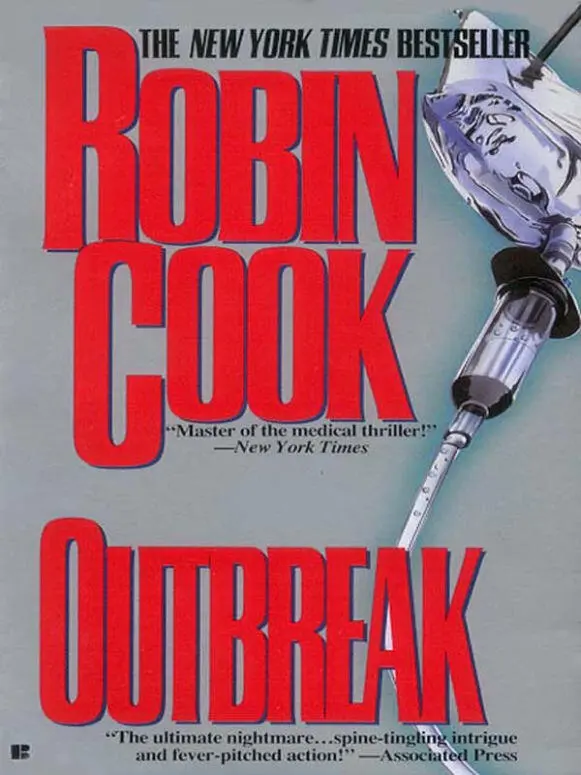
- Название:Outbreak
- Автор:
- Издательство:Berkley Books
- Жанр:
- Год:2002
- Город:New York
- ISBN:978-1-1012-0348-4
- Рейтинг книги:5 / 5. Голосов: 1
-
Избранное:Добавить в избранное
- Отзывы:
-
Ваша оценка:
Outbreak: краткое содержание, описание и аннотация
Предлагаем к чтению аннотацию, описание, краткое содержание или предисловие (зависит от того, что написал сам автор книги «Outbreak»). Если вы не нашли необходимую информацию о книге — напишите в комментариях, мы постараемся отыскать её.
Outbreak — читать онлайн бесплатно полную книгу (весь текст) целиком
Ниже представлен текст книги, разбитый по страницам. Система сохранения места последней прочитанной страницы, позволяет с удобством читать онлайн бесплатно книгу «Outbreak», без необходимости каждый раз заново искать на чём Вы остановились. Поставьте закладку, и сможете в любой момент перейти на страницу, на которой закончили чтение.
Интервал:
Закладка:
“As a group, all eighty-four cases developed symptoms within a six-hour period, suggesting that they all were exposed at the same time. The severity of the initial symptoms suggests that they all received an overwhelming dose of the infective agent. Everyone worked at the Medica Hospital but not in the same area, which suggests the air-conditioning system was probably not the source. It seems to me we are dealing with a food- or waterborne infection, and in that regard, the only commonality that has appeared in the data is that all eighty-four people used the hospital cafeteria. In fact, as nearly as can be determined, all eighty-four people had lunch there three days ago.”
Marissa finally looked up at Dubchek, who was staring at the ceiling. When he realized that she had finished speaking, he said, “What about contact with any of the patients in the L.A. or St. Louis episodes?”
“None,” said Marissa. “At least none that we can discover.”
“Have you sent blood samples to Tad?”
“Yes,” said Marissa.
Cyrill headed for the door. “I think you should redouble your efforts to associate this outbreak with one of the other two. There has to be a connection.”
“What about the cafeteria?” asked Marissa.
“You’re on your own there,” said Dubchek. “Ebola has never been spread by food, so I can’t see how the cafeteria could be associated…” He pulled open the door. “Still, the coincidence is curious, and I suppose you’ll follow your own instincts no matter what I recommend. Just be sure you exhaust the possibilities of a connection with L.A. or St. Louis.”
For a moment Marissa stared at the closed door. Then she looked back at her summary sheet and the huge pile of histories. It was depressing.
Almost as if Cyrill’s last words had been a challenge, Marissa decided to visit the cafeteria, which had been built as a separate wing over a garden courtyard. The double doors leading to the large room were closed, and on the right one a notice had been tacked up stating: CLOSED BY ORDER OF STATE HEALTH COMMISSIONER. Marissa tried the door. It was unlocked.
Inside, the room was spotlessly clean and furnished in stainless steel and molded plastic. Directly ahead of Marissa was the steam table, with stacks of trays at one end and a cash register at the other.
A second set of double doors, with little round windows, was located behind the steam table and led to the kitchen. Just as Marissa was deciding whether to go through or not, they opened, and a stout but attractive middle-aged woman appeared and called out to Marissa that the cafeteria was closed. Marissa introduced herself and asked if she could ask the woman a few questions.
“Certainly,” replied the woman, who explained with a faint Scandinavian accent that her name was Jana Beronson and that she was the cafeteria manager. Marissa followed her into her office, a windowless cubicle whose walls were filled with schedules and menus.
After some polite conversation, Marissa asked to see the lunch menu for three days ago. Miss Beronson got it out of the file, and Marissa scanned the page. It was a usual cafeteria menu, with three entrées, two soups and a selection of desserts.
“Is this all the food offered?”
“Those are all the specials,” answered Miss Beronson. “Of course we always offer a selection of sandwiches and salads and beverages.”
Marissa asked if she could have a copy of the menu, and Miss Beronson took the paper and left the office to Xerox it. Marissa decided that she would go back to each of the initial cases and ask what they had eaten for lunch three days ago. She would also question a control group made up of people who ate from the same menu but who did not become ill.
Miss Beronson returned with the copy. As she folded the paper, Marissa said, “One of your employees was stricken, wasn’t she?”
“Maria Gonzales,” said Miss Beronson.
“What was her job here?”
“She worked either the steam table or the salad bar,” answered Miss Beronson.
“Could you tell me what she did on the day in question?” asked Marissa.
Getting up, Miss Beronson went over to one of the large scheduling boards on her wall. “Desserts and salads,” she told Marissa.
Marissa wondered if they should test the whole cafeteria staff for Ebola antibodies. Although Ralph had been joking when he’d suggested an “Ebola Mary,” perhaps it was possible, although it had not been the case in Africa.
“Would you like to see our facility?” asked Miss Beronson, trying to be helpful.
For the next thirty minutes Marissa was given a grand tour of the cafeteria, including both the kitchen and the dining area. In the kitchen, she saw the walk-in cooler, the food preparation area and the huge gas ranges. In the dining area, she walked along the steam table, peering into silverware bins and lifting the covers of the salad-dressing cannisters.
“Would you like to see the stock rooms?” Miss Beronson asked, when they were done.
Marissa declined, deciding it was time to start checking to see what the initial Ebola patients had chosen from the menu in her purse.
Marissa rocked back in the swivel chair and rubbed her eyes. It was 11:00 A.M. of her second day in Phoenix, and she’d only managed four hours of sleep the previous night. She’d been assigned one of the examination alcoves in the OB-GYN clinic, and every time someone went by, she’d been awakened.
Behind her, Marissa heard the door open. She turned and saw Dubchek holding up the front page of a local newspaper. The headline read: CDC BELIEVES HIDDEN SOURCE OF EBOLA IN U.S.A. Looking at his expression, Marissa guessed that he was, as usual, angry.
“I told you not to talk to the press.”
“I haven’t.”
Dubchek smacked the paper. “It says right here that Dr. Blumenthal of the CDC said that there is a reservoir of Ebola in the U.S.A., and that the outbreak in Phoenix was spread by either contaminated food or water. Marissa, I don’t mind telling you that you are in a lot of trouble!”
Marissa took the paper and read the article quickly. It was true that her name was mentioned, but only at second hand. The source of the information was a Bill Freeman, one of the doctors who’d helped take patient histories. She pointed this fact out to Dubchek.
“Whether you talk directly to the press, or to an intermediary who talks to the press, is immaterial. The effect is the same. It suggests that the CDC supports your opinions, which is not the case. We have no evidence of a food-related problem, and the last thing we want to do is cause mass hysteria.”
Marissa bit her lower lip. It seemed that every time the man spoke to her, it was to find fault. If only she’d been able to handle the episode in the hotel room in L.A. in a more diplomatic way, perhaps he wouldn’t be so angry. After all, what did he expect—that she wouldn’t talk to anyone? Any team effort meant communication.
Controlling her temper, Marissa handed Dubchek a paper. “I think you should take a look at this.”
“What is it?” he asked irritably.
“It’s the result of a second survey of the initially infected patients. At least those who were able to respond. You’ll notice that one fact jumps out. Except for two people who couldn’t remember, all the patients had eaten custard in the hospital cafeteria four days ago. You’ll remember that in my first survey, lunch in the cafeteria on that day was the only point of commonality. You’ll also see that a group of twenty-one people who ate in the cafeteria on the same day but did not eat the custard remained healthy.”
Dubchek put the paper down on the counter top. “This is a wonderful exercise for you, but you are forgetting one important fact: Ebola is not a food-borne disease.”
Читать дальшеИнтервал:
Закладка:
Похожие книги на «Outbreak»
Представляем Вашему вниманию похожие книги на «Outbreak» списком для выбора. Мы отобрали схожую по названию и смыслу литературу в надежде предоставить читателям больше вариантов отыскать новые, интересные, ещё непрочитанные произведения.



Обсуждение, отзывы о книге «Outbreak» и просто собственные мнения читателей. Оставьте ваши комментарии, напишите, что Вы думаете о произведении, его смысле или главных героях. Укажите что конкретно понравилось, а что нет, и почему Вы так считаете.