Robin Cook - Outbreak
Здесь есть возможность читать онлайн «Robin Cook - Outbreak» весь текст электронной книги совершенно бесплатно (целиком полную версию без сокращений). В некоторых случаях можно слушать аудио, скачать через торрент в формате fb2 и присутствует краткое содержание. Город: New York, Год выпуска: 2002, ISBN: 2002, Издательство: Berkley Books, Жанр: thriller_medical, на английском языке. Описание произведения, (предисловие) а так же отзывы посетителей доступны на портале библиотеки ЛибКат.
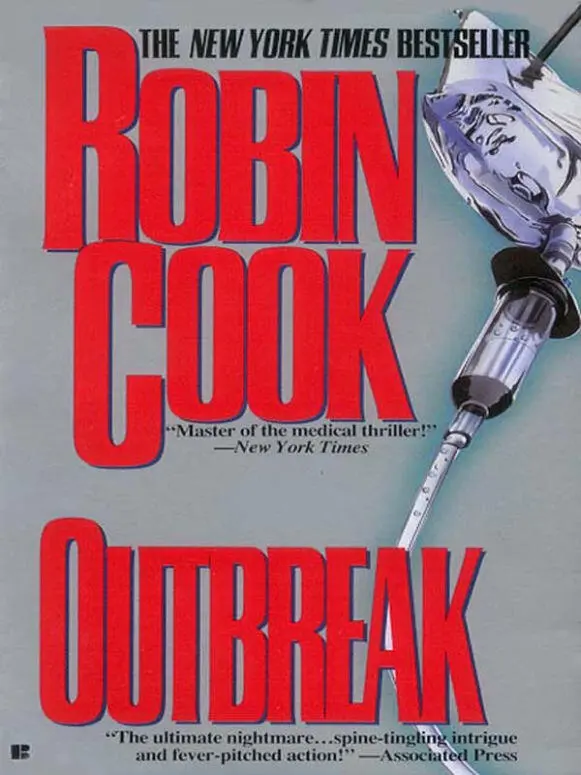
- Название:Outbreak
- Автор:
- Издательство:Berkley Books
- Жанр:
- Год:2002
- Город:New York
- ISBN:978-1-1012-0348-4
- Рейтинг книги:5 / 5. Голосов: 1
-
Избранное:Добавить в избранное
- Отзывы:
-
Ваша оценка:
Outbreak: краткое содержание, описание и аннотация
Предлагаем к чтению аннотацию, описание, краткое содержание или предисловие (зависит от того, что написал сам автор книги «Outbreak»). Если вы не нашли необходимую информацию о книге — напишите в комментариях, мы постараемся отыскать её.
Outbreak — читать онлайн бесплатно полную книгу (весь текст) целиком
Ниже представлен текст книги, разбитый по страницам. Система сохранения места последней прочитанной страницы, позволяет с удобством читать онлайн бесплатно книгу «Outbreak», без необходимости каждый раз заново искать на чём Вы остановились. Поставьте закладку, и сможете в любой момент перейти на страницу, на которой закончили чтение.
Интервал:
Закладка:
Leaving the floor, Marissa first requested access to a telephone, then said she wanted to have as many physician volunteers as she could get to help her interview the patients. If many patients were as sick as the Indian doctor, they would have to work quickly if they were going to get any information at all.
Marissa was given the phone in Mr. Davis’s office. It was already after eleven in Atlanta, and Marissa reached Dubchek immediately. The trouble was, he was irritated.
“Why didn’t you call me as soon as the aid request came in? I didn’t know you had gone until I got into my office.”
Marissa held her tongue. The truth was that she’d told the CDC operators that she should be called directly if a call came in suggestive of an Ebola outbreak. She assumed Dubchek could have done the same if he’d wanted to be called immediately, but she certainly wasn’t going to antagonize him further by pointing out the fact.
“Does it look like Ebola?”
“It does,” said Marissa, anticipating Dubchek’s reaction to her next bomb. “The chief difference is in number of those infected. This outbreak involves one hundred cases at this point.”
“I hope that you have instituted the proper isolation,” was Dubchek’s only reply.
Marissa felt cheated. She’d expected Dubchek to be overwhelmed. “Aren’t you surprised by the number of cases?” she asked.
“Ebola is a relatively unknown entity,” said Dubchek. “At this point, nothing would surprise me. I’m more concerned about containment; what about the isolation?”
“The isolation is fine,” said Marissa.
“Good,” said Dubchek. “The Vickers Lab is ready and we will be leaving within the hour. Make sure you have viral samples for Tad as soon as possible.”
Marissa found herself giving assurances to a dead phone. The bastard had hung up. She hadn’t even had a chance to warn him that the entire hospital was under quarantine��that if he entered, he’d not be allowed to leave. “It’ll serve him right,” she said aloud as she got up from the desk.
When she left the office, she discovered that Dr. Weaver had assembled eleven doctors to help take histories: five women and six men. All of them voiced the same motivation: as long as they had to be cooped up in the hospital, they might as well work.
Marissa sat down and explained what she needed: good histories on as many of the initial eighty-four cases as possible. She explained that in both the L.A. and the St. Louis incidents there had been an index case to which all other patients could be traced. Obviously, there in Phoenix it was different. With so many simultaneous cases there was the suggestion of a food- or waterborne disease.
“If it were waterborne, wouldn’t more people have been infected?” asked one of the women.
“If the entire hospital supply was involved,” said Marissa. “But perhaps a certain water fountain…” Her voice trailed off. “Ebola had never been a water- or food-borne infection,” she admitted. “It is all very mysterious, and it just underlines the need for complete histories to try to find some area of commonality. Were all the patients on the same shifts? Were they all in the same areas of the hospital? Did they all drink coffee from the same pot, eat the same food, come in contact with the same animal?”
Pushing back her chair, Marissa went to a blackboard and began outlining a sequence of questions that each patient should be asked. The other doctors rose to the challenge and began giving suggestions. When they were done, Marissa added as an afterthought that they might ask if any of the patients had attended the eyelid surgery conference in San Diego that had been held about three months before.
Before the group disbanded, Marissa reminded everyone to adhere carefully to all the isolation techniques. Then she thanked them again and went to review the material that was already available.
As she had done in L.A., Marissa commandeered the chart room behind the nurses’ station on one of the isolation floors as her command post. As the other doctors finished their history taking, they brought their notes to Marissa, who had begun the burdensome task of collating them. Nothing jumped out of the data except the fact that all the patients worked at the Medica Hospital, something that was already well known.
By midday, fourteen more cases had been admitted, which made Marissa extremely fearful that they had a full-blown epidemic on their hands. All the new patients, save one, were Medica subscribers who had been treated by one of the original forty-two sick physicians before the physicians developed symptoms. The other new case was a lab tech who had done studies on the first few cases before Ebola was suspected.
Just as the evening shift was coming on duty, Marissa learned that the other CDC physicians had arrived. Relieved, she went to meet them. She found Dubchek helping to set up the Vickers Lab.
“You might have told me the damn hospital was quarantined,” he snapped when he caught sight of her.
“You didn’t give me a chance,” she said, skirting the fact that he had hung up on her. She wished there was something she could do to improve their relationship, which seemed to be getting worse instead of better.
“Well, Paul and Mark are not very happy,” said Dubchek. “When they learned all three of us would be trapped for the length of the outbreak, they turned around and went back to Atlanta.”
“What about Dr. Layne?” asked Marissa guiltily.
“He’s already meeting with Weaver and the hospital administration. Then he will see if the State Health Commissioner can modify the quarantine for the CDC.”
“I suppose I can’t talk to you until you get the lab going,” said Marissa.
“At least you have a good memory,” said Dubchek, bending over to lift a centrifuge from its wooden container. “After I finish here and I’ve seen Layne about the isolation procedures, I’ll go over your findings.”
As Marissa headed back to her room, she mulled over a number of nasty retorts, all of which only would have made things worse. That was why she had said nothing.
After a meal of catered airplane food eaten in an area of the outpatient clinic reserved for staff in direct contact with the presumed Ebola patients, Marissa returned to her chart work. She now had histories on most of the initial eighty-four cases.
She found Dubchek leafing through her notes. He straightened up on seeing her. “I’m not sure it was a good idea to use the regular hospital staff to take these histories.”
Marissa was caught off guard. “There were so many cases,” she said defensively. “I couldn’t possibly interview all of them quickly enough. As it is, seven people were too sick to speak and three have subsequently died.”
“That’s still not reason enough to expose doctors who aren’t trained epidemiologists. The Arizona State Health Department has trained staff that should have been utilized. If any of these physicians you’ve drafted become ill, the CDC might be held responsible.”
“But they—” protested Marissa.
“Enough!” interrupted Dubchek. “I’m not here to argue. What have you learned?”
Marissa tried to organize her thoughts and control her emotions. It was true that she’d not considered the legal implications, but she was not convinced there was a problem. The quarantined physicians were already considered contacts. She sat down at the desk and searched for the summary page of her findings. When she found it, she began reading in a flat monotone, without glancing up at Dubchek: “One of the initial patients is an ophthalmologist who attended the same San Diego conference as Drs. Richter and Zabriski. Another of the initial cases, an orthopedic surgeon, went on safari to East Africa two months ago. Two of the initial cases have used monkeys in their research but have not suffered recent bites.
Читать дальшеИнтервал:
Закладка:
Похожие книги на «Outbreak»
Представляем Вашему вниманию похожие книги на «Outbreak» списком для выбора. Мы отобрали схожую по названию и смыслу литературу в надежде предоставить читателям больше вариантов отыскать новые, интересные, ещё непрочитанные произведения.

Обсуждение, отзывы о книге «Outbreak» и просто собственные мнения читателей. Оставьте ваши комментарии, напишите, что Вы думаете о произведении, его смысле или главных героях. Укажите что конкретно понравилось, а что нет, и почему Вы так считаете.