Sam Eastland - Berlin Red
Здесь есть возможность читать онлайн «Sam Eastland - Berlin Red» весь текст электронной книги совершенно бесплатно (целиком полную версию без сокращений). В некоторых случаях можно слушать аудио, скачать через торрент в формате fb2 и присутствует краткое содержание. Год выпуска: 2016, ISBN: 2016, Издательство: Faber & Faber, Жанр: Триллер, на английском языке. Описание произведения, (предисловие) а так же отзывы посетителей доступны на портале библиотеки ЛибКат.
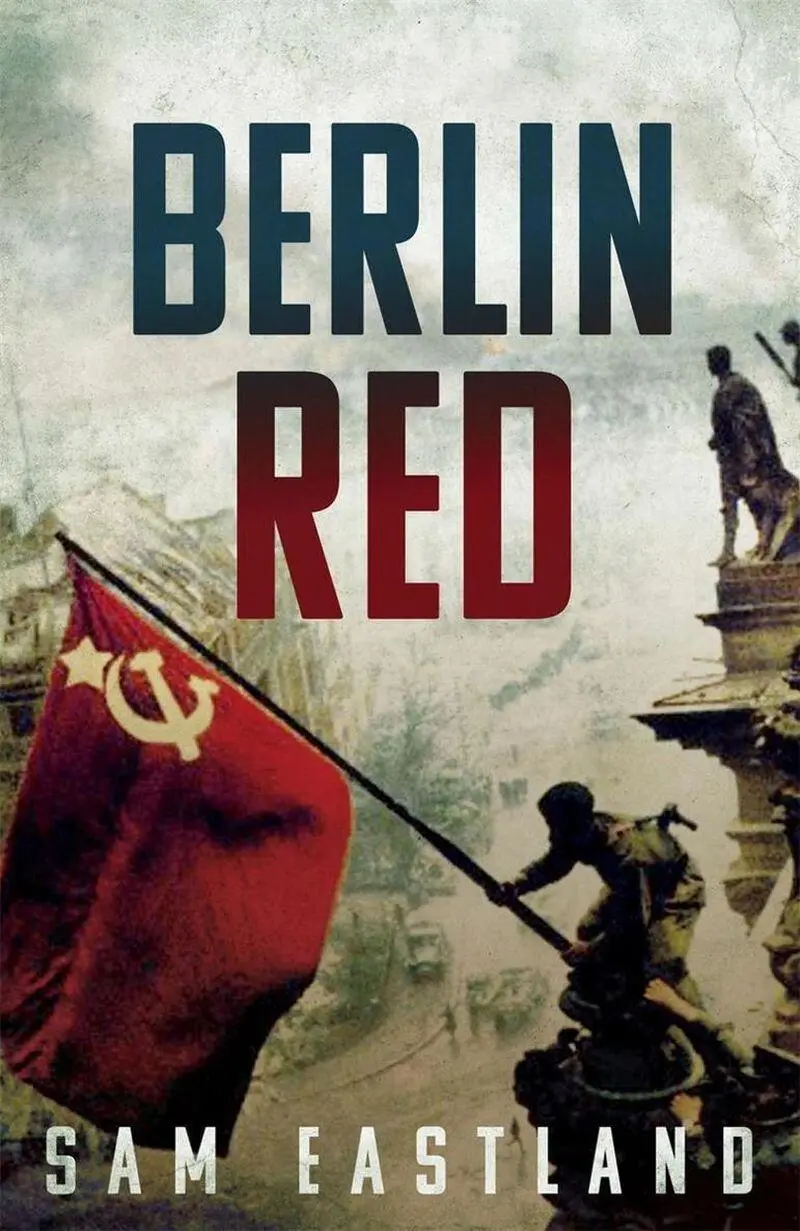
- Название:Berlin Red
- Автор:
- Издательство:Faber & Faber
- Жанр:
- Год:2016
- ISBN:9780571322374
- Рейтинг книги:3 / 5. Голосов: 1
-
Избранное:Добавить в избранное
- Отзывы:
-
Ваша оценка:
Berlin Red: краткое содержание, описание и аннотация
Предлагаем к чтению аннотацию, описание, краткое содержание или предисловие (зависит от того, что написал сам автор книги «Berlin Red»). Если вы не нашли необходимую информацию о книге — напишите в комментариях, мы постараемся отыскать её.
Berlin Red — читать онлайн бесплатно полную книгу (весь текст) целиком
Ниже представлен текст книги, разбитый по страницам. Система сохранения места последней прочитанной страницы, позволяет с удобством читать онлайн бесплатно книгу «Berlin Red», без необходимости каждый раз заново искать на чём Вы остановились. Поставьте закладку, и сможете в любой момент перейти на страницу, на которой закончили чтение.
Интервал:
Закладка:
The Junkers had been captured the year before when Russian troops overran an airfield near Orel. Since then, it had been used in several missions that involved dropping supplies or spare parts to Red Army soldiers encircled by the German Army.
On this occasion, however, the cargo was human.
Beside Pekkala sat Kirov. For the fifth time, the major was checking his parachute. Still echoing in Kirov’s head were the words of the jump instructor who had met them at the airport and having described how they would be jumping from the aircraft, went on to explain that, if his chute failed, he would reach a terminal velocity of approximately 110 miles per hour, the speed at which he would strike the ground, whether he fell from 500 or 5,000 feet, and that when he did strike the ground, he would break every bone in his body, even the tiny ones in his ears. In spite of the matter-of-fact delivery of this information, the instructor had meant this to be reassuring, since it would all be over in a second and there would be no time for feeling any pain.
Kirov, however, was having trouble seeing it that way. As he peered at the various straps and clips, he realised that he had no idea whether the parachute had been correctly assembled or not, and he was afraid to touch anything in case he accidentally rearranged or broke some important part, which would cause him to be gelatinised on impact.
He cast a scathing glance at Pekkala, who did not seem at all troubled by the fact that they would soon be hurling themselves into space. In fact, to judge from the look on Pekkala’s face, he appeared to be looking forward to it.
Muttering curses he knew no one would hear above the rumble of the Junkers’ engines, Kirov went back to checking his equipment.
Opposite them was their guide, a grim-faced man with a German accent, who introduced himself as Corporal Luther Strohmeyer.
One year before, Strohmeyer had been an Untersturmfuhrer, or lieutenant, commanding a much reduced company of Panzer Grenadiers from the SS Panzer Division ‘Das Reich’. During the same vast clash of armour in which his present mode of transport had been captured, Strohmeyer had been ordered to lead a frontal assault on a town called Fatezh. His orders were to attack without any preliminary bombardment of the town which, since it involved traversing a wide expanse of open ground, was tantamount to suicide. Assuming that there must have been a mistake somewhere up the line, Strohmeyer took matters into his own hands and ordered a mortar barrage on Fatezh. The Soviet defenders, surprised and out-gunned, immediately retreated, enabling Strohmeyer and his men to capture the town without a single casualty.
For this, Strohmeyer had expected an Iron Cross 1st Class at the very least, or perhaps even a Knight’s Cross to hang around his throat.
But this was not what happened.
It emerged that Strohmeyer’s company had been selected as a diversion for a much larger attack taking place to the north. He and his men were to be sacrificed. None had been expected to survive. As a result of Strohmeyer’s successful capture of Fatezh, he was charged with failing to carry out an order in the spirit in which it was given. He still had no idea what that really meant. The result, however, was exile for the duration of the war to a group known as Parachute Battalion 500, formed largely out of troops who, after disgracing themselves in one way or another, had been stripped of their rank and decorations and bundled into a military formation for whom survival was an even more remote prospect than it had been for them when they were regular soldiers.
In May of 1944, the battalion was sent to capture the Communist partisan leader Tito in his remote mountain hideaway near Dvor in western Bosnia. Not only did the battalion fail to capture Tito, but more than eight hundred of the thousand men taking part in the mission were killed or captured, thanks to a tip which the Communists had received before the battalion had even set out on their mission.
The man who tipped them off was Luther Strohmeyer, who had passed a message through an informant at the camp where the battalion underwent parachute training. Driven by bitterness at how he had been treated, the fanaticism with which Strohmeyer had entered the war on the side of the Fascists transferred almost seamlessly to the Communist cause.
Only rarely, in the months ahead, would the guilt of what he’d done emerge from the dark corners of his mind to torment Strohmeyer. Then images of the men whose deaths he had assured would flash behind his eyes and he would twitch and jerk his head, as if someone were holding a lit match too close to his face.
As soon as his feet touched the ground in Bosnia, he deserted to Soviet troops stationed in Dvor. From there, he was transferred to Moscow and cautiously welcomed as a hero for his role in saving Tito’s life.
Since then, in his work for Soviet Counter-Intelligence, he had taken part in several missions inside Germany, all of them involving parachute drops behind enemy lines. What he had learned from these jumps was not only the technique of hurling himself from a plane travelling 500 feet above the ground but also the fact that, when the time came to jump, he was never afraid. Strohmeyer did not know why he wasn’t terrified at moments like this. He knew he ought to be. Before he climbed aboard the plane, and later, after he was safely on the ground, nightmares would crowd his head like flocks of starlings taking to the sky. But as soon as the plane left the ground, all terror ceased and where it went and why, Strohmeyer had no idea, nor did he care to know.
This mission looked to be no different from the rest. A native of Berlin, Strohmeyer had volunteered to escort the Russians into and out of the city, along with the person they had been sent to rescue. He knew nothing of the mission itself, nor did he have an inkling about the identities of the men who sat before him now or the person they had been sent to extract. All he knew was the location of a safe house on Heiligenberg Street in the eastern district of Berlin and the time of the rendezvous, at noon three days from now. Although the men he was escorting were aware of the date, the actual location of the safe house had been shared with him alone by the tweed-jacketed British diplomat named Swift who briefed him on the task which lay ahead. On operations like this, it was standard procedure to compartmentalise information so that no one man knew everything. That way, if anything went wrong and one of them was captured, the entire mission would not be jeopardised.
There was one significant difference in the orders he had been given this time. On his way to the airfield, the NKVD officer who had prepared Strohmeyer for the mission instructed him to shoot both of the men he was guiding into Berlin in the event that, on the homeward journey, either of them showed any reluctance to return to Soviet lines. Exactly what constituted reluctance, Strohmeyer was not told. He had the impression that the Kremlin would rather these men did not survive and yet, clearly, they were needed for the task. One thing the NKVD officer had made clear was that under no circumstances was any harm to come to the person they were rescuing from the city. Strohmeyer knew without having to ask that his own life depended on that.
It was painfully cold in the belly of the plane. In addition to the clothes they would wear on the ground, the only protective garments they had been issued were brown cotton overalls, over which the heavy parachute harnesses had been strapped. Lulled into dream-like stupors by the frigid air, each man disappeared into the catacombs of his own thoughts.
After two hours in the sky, they were startled by a sudden, sharp rattling sound against the hull of the aircraft. This was accompanied, a second later, by a high-pitched whistling of air.
Читать дальшеИнтервал:
Закладка:
Похожие книги на «Berlin Red»
Представляем Вашему вниманию похожие книги на «Berlin Red» списком для выбора. Мы отобрали схожую по названию и смыслу литературу в надежде предоставить читателям больше вариантов отыскать новые, интересные, ещё непрочитанные произведения.











Обсуждение, отзывы о книге «Berlin Red» и просто собственные мнения читателей. Оставьте ваши комментарии, напишите, что Вы думаете о произведении, его смысле или главных героях. Укажите что конкретно понравилось, а что нет, и почему Вы так считаете.