Lee Child - Night School
Здесь есть возможность читать онлайн «Lee Child - Night School» весь текст электронной книги совершенно бесплатно (целиком полную версию без сокращений). В некоторых случаях можно слушать аудио, скачать через торрент в формате fb2 и присутствует краткое содержание. Жанр: Триллер, на английском языке. Описание произведения, (предисловие) а так же отзывы посетителей доступны на портале библиотеки ЛибКат.
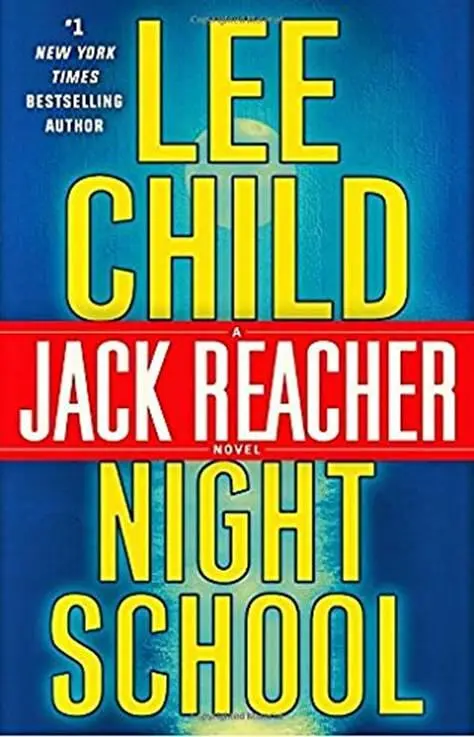
- Название:Night School
- Автор:
- Жанр:
- Год:неизвестен
- ISBN:нет данных
- Рейтинг книги:4 / 5. Голосов: 1
-
Избранное:Добавить в избранное
- Отзывы:
-
Ваша оценка:
Night School: краткое содержание, описание и аннотация
Предлагаем к чтению аннотацию, описание, краткое содержание или предисловие (зависит от того, что написал сам автор книги «Night School»). Если вы не нашли необходимую информацию о книге — напишите в комментариях, мы постараемся отыскать её.
It's 1996, and Reacher is still in the army. In the morning they give him a medal, and in the afternoon they send him back to school. That night he's off the grid. Out of sight, out of mind.
Two other men are in the classroom – an FBI agent and a CIA analyst. Each is a first-rate operator, each is fresh off a big win, and each is wondering what the hell they are doing there.
Then they find out: A jihadist sleeper cell in Hamburg, Germany, has received an unexpected visitor – a Saudi courier seeking safe haven while waiting to rendezvous with persons unknown. A CIA asset undercover inside the cell has overheard the courier whisper a chilling message: "The American wants a hundred million dollars."
For what? And who from? Reacher and his two new friends are told to find the American. Reacher recruits the best soldier he has ever worked with: Sergeant Frances Neagley. Their mission heats up in more ways than one, while always keeping their eyes on the prize: If they don't get their man, the world will suffer an epic act of terrorism.
From Langley to Hamburg, Jalalabad to Kiev, Night School moves like a bullet through a treacherous landscape of double crosses, faked identities, and new and terrible enemies as Reacher maneuvers inside the game and outside the law.
Night School — читать онлайн бесплатно полную книгу (весь текст) целиком
Ниже представлен текст книги, разбитый по страницам. Система сохранения места последней прочитанной страницы, позволяет с удобством читать онлайн бесплатно книгу «Night School», без необходимости каждый раз заново искать на чём Вы остановились. Поставьте закладку, и сможете в любой момент перейти на страницу, на которой закончили чтение.
Интервал:
Закладка:
“My lawyer knows them all. My accountant knows them all. Probably my housekeeper knows them all.”
“You were eating breakfast under an assumed name four thousand miles from home. Your replica DL was dropped twenty feet away. You don’t believe in coincidence. Who knew you were here?”
Sinclair paused a beat and said, “The White House travel office.”
“Who else?”
“No one else.”
“Not even the hotel desk,” Reacher said. “You’re using a different name. Only one possible explanation. Someone in the travel office made a phone call.”
“To who? Some local woman trained to impersonate me?”
“There is no local woman. No one went to the desk. No one entered the lobby except a small man in a raincoat.”
“So what happened?”
“The small man in the raincoat knew your ETA. The night flight, on Lufthansa. Someone in the travel office told him all about it. He followed you from the airport to the hotel, he hung around across the street, he saw you check in, he saw you get in the elevator, he snuck in the lobby, he called the elevator back down, he dropped the license on the floor, and he turned around and walked away.”
“Why did he do all that?”
“It was a message. I think you were supposed to find the license yourself. You went up to dump your bag, and he expected you to come back down again for breakfast.”
“I took the stairs.”
“Evidently.”
“Why an older person who has been in the travel office a long time?”
“You can figure that out. In fact I think you already have. You’re not wondering who the man in the raincoat was. Because you know.”
“I don’t.”
“You’re pretty sure.”
“There are things I can’t tell you.”
Neagley said, “Let me hazard a wild-ass guess. You guys ran a black operation somewhere and gave our side German papers. For false-flag cover. Or just for the fun of it. Or the Israelis did, with your permission. The German government found out and got upset. You wouldn’t admit it or discuss it, so now their intelligence service is applying some very civilized German-style pressure. They’re saying, see, we can do it, too. They’re asking, how do you like it now? There’s an element of showing off in there, I guess, but why not? It’s all very discreet, and ultimately harmless. But unsettling, I imagine.”
“Why an older person who has been there a long time?”
“They have embassy people who could have done it, but deniability is always a good thing, so they called on a local asset. There are no new relationships of that type. Not for the new Germany. They’re all historic survivors from the old East Germany. Some young U.S. government worker, way back when, hoping for a revolution, copying documents and leaving them under a rock in a park. Then he buys a house and needs some cash, and it rolls on, until eventually the new Germany and its new intelligence service inherit him. Now finally he’s useful. He knows your home address, because he’s in the travel office now. So he runs the license scam, and he delivers the replacement to the embassy. Ratcliffe’s too, maybe, plus whoever else they’re tweaking. Where they all wait patiently in a drawer, until the first of you comes to Germany. Which would be you, this morning. Lufthansa cooperated, because it’s a state airline. You didn’t fly alone. A German embassy worker got a last-minute seat, with your license in an envelope. Which is why the man in the raincoat had to follow you from the airport. He could have waited here, because he knew where you were headed, because the travel office booked your room, but he had to meet the flight first, because the embassy worker had to hand off the envelope. The license was about two minutes behind you, all the way into town.”
Sinclair was quiet for a long time. Then she said, “I won’t comment on any of that. But obviously we couldn’t admit it. If such a thing had happened. Which I’m not saying either way.”
Reacher asked, “Are you going to respond?”
“That would be a complicated double bluff, wouldn’t it?”
“You could go to Griezman. Make him bluff. He’ll make nice to you, but then he’ll bury it behind your back, in order to be seen as a reliable guy by his own government. Which would do him good. He might regard that as a favor. He might watch the safe house in return.”
“Simpler for him to insist on us running the fingerprint.”
“Which we should anyway. A woman was killed. It would be the right thing to do.”
“That’s the view from the cheap seats?”
“Should be the view from every seat.”
Sinclair said nothing.
Reacher said, “We could run it privately. If it’s a null result, we could tell him. If it isn’t, we could figure something out as we went along.”
“What are the odds?”
“Soldiers use hookers but don’t usually kill them. And she was expensive, judging by the neighborhood. Which makes it even less likely.”
“No,” Sinclair said. “It’s a can of worms. Too much political risk.”
–
At that moment the new messenger was in the immigration line, at the Hamburg airport. There were four booths operational, two labeled for European Union passports only, and two for other passports. Hers was Pakistani. She was fifth in line. Not nervous. No reason to be. She was a clean skin. Brand-new. She was in no databases. She had never been anywhere. Never seen, never fingerprinted, never photographed except literally once in her life, for the passport she was carrying. Which was completely real, except for the name, and the nationality.
Now she was fourth in line. She could see her reflection in the glass of the booth. Her hair was mussed, and her eyes were sleepy. Vulnerable. Her explorer shirt was still white and crisp. All treated and antimicrobial. Unbuttoned two down. Never three, she had been told. Unless it looks accidental. Pick a line with a male official .
Now she was third in line.
–
Reacher and Neagley left Sinclair in her room. They leapfrogged Reacher’s billet and went to Neagley’s, so they couldn’t be heard through the wall. Reacher said, “I don’t know why she came. She won’t watch the safe house.”
“She’s here because slim is better than none.”
“Except she’s deliberately opting for none.”
“Is she?”
“What are you talking about?”
“Never mind,” Neagley said. “Take a break. The East Coast won’t be up and running for another hour. We’ll get together then. I’m sure a conference call will cheer us up.”
–
Reacher went out for a walk. He found himself in a street full of menswear shops. And belts and gloves and watches and wallets. Clothing and accessories. Like an unofficial outdoor mall. He stopped in at a basic place and bought fresh underwear and a new T-shirt. The T-shirt was black, and spun from a fine grade of cotton. It cost about four times what he was accustomed to paying. But it fit. Germans were tall, on average. Not as tall as the Dutch, who were world champions, but taller than Americans, as a whole.
He changed in the store’s cubicle and dumped his old stuff in the trash. Like Neagley had said. A million small things missing. An olive drab undershirt, right there, once issued, never returned or reported missing or destroyed, and therefore now suddenly subtracted from an inventory that as a consequence would be out of balance forever.
He walked on. Halfway down the street there was a barbershop, like the centerpiece of the unofficial mall. It was tricked out to look like an old-time American place. Two vinyl chairs, with more chrome than a Cadillac. A big old radio on a shelf. Not a marketing plan, but a tribute. There was no large number of U.S. military nearby. And the PX barber was always cheaper. To Reacher’s practiced eye the place looked more like a diner than a barbershop, but it was a brave attempt. Some of the accessories were good. There was a visual chart taped to a mirror. An American publication. Reacher had seen hundreds of them in the States. Black-and-white line drawings, twenty-four heads, all with different styles, so the customer could point, instead of explaining. Top left was a standard crew cut, then came the whitewall, and the flat top, and the fade, and so on, the styles getting a little longer and a little weirder as they approached the bottom right. The Mohawk was in there, plus a couple of others that made the Mohawk look a model of probity.
Читать дальшеИнтервал:
Закладка:
Похожие книги на «Night School»
Представляем Вашему вниманию похожие книги на «Night School» списком для выбора. Мы отобрали схожую по названию и смыслу литературу в надежде предоставить читателям больше вариантов отыскать новые, интересные, ещё непрочитанные произведения.





Обсуждение, отзывы о книге «Night School» и просто собственные мнения читателей. Оставьте ваши комментарии, напишите, что Вы думаете о произведении, его смысле или главных героях. Укажите что конкретно понравилось, а что нет, и почему Вы так считаете.