Dale Brown - Puppet Master
Здесь есть возможность читать онлайн «Dale Brown - Puppet Master» весь текст электронной книги совершенно бесплатно (целиком полную версию без сокращений). В некоторых случаях можно слушать аудио, скачать через торрент в формате fb2 и присутствует краткое содержание. Город: New York, Год выпуска: 2016, ISBN: 2016, Издательство: William Morrow, Жанр: Триллер, на английском языке. Описание произведения, (предисловие) а так же отзывы посетителей доступны на портале библиотеки ЛибКат.
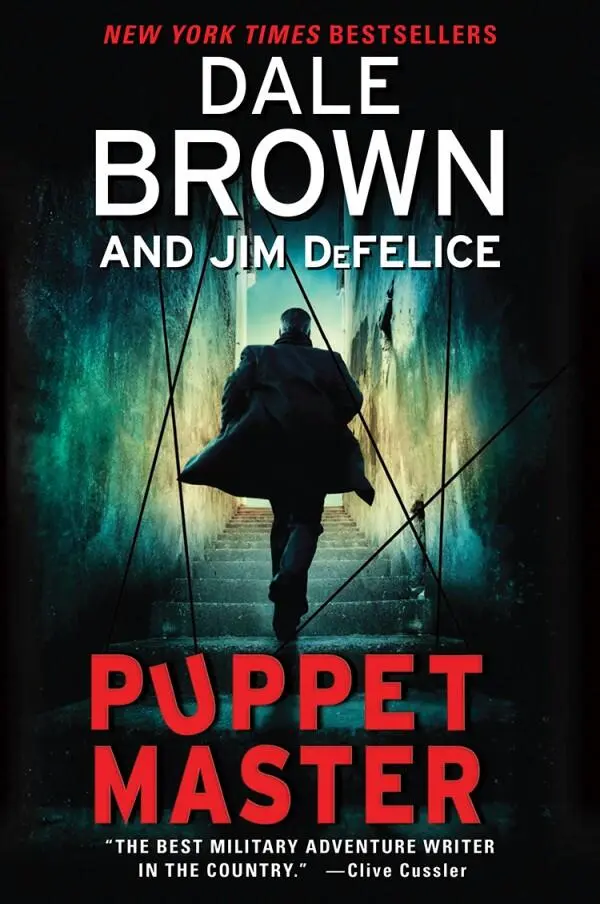
- Название:Puppet Master
- Автор:
- Издательство:William Morrow
- Жанр:
- Год:2016
- Город:New York
- ISBN:9780062411310
- Рейтинг книги:5 / 5. Голосов: 1
-
Избранное:Добавить в избранное
- Отзывы:
-
Ваша оценка:
Puppet Master: краткое содержание, описание и аннотация
Предлагаем к чтению аннотацию, описание, краткое содержание или предисловие (зависит от того, что написал сам автор книги «Puppet Master»). Если вы не нашли необходимую информацию о книге — напишите в комментариях, мы постараемся отыскать её.
, intelligent machines take center stage as America battles the Russian mafia in Eastern Europe
Louis Massina is revolutionizing the field of robotics. His technological wonders are capable of locating disaster survivors, preventing nuclear meltdowns, and replacing missing limbs. After one of Massina’s creations makes a miraculous rescue, an FBI agent recruits him to pursue criminals running a massive financial scam — and not coincidentally, suspected of killing the agent’s brother. Massina agrees to deploy a surveillance “bot” that uses artificial intelligence to follow its target. But when he’s thrust into a dangerous conspiracy, the billionaire inventor decides to take matters into his own hands, unleashing the greatest cyber-weapons in the world and becoming the Puppet Master.
Puppet Master — читать онлайн бесплатно полную книгу (весь текст) целиком
Ниже представлен текст книги, разбитый по страницам. Система сохранения места последней прочитанной страницы, позволяет с удобством читать онлайн бесплатно книгу «Puppet Master», без необходимости каждый раз заново искать на чём Вы остановились. Поставьте закладку, и сможете в любой момент перейти на страницу, на которой закончили чтение.
Интервал:
Закладка:
Caulfield’s escape to New York had a certain appeal, given her father’s likely attitude at her breaking curfew and using a “found” ATM card (the explanation she had settled on), but ultimately she decided to go home. She knew from experience that his anger would be short-lived. She also knew, or guessed, that he would be unable to figure out what she was up to, and as long as she supplied a halfway decent story to explain it, the repercussions would be limited.
I found the ATM card on the way home and decided to see if it worked.
A simple story, impossible to refute. She worked on the narrative as she walked home, imagining it unfolding as an interrogation:
Where did you find it?
On the sidewalk.
You didn’t look for the owner?
I asked a man I saw. He shook his head.
Where was this?
Around the corner.
No, that was too close. Someone might have seen her, or rather, not seen her.
A block from school, in the gutter. It was wet.
Good touch.
Why did you go out after curfew?
I had to do my homework first.
He’d like that answer. Maybe he wouldn’t believe it — she could offer to have him call her teachers, who’d all remember how bright she’d been today.
Curfew was going to be the sticker. She couldn’t get away from the basic fact that she had been out late. So she was going to be in trouble for that, no matter what else.
She could say she was sorry about that, right away.
I throw myself on the mercy of the court and I fall on my sword.
He’d ask where she got such expressions. She could mention Catcher in the Rye, even though they weren’t in there that she recalled. He’d accuse her of changing the subject. She’d say she was simply answering questions.
A thousand variations occurred to her as she neared her home. She needed more time to rehearse — she turned quickly up the block, planning to circle until she felt ready.
Tolevi leapt from the couch, caught by surprise.
“Easy,” said Yuri Johansen. “Slow down.”
Johansen stood in front of him in the living room. Two men, both in black pin-striped suits, stood behind him. Both looked as if they could headline a heavyweight boxing match, even in formal wear. Johansen himself was dressed in tan khakis and a pullover sweater, casual. Tolevi shook his head, trying to wake up. He’d been in the middle of a dream.
His wife was in it, alive. They were in a building somewhere, running, lost… He couldn’t remember the details.
“What’s this ATM scam you’re running?” asked Johansen mildly.
“What ATM scam?” asked Tolevi.
“The FBI has you fingered for a bank scam. That’s why they picked you up. Luckily for you, I intervened. It wasn’t easy. I had to get the deputy director involved.” Johansen turned to one of the suits. “Go make him some coffee.”
“Why are you here?” Tolevi asked.
“Because you were in trouble.” Johansen shook his head, smiling. “You are being a naughtier boy than we thought.”
“I don’t like games,” said Tolevi. He thought of the pistol hidden below the end table, and the other, behind the dresser in his bedroom. It was impossible to reach either, and beyond foolish to use them, yet something about the idea of shooting Johansen appealed to him in a way it never had before.
Kill all of them and be done with them .
Then what? Escape to Mexico with Borya. Or Russia, or Kiev.
Neither would do.
“End whatever you are doing with the banks,” said Johansen, his tone once more businesslike. “That is over.”
“I’m not doing anything with the banks.”
“Your mob connections — it’s time for you to ease them off. To the extent you can without destroying your contacts.”
“I’m not part of the family. You know that. But they are very useful.”
“Find another way to get things done.”
“Why are you giving me orders?” asked Tolevi. “That’s not how I work.”
“Have some coffee,” said Johansen, nodding at the suit who was approaching with a cup. “You take it black, yes?”
Borya trotted up the stairs, ready to deal with her father. She pushed through the outside door and walked quickly through the hall. The building had once housed two apartments; when it was remodeled, the exterior stairs to the second floor were retained, along with the opening to the first floor near the rear of the hall. Borya swung her key from its string on her pocket, then saw that the door was ajar.
A sure sign her father was home and awake.
Oh well.
She pushed inside, taking two steps across the foyer before spotting the two men in business suits gaping at her near the open dining area on the other side of the living room. Her father and another man, older, with white hair, were sitting at the table. She didn’t recognize any of them, aside from her father.
The man with the white hair turned and looked at her.
“You must be Borya,” he said cheerfully. “Hello.”
“We’re busy,” snapped her father. “Go do your homework.”
“I get a snack,” she said, taken off guard by his tone. “I—”
“Later.”
Borya put her head down and headed quickly through the living room to the back hall.
Why were the men here? Were they police?
They must have discovered her ATM scam. She cursed herself for letting it go on too long.
Gluttony. That was the worst sin. The nuns told her that all the time. Why hadn’t she listened? They were humorless old farts, but they did know certain things, things that could at least get you out of trouble, or steer you away from it.
She’d damned herself by being too cocky, too confident. She didn’t need the money — she’d barely spent any of it. She’d done it for the thrill, and what was that now, now that they were going to send her to jail?
Borya closed her door carefully and threw herself on the bed, completely in despair. She would never get out of this. They would drive her to jail, lock her up until she was an old woman.
My life is over.
She rolled over to her back, staring at the ceiling and trying to hear what the men were saying below. Their voices were too low and muffled to make anything out. Reluctantly, she got up and crept to the door. Still unable to make any sense of the muffled voices, she cracked the door open and put her ear into the opening, holding her breath as she listened.
“We need you there by the end of the week,” said one of the men — the white-haired geezer guy.
“That’s all you tell me?” That was definitely her father. He was speaking sharply, his tone even harder than he used when the nuns called about a test she had blown off.
The white-haired guy said something too muffled to make out. Then her father again:
“I can’t leave my daughter.”
“Find a way.”
They weren’t talking about ATMs and the banks. They weren’t here about her at all.
Borya’s mood rocketed. She pressed her ear against the open space, leaning out, curious now.
Careful! Curiosity killed the cat.
“Use this phone to contact me tomorrow,” said the white-haired guy.
Chairs scraped. Footsteps.
Borya pushed the door closed and tiptoed over to the bed, trying to be quiet.
If they come in, I’ll pretend to be asleep.
As soon as Johansen and his goons were gone, Tolevi went to the kitchen and retrieved a bottle of vodka from below the sink. He poured three fingers’ worth into a tumbler and downed it all. He refilled it, this time about two fingers’ worth, and once more drained the glass. Then he splashed about a finger’s worth in and went to sit down on the couch.
Читать дальшеИнтервал:
Закладка:
Похожие книги на «Puppet Master»
Представляем Вашему вниманию похожие книги на «Puppet Master» списком для выбора. Мы отобрали схожую по названию и смыслу литературу в надежде предоставить читателям больше вариантов отыскать новые, интересные, ещё непрочитанные произведения.











Обсуждение, отзывы о книге «Puppet Master» и просто собственные мнения читателей. Оставьте ваши комментарии, напишите, что Вы думаете о произведении, его смысле или главных героях. Укажите что конкретно понравилось, а что нет, и почему Вы так считаете.