Dale Brown - Puppet Master
Здесь есть возможность читать онлайн «Dale Brown - Puppet Master» весь текст электронной книги совершенно бесплатно (целиком полную версию без сокращений). В некоторых случаях можно слушать аудио, скачать через торрент в формате fb2 и присутствует краткое содержание. Город: New York, Год выпуска: 2016, ISBN: 2016, Издательство: William Morrow, Жанр: Триллер, на английском языке. Описание произведения, (предисловие) а так же отзывы посетителей доступны на портале библиотеки ЛибКат.
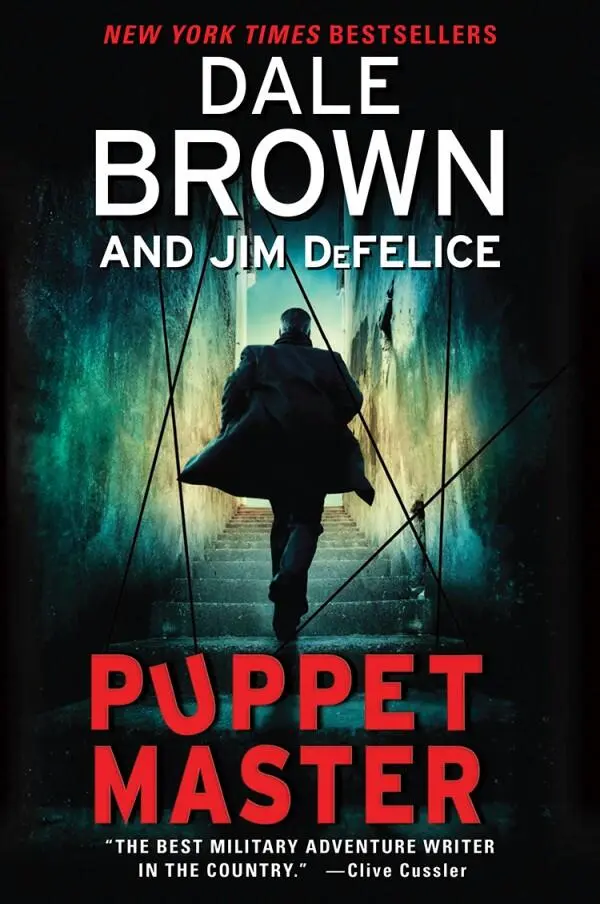
- Название:Puppet Master
- Автор:
- Издательство:William Morrow
- Жанр:
- Год:2016
- Город:New York
- ISBN:9780062411310
- Рейтинг книги:5 / 5. Голосов: 1
-
Избранное:Добавить в избранное
- Отзывы:
-
Ваша оценка:
Puppet Master: краткое содержание, описание и аннотация
Предлагаем к чтению аннотацию, описание, краткое содержание или предисловие (зависит от того, что написал сам автор книги «Puppet Master»). Если вы не нашли необходимую информацию о книге — напишите в комментариях, мы постараемся отыскать её.
, intelligent machines take center stage as America battles the Russian mafia in Eastern Europe
Louis Massina is revolutionizing the field of robotics. His technological wonders are capable of locating disaster survivors, preventing nuclear meltdowns, and replacing missing limbs. After one of Massina’s creations makes a miraculous rescue, an FBI agent recruits him to pursue criminals running a massive financial scam — and not coincidentally, suspected of killing the agent’s brother. Massina agrees to deploy a surveillance “bot” that uses artificial intelligence to follow its target. But when he’s thrust into a dangerous conspiracy, the billionaire inventor decides to take matters into his own hands, unleashing the greatest cyber-weapons in the world and becoming the Puppet Master.
Puppet Master — читать онлайн бесплатно полную книгу (весь текст) целиком
Ниже представлен текст книги, разбитый по страницам. Система сохранения места последней прочитанной страницы, позволяет с удобством читать онлайн бесплатно книгу «Puppet Master», без необходимости каждый раз заново искать на чём Вы остановились. Поставьте закладку, и сможете в любой момент перейти на страницу, на которой закончили чтение.
Интервал:
Закладка:
They turned the corner. Jenkins accelerated, not wanting to lose them. As he came around the corner, a white panel truck cut into his lane. Jenkins hit the brakes so hard the car veered to the right, just missing a Volkswagen parked near the corner.
“Son of a bitch,” he shouted.
He laid on the horn, cursing. Then another car hit him from behind, pushing his vehicle into the VW. Jenkins pounded the steering wheel and went to grab the door handle.
Instead he found himself being lifted through the already open door. Before he could react, he was thrown against the hood of his car. His jacket and arms were pulled behind him, and his gun holster twisted back. As two men, each much larger than himself, pinned him against the car, another removed his wallet and his pistol.
“Let him go.”
Jenkins shook himself free as he was let up off the car. He turned and saw the man with the white hair who’d come out of the apartment holding his wallet and service pistol. He was grinning.
“Special Agent in Charge, huh?” The man flipped the wallet to him but held on to the gun. “You have to be more alert in Boston, even down here.”
“What’s it to you?”
“Just some friendly advice.” The man flicked the magazine latch on the pistol, dropping the box to the ground. Then he cleared the chamber, making sure the weapon was empty. “The streets can be pretty mean. I know you have a pistol on your leg,” he added. “Reaching for it wouldn’t be the smartest thing you’ve ever done.”
“I’m going to nail you,” said Jenkins.
The man laughed. “You don’t even know who I am. Let me give you another piece of advice — don’t poke your nose into places where it doesn’t belong. The next person who sees it may not be as considerate as I am.”
He tossed the gun into Jenkins’s chest so quickly that the FBI agent didn’t have time to grab it; it bounced through his hands and fell to the ground.
“I’d get the car fixed if I were you,” added the man as he started away. “Boston police love to give out tickets for broken taillights.”
39
Johnny Givens took a deep breath, then pushed himself forward on the parallel bars.
The legs, newly fitted, felt unsteady.
That was the strange thing — they felt unsteady. He really did feel them, even though they were carbon fiber and fancy plastic and wires and circuits — not skin, not blood, not bones or nerves.
Fake legs.
But he could feel them.
Partly this was his brain making things up. His mind was substituting what it knew for the sensations that were tickling the nerve endings in the stumps. But there were real sensations. That was the marvel of the legs Massina and his people had invented for him. They were real legs. Almost.
“Keep going, Mr. Givens,” said Dr. Gleason. Gleason was the doctor in charge of his health, the head of a large team of surgeons and other specialists, therapists, scientists, engineers, nurses, and probably a dishwasher or two. Despite his other responsibilities, Gleason spent at least an hour every afternoon with Johnny.
The physical therapist spent three hours each morning, and four in the afternoons. Every moment sucked. Johnny called her Gestapo Bitch.
Not to her face. She looked like she could put him through the wall if he did.
“Use your legs to walk,” she commanded from the far end of the bars. “Move!”
“Easy,” said Gleason. “I don’t want his heart overtaxed.”
“He’s barely at sixty beats a minute. I’ve seen nine-year-olds work harder than this.” Gestapo Bitch shook her head in disgust. “Move, Givens, move! And put your weight on your legs. They’re not going to break!”
Givens put more weight on his left foot, pushing forward. He was a little kid, learning to walk again.
Was he ever going to really walk again?
“You’re doing really well, Johnny,” said Dr. Gleason. “Keep going.”
Johnny felt his hips swinging as he maneuvered down the bars. That was good — he was supposed to use his whole body.
Sweat poured down the sides of his face, down his back, across his neck. It flowed from every pore in his torso, from his arms, from his hands. Gestapo Bitch might think that he was barely working, but he knew better. He could feel the mechanical heart beating away.
It was interesting, though. It did increase its rate, but not nearly as much as a “real” heart would. It was very steady, measured, as if it knew better than the rest of his body what he needed.
As Johnny reached the end of the parallel bars, the sweat from his hands made his palms slippery. He decided to stop and wipe his hands on his shirt, needing to dry them. Steadying himself on his left side, he took his right hand off the bar and ran it down his right rib cage, the driest part of his T-shirt. As he started to switch sides, his left hand slipped. He quickly shoved his right hand toward the bar, but his momentum pitched him to the side. He tried grabbing the bar, but it was too late; he unceremoniously toppled backward, to the floor.
Son of a bitch!
I am never going to do this! Never!
Why the hell did God screw me like this? Why is he such a bastard?
“Are you all right, Johnny?” asked Dr. Gleason, starting over.
“He’s OK,” scolded Gestapo Bitch. “Get up and go back. You don’t stop until you get to the end. You stop, you do it again.”
Johnny didn’t move.
“Do you need help?” asked Gleason.
“He doesn’t need help,” snapped Gestapo Bitch.
Damn you, bitch!
Johnny reached up to the bar. Gestapo Bitch loomed over him and smacked his hand away. “Push yourself up with your legs. Use them or lose them.”
“They’re not my legs,” he told her.
“They sure as hell are. Push yourself up with your legs.”
“I hate you.”
“Good. Now push yourself up with your legs and stop being a crybaby.”
“I’m going to kick your ass when I’m better.”
Gestapo Bitch leaned in until her face was an inch from his. “I’m waiting for the day, Sissy Breath.” She straightened. “Now get on your feet.”
40
Louis Massina was not used to giving up, much less being told to give up. There was simply no way that he was not going to pursue the ATM thieves.
On the contrary, it was now his number-one priority. But Massina being Massina, the issue was not simply one of revenge, let alone getting his money back. It had provoked a wide range of thoughts about computer security, national security, and even politics. Petty thievery was one thing; being able to infiltrate and manipulate the banking system, quite another. The FBI’s sudden decision to drop the case suggested many things to Massina, not least of which was the possibility that the government could secretly manipulate the banking system for its own purposes. Even if that wasn’t what was going on here — more evidence would be needed on that score — the potential surely existed.
Massina had always taken Internet security very seriously; that was a necessity at a firm where IT was critical to its operations. Chinese and Russian hackers, almost surely state-sponsored, constantly tried to break into Smart Metal’s systems. And they were only the more notorious — just in the past week, hackers from several Western European countries had tried to breach the company’s e-mail systems. Most of Smart Metal’s work was done on internal systems that would not allow any outside access, from trusted sources or not, but even that system had to be constantly monitored for potential breaches.
Читать дальшеИнтервал:
Закладка:
Похожие книги на «Puppet Master»
Представляем Вашему вниманию похожие книги на «Puppet Master» списком для выбора. Мы отобрали схожую по названию и смыслу литературу в надежде предоставить читателям больше вариантов отыскать новые, интересные, ещё непрочитанные произведения.












Обсуждение, отзывы о книге «Puppet Master» и просто собственные мнения читателей. Оставьте ваши комментарии, напишите, что Вы думаете о произведении, его смысле или главных героях. Укажите что конкретно понравилось, а что нет, и почему Вы так считаете.