Dale Brown - Puppet Master
Здесь есть возможность читать онлайн «Dale Brown - Puppet Master» весь текст электронной книги совершенно бесплатно (целиком полную версию без сокращений). В некоторых случаях можно слушать аудио, скачать через торрент в формате fb2 и присутствует краткое содержание. Город: New York, Год выпуска: 2016, ISBN: 2016, Издательство: William Morrow, Жанр: Триллер, на английском языке. Описание произведения, (предисловие) а так же отзывы посетителей доступны на портале библиотеки ЛибКат.
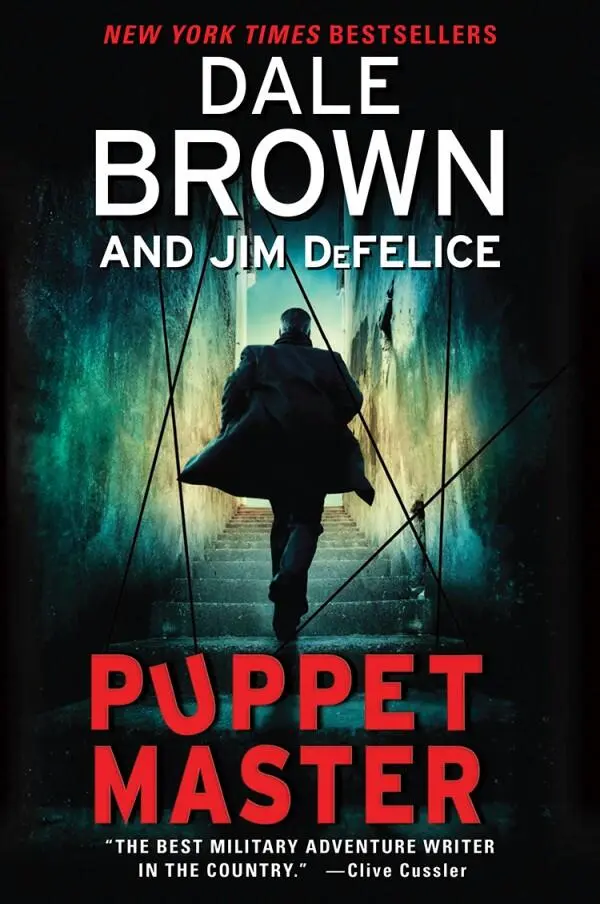
- Название:Puppet Master
- Автор:
- Издательство:William Morrow
- Жанр:
- Год:2016
- Город:New York
- ISBN:9780062411310
- Рейтинг книги:5 / 5. Голосов: 1
-
Избранное:Добавить в избранное
- Отзывы:
-
Ваша оценка:
Puppet Master: краткое содержание, описание и аннотация
Предлагаем к чтению аннотацию, описание, краткое содержание или предисловие (зависит от того, что написал сам автор книги «Puppet Master»). Если вы не нашли необходимую информацию о книге — напишите в комментариях, мы постараемся отыскать её.
, intelligent machines take center stage as America battles the Russian mafia in Eastern Europe
Louis Massina is revolutionizing the field of robotics. His technological wonders are capable of locating disaster survivors, preventing nuclear meltdowns, and replacing missing limbs. After one of Massina’s creations makes a miraculous rescue, an FBI agent recruits him to pursue criminals running a massive financial scam — and not coincidentally, suspected of killing the agent’s brother. Massina agrees to deploy a surveillance “bot” that uses artificial intelligence to follow its target. But when he’s thrust into a dangerous conspiracy, the billionaire inventor decides to take matters into his own hands, unleashing the greatest cyber-weapons in the world and becoming the Puppet Master.
Puppet Master — читать онлайн бесплатно полную книгу (весь текст) целиком
Ниже представлен текст книги, разбитый по страницам. Система сохранения места последней прочитанной страницы, позволяет с удобством читать онлайн бесплатно книгу «Puppet Master», без необходимости каждый раз заново искать на чём Вы остановились. Поставьте закладку, и сможете в любой момент перейти на страницу, на которой закончили чтение.
Интервал:
Закладка:
“The loyalists are clearly losing ground if they’re scraping the bottom of the barrel,” he explained. “And that is bad for my business as well. Bad all around.”
“I see.” Johansen seemed neither concerned nor surprised. But then he never did.
So how had he heard about the problem at the airport? Perhaps the man with the bad haircut worked for him, rather than the Russians.
Tolevi bit into the hamburger. It didn’t quite taste like a burger he’d have back in the States. Then again, he rarely if ever ate at a fast-food restaurant; that was only something he did as part of the recognition routine.
Maybe a way for the CIA to torture him, he thought.
“We have something critical coming up we were wondering if you could handle,” said Johansen. “We need to get somebody out.”
“That’s not my usual line,” said Tolevi.
“You’ve done it before.”
“That was a onetime deal,” said Tolevi, picking up a French fry. “I’ve been thinking about getting out of the business completely.”
“Can you afford that? The rent on your town house is very high. Your car lease, the summer house in Maine? And you owe quite a bit of money to your friends, I understand.”
“Easily paid,” lied Tolevi. He was, in fact, quite a bit in the hole of late; several deals had not worked out, costing him his principal.
“And then there’s college tuition soon.”
The reference to his daughter was subtle, but not subtle enough. It was more like something the Russian FGB would say.
“That’s not a threat,” said Johansen quickly. “I’m just saying compensation will be very good for this. And then maybe that will be the time for a sabbatical. When it’s done.”
“What exactly are we talking about?”
“In a few days.” Johansen rose, then reached across and took the briefcase Tolevi had put on the seat. “Go home and rest. Have a good flight.”
23
I’m in a room with an aquarium.
I’m in an aquarium.
Who are these people talking?
Why are the lights on?
Johnny Givens opened his eyes. He wasn’t exactly sure where he was.
No, he knew he was in a hospital. How he knew that, though, he couldn’t say.
A woman was standing over him. She was smiling.
A nurse. She wore a paisley blue top and white pants.
A man stood next to her. Older. Gray hair. He was frowning.
“Doc?” he muttered.
“I’m not your doctor. My name is Louis Massina. I’m responsible for your being here.”
“You found me?”
The nurse choked back a laugh.
“No. I had you moved here. You needed a new heart.”
“What?”
“Dr. Gleason will be in soon to explain,” said the nurse.
“Can I have some water?” Johnny asked.
The nurse left to fetch it. Massina stared at him, his face stone.
“You’ve lost your legs. Both of them,” Massina told him. “We’re preparing prosthetics.”
“What? My legs? They’re here. I feel them.” Johnny started to push himself up, but a black wave hit him and slammed his head back to the pillow.
“They’re not,” said Massina coldly. “It’s phantom pain. They’ve done a lot of work on you. They’re going to do more. The sooner you can start rehabilitation, the better.”
“What the hell are you talking about?” asked Johnny.
“The heart is designed to last ten years. By then, either you’ll be a candidate for a human one, or we’ll have a better model. I suspect both. It’ll be your choice.”
“What?”
“We’ve given you drugs to speed your recovery. Normally it takes weeks to get stumps. In my day, it was months. Many months. The drugs will make it happen overnight. Literally. Without them you would have died. There are side effects,” Massina added, “but we’ll get into that when you’re well.”
“Who the hell are you?”
“I’m sorry you were hurt,” said Massina. He turned to leave.
“Wait,” demanded Johnny. “My legs—”
“You won’t miss them.”
“What the hell are you saying? How would you know?”
Massina removed his sport jacket, then slowly rolled up the right-hand sleeve of his sweater. He reached his left hand up to his shoulder below the shirt. Then he removed the arm and held it toward Johnny.
The black wave returned. Johnny felt as if he was going to faint. Massina left without saying another word.
24
Borya threw herself back on the bed, rolling against the twenty-dollar bills she’d sorted into neat piles perpendicular to her pillows. Her home “stash” amounted to just over a thousand dollars, including money from her birthday, her godmother’s semi-monthly presents, and her dad’s allowance. It was literally more cash than she knew what to do with; it didn’t count her “secret” money, or even the bills hidden in an envelope taped to the back of the dresser: two hundred and fifty-seven dollars she had saved from her last enterprise, helping Gordon Heller dispose of two stolen TVs last year.
She shouldn’t have done that. Three years older than her, Gordon had practically hypnotized her at the time, though now she couldn’t begin to imagine why. He was smelly and not very bright, though obviously smart enough to find someone else to deflect blame when doing something illegal. Two days after she told him she wasn’t going to give him a bj — as he called it — he started going out with Cynthia Greiss, and that was that.
Jerk.
But what was she going to do with all this money?
A new computer. Her MSI was starting to seem a little slow, even though it was only six months old. TromboneHackerD had been bragging on Asus lately; maybe she’d check it out.
She didn’t have enough for that. She wasn’t going to touch the money she’d already hidden in the Austrian bank — the vast bulk of her gleanings from the ATMs. There was a reason to do one more round, then close down.
OK. A goal .
Borya rolled back off the bed, gathered the money back into four separate piles, and hid it away in various places in her room. Then she grabbed a sweatshirt, checked her hair, and went down to get her bike.
When she’d started, the ATM enterprise had been a challenge and a lark, a goof, a little bit of fun and excitement. It didn’t hurt anyone, not like Gordon’s thefts; the banks made good, from what she heard. She had started by looking into skimmers, then realized that the card machine her father had locked in his office safe gave her possibilities far beyond what a skimmer gang might have. Figuring out how to get the safe open was harder than the coding.
Not really. But the coding wasn’t all that hard to do, with the help of a little research on the Internet.
But the excitement had worn off. It was time to try something else.
What exactly?
Borya pondered the possibilities as she unchained her bike from beneath the back porch.
Tolevi leaned forward in the backseat as the sedan pulled up the street near his house. As always, he felt a slight touch of nostalgia, remembering how his wife would always be waiting when he returned. That was more than a decade ago, several lifetimes, and a different continent.
As he reached for the door, a figure darted from the driveway of the neighbor’s house, one door down. It mounted a bicycle, smoothly gliding down the street.
Was that his daughter, Borya?
It certainly looked like her: slim build, pressing down toward the handlebars exactly the way she rode. The rider passed under a lamppost near the corner; he or she was wearing a gray hoodie.
Читать дальшеИнтервал:
Закладка:
Похожие книги на «Puppet Master»
Представляем Вашему вниманию похожие книги на «Puppet Master» списком для выбора. Мы отобрали схожую по названию и смыслу литературу в надежде предоставить читателям больше вариантов отыскать новые, интересные, ещё непрочитанные произведения.











Обсуждение, отзывы о книге «Puppet Master» и просто собственные мнения читателей. Оставьте ваши комментарии, напишите, что Вы думаете о произведении, его смысле или главных героях. Укажите что конкретно понравилось, а что нет, и почему Вы так считаете.