Lee Child - Killing Floor
Здесь есть возможность читать онлайн «Lee Child - Killing Floor» весь текст электронной книги совершенно бесплатно (целиком полную версию без сокращений). В некоторых случаях можно слушать аудио, скачать через торрент в формате fb2 и присутствует краткое содержание. Жанр: Триллер, Детектив, на английском языке. Описание произведения, (предисловие) а так же отзывы посетителей доступны на портале библиотеки ЛибКат.
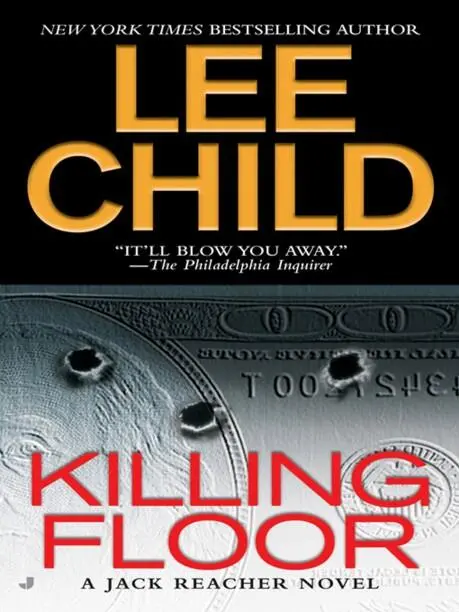
- Название:Killing Floor
- Автор:
- Жанр:
- Год:неизвестен
- ISBN:нет данных
- Рейтинг книги:4 / 5. Голосов: 1
-
Избранное:Добавить в избранное
- Отзывы:
-
Ваша оценка:
Killing Floor: краткое содержание, описание и аннотация
Предлагаем к чтению аннотацию, описание, краткое содержание или предисловие (зависит от того, что написал сам автор книги «Killing Floor»). Если вы не нашли необходимую информацию о книге — напишите в комментариях, мы постараемся отыскать её.
Killing Floor — читать онлайн бесплатно полную книгу (весь текст) целиком
Ниже представлен текст книги, разбитый по страницам. Система сохранения места последней прочитанной страницы, позволяет с удобством читать онлайн бесплатно книгу «Killing Floor», без необходимости каждый раз заново искать на чём Вы остановились. Поставьте закладку, и сможете в любой момент перейти на страницу, на которой закончили чтение.
Интервал:
Закладка:
“But what was he talking to you about?” I said.
“Joe was a new broom,” Kelstein said. “He was brought in to solve problems. He was a very talented man indeed. His job was to eradicate counterfeiting. Now, that’s an impossible job. Walter and I told him that. But he nearly succeeded. He thought hard, and he applied strokes of appealing simplicity. He just about halted all illicit printing within the United States.”
I sat in his crowded office and listened to the old guy. Kelstein had known Joe better than I had. He had shared Joe’s hopes and plans. Celebrated his successes. Sympathized over his setbacks. They had talked at length, animatedly, sparking off each other. The last time I had spoken to Joe face to face was very briefly after our mother’s funeral. I hadn’t asked him what he was doing. I’d just seen him as my older brother. Just seen him as Joe. I hadn’t seen the reality of his life as a senior agent, with hundreds of people under him, trusted by the White House to solve big problems, capable of impressing a smart old bird like Kelstein. I sat there in the armchair and felt bad. I’d lost something I never knew I’d had.
“His systems were brilliant,” Kelstein said. “His analysis was acute. He targeted ink and paper. In the end, it all boils down to ink and paper, doesn’t it? If anybody bought the sort of ink or paper that could be used to forge a banknote, Joe’s people knew within hours. He swept people up within days. Inside the States, he reduced counterfeiting activity by ninety percent. And he tracked the remaining ten percent so vigorously he got almost all of them before they’d even distributed the fakes. He impressed me greatly.”
“So what was the problem?” I asked him.
Kelstein made a couple of precise little motions with his small white hands, like he was moving one scenario aside and introducing another.
“The problem lay abroad,” he said. “Outside the United States. The situation there is very different. Did you know there are twice as many dollars outside the U.S. as inside?”
I nodded. I summarized what Molly had told me about foreign holdings. The trust and the faith. The fear of a sudden collapse in the desirability of the dollar. Kelstein was nodding away like I was his student and he liked my thesis.
“Quite so,” he said. “It’s more about politics than crime. In the end, a government’s primary duty is to defend the value of its currency. We have two hundred and sixty billion dollars abroad. The dollar is the unofficial currency of dozens of nations. In the new Russia, for instance, there are more dollars than rubles. In effect, it’s like Washington has raised a massive foreign loan. Raised any other way, that loan would cost us twenty-six billion dollars a year in interest payments alone. But this way, it costs us nothing at all except what we spend on printing pictures of dead politicians on little pieces of paper. That’s what it’s all about, Mr. Reacher. Printing currency for foreigners to buy is the best racket a government can get into. So Joe’s job in reality was worth twenty-six billion dollars a year to this country. And he pursued it with an energy appropriate to those high stakes.”
“So where was the problem?” I said. “Geographically?”
“Two main places,” Kelstein said. “First, the Middle East. Joe believed there was a plant in the Bekaa Valley that turned out fake hundreds which were practically perfect. But there was very little he could do about it. Have you been there?”
I shook my head. I’d been stationed in Beirut for a while. I had known a few people who had gone out to the Bekaa Valley for one reason or another. Not too many of them had come back.
“Syrian-controlled Lebanon,” Kelstein said. “Joe called it the badlands. They do everything there. Training camps for the world’s terrorists, drug processing laboratories, you name it, they’ve got it. Including a pretty good replica of our own Bureau of Printing and Engraving.”
I thought about it. Thought about my time there.
“Protected by who?” I asked him.
Kelstein smiled at me again. Nodded.
“A perceptive question,” he said. “You instinctively grasp that an operation of that size is so visible, so complex, that it must be in some way sponsored. Joe believed it was protected by, or maybe even owned by, the Syrian government. Therefore his involvement was marginal. His conclusion was that the only solution was diplomatic. Failing that, he was in favor of air strikes against it. We may live to see such a solution one day.”
“And the second place?” I asked him.
He pointed his finger at his grimy office window. Aiming south down Amsterdam Avenue.
“South America,” he said. “The second source is Venezuela. Joe had located it. That is what he was working on. Absolutely outstanding counterfeit hundred-dollar bills are coming out of Venezuela. But strictly private enterprise. No suggestion of government involvement.”
I nodded.
“We got that far,” I said. “A guy called Kliner, based down in Georgia where Joe was killed.”
“Quite so,” Kelstein said. “The ingenious Mr. Kliner. It’s his operation. He’s running the whole thing. We knew that for certain. How is he?”
“He’s panicking,” I said. “He’s killing people.”
Kelstein nodded sadly.
“We thought Kliner might panic,” he said. “He’s protecting an outstanding operation. The very best we’ve ever seen.”
“The best?” I said.
Kelstein nodded enthusiastically.
“Outstanding,” he said again. “How much do you know about counterfeiting?”
I shrugged at him.
“More than I did last week,” I said. “But not enough, I guess.”
Kelstein nodded and shifted his frail weight forward in his chair. His eyes lit up. He was about to start a lecture on his favorite subject.
“There are two sorts of counterfeiters,” he said. “The bad ones and the good ones. The good ones do it properly. Do you know the difference between intaglio and lithography?”
I shrugged and shook my head. Kelstein scooped up a magazine from a pile and handed it to me. It was a quarterly bulletin from a history society.
“Open it,” he said. “Any page will do. Run your fingers over the paper. It’s smooth, isn’t it? That’s lithographic printing. That’s how virtually everything is printed. Books, magazines, newspapers, everything. An inked roller passes over the blank paper. But intaglio is different.”
He suddenly clapped his hands together. I jumped. The sound was very loud in his quiet office.
“That’s intaglio,” he said. “A metal plate is smashed into the paper with considerable force. It leaves a definite embossed feel to the product. The printed image looks three dimensional. It feels three dimensional. It’s unmistakable.”
He eased himself up and took his wallet out of his hip pocket. Pulled out a ten-dollar bill. Passed it over to me.
“Can you feel it?” he asked. “The metal plates are nickel, coated with chromium. Fine lines are engraved into the chromium and the lines are filled with ink. The plate hits the paper and the ink is printed onto its topmost surface. Understand? The ink is in the valleys of the plate, so it’s transferred to the ridges on the paper. Intaglio printing is the only way to get that raised image. The only way to make the forgery feel right. It’s how the real thing is done.”
“What about the ink?” I said.
“There are three colors,” he said. “Black, and two greens. The back of the bill is printed first, with the darker green. Then the paper is left to dry, and the next day, the front is printed with the black ink. That dries, and the front is printed again, with the lighter green. That’s the other stuff you see there on the front, including the serial number. But the lighter green is printed by a different process, called letterpress. It’s a stamping action, the same as intaglio, but the ink is stamped into the valleys on the paper, not onto the peaks.”
Читать дальшеИнтервал:
Закладка:
Похожие книги на «Killing Floor»
Представляем Вашему вниманию похожие книги на «Killing Floor» списком для выбора. Мы отобрали схожую по названию и смыслу литературу в надежде предоставить читателям больше вариантов отыскать новые, интересные, ещё непрочитанные произведения.



Обсуждение, отзывы о книге «Killing Floor» и просто собственные мнения читателей. Оставьте ваши комментарии, напишите, что Вы думаете о произведении, его смысле или главных героях. Укажите что конкретно понравилось, а что нет, и почему Вы так считаете.