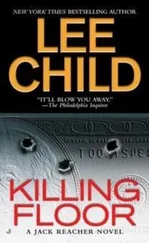
Lee Child - Killing Floor
Здесь есть возможность читать онлайн «Lee Child - Killing Floor» весь текст электронной книги совершенно бесплатно (целиком полную версию без сокращений). В некоторых случаях можно слушать аудио, скачать через торрент в формате fb2 и присутствует краткое содержание. Жанр: Триллер, Детектив, на английском языке. Описание произведения, (предисловие) а так же отзывы посетителей доступны на портале библиотеки ЛибКат.
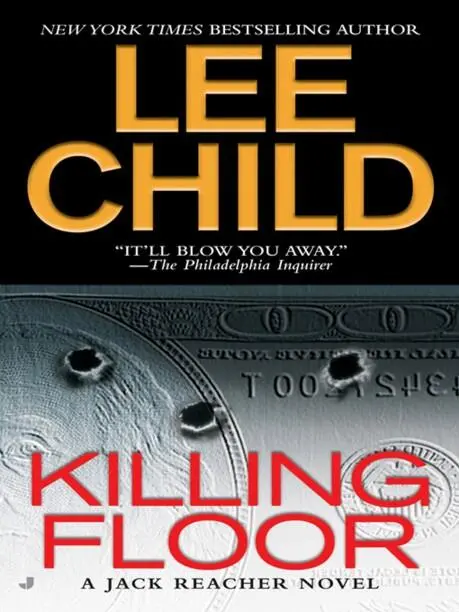
- Название:Killing Floor
- Автор:
- Жанр:
- Год:неизвестен
- ISBN:нет данных
- Рейтинг книги:4 / 5. Голосов: 1
-
Избранное:Добавить в избранное
- Отзывы:
-
Ваша оценка:
Killing Floor: краткое содержание, описание и аннотация
Предлагаем к чтению аннотацию, описание, краткое содержание или предисловие (зависит от того, что написал сам автор книги «Killing Floor»). Если вы не нашли необходимую информацию о книге — напишите в комментариях, мы постараемся отыскать её.
Killing Floor — читать онлайн бесплатно полную книгу (весь текст) целиком
Ниже представлен текст книги, разбитый по страницам. Система сохранения места последней прочитанной страницы, позволяет с удобством читать онлайн бесплатно книгу «Killing Floor», без необходимости каждый раз заново искать на чём Вы остановились. Поставьте закладку, и сможете в любой момент перейти на страницу, на которой закончили чтение.
Интервал:
Закладка:
I nodded and looked at the ten-dollar bill, front and back. Ran my fingers over it carefully. I’d never really studied one before.
“So, four problems,” Kelstein said. “The press, the plates, the inks, and the paper. The press can be bought, new or used, anywhere in the world. There are hundreds of sources. Most countries print money and securities and bonds on them. So the presses are obtainable abroad. They can even be improvised. Joe found one intaglio operation in Thailand which was using a converted squid-processing machine. Their hundreds were absolutely immaculate.”
“What about the plates?” I asked him.
“Plates are problem number two,” he said. “But it’s a matter of talent. There are people in the world who can forge Old Master paintings and there are people who can play a Mozart piano concerto after hearing it once. And certainly there are engravers who can reproduce banknotes. It’s a perfectly logical proposition, isn’t it? If a human being in Washington can engrave the original, certainly there’s a human being somewhere else who can copy it. But they’re rare. Really good copyists, rarer still. There are a few in Armenia. The Thai operation using the squid-processor got a Malaysian to make the plates.”
“OK,” I said. “So Kliner has bought a press, and he’s found an engraver. What about the inks?”
“The inks are problem number three,” he said. “You can’t buy anything vaguely like them in the U.S. Joe saw to that. But abroad, they’re available. As I said, virtually every country in the world has its own banknote printing industry. And obviously, Joe couldn’t enforce his systems in every country in the world. So the inks are easy enough to find. The greens are only a question of color. They mix them and experiment until they get them right. The black ink is magnetic, did you know that?”
I shook my head again. Looked at the sawbuck closely. Kelstein smiled.
“You can’t see it,” he said. “A liquid ferrous chemical is mixed with the black ink. That’s how electronic money counters work. They scan the engraving down the center of the portrait, and the machine reads the signal it gives off, like a tape head reads the sounds on a music cassette.”
“And they can get that ink?” I said.
“Anywhere in the world,” he said. “Everybody uses it. We lag behind other countries. We don’t like to admit we worry about counterfeiting.”
I remembered what Molly had said. Faith and trust. I nodded.
“The currency must look stable,” Kelstein said. “That’s why we’re so reluctant to change it. It’s got to look reliable, solid, unchanging. Turn that ten over and take a look.”
I looked at the green picture on the back of the ten. The Treasury Building was standing in a deserted street. Only one car was driving past. It looked like a Model-T Ford.
“Hardly changed since 1929,” Kelstein said. “Psychologically, it’s very important. We choose to put the appearance of dependability before security. It made Joe’s job very difficult.”
I nodded again.
“Right,” I said. “So we’ve covered the press, the plates, and the inks. What about the paper?”
Kelstein brightened up and clasped his small hands like we’d reached the really interesting part.
“Paper is problem number four,” he said. “Actually, we should really say it’s problem number one. It’s by far the biggest problem. It’s the thing Joe and I couldn’t understand about Kliner’s operation.”
“Why not?” I asked him.
“Because their paper is perfect,” he said. “It’s one hundred percent perfect. Their paper is better than their printing. And that is absolutely unheard of.”
He started shaking his great white head in wonderment. Like he was lost in admiration for Kliner’s achievement. We sat there, knee to knee in the old armchairs in silence.
“Perfect?” I prompted him.
He nodded and started up with the lecture again.
“It’s unheard of,” he said again. “The paper is the hardest part of the whole process. Don’t forget, we’re not talking about some amateur thing here. We’re talking about an industrial-scale operation. In a year, they’re printing four billion dollars’ worth of hundreds.”
“That many?” I said, surprised.
“Four billion,” he said again. “About the same as the Lebanon operation. Those were Joe’s figures. He was in a position to know. And that makes it inexplicable. Four billion in hundreds is forty million banknotes. That’s a lot of paper. That’s a completely inexplicable amount of paper, Mr. Reacher. And their paper is perfect.”
“What sort of paper would they need?” I asked him.
He reached over and took the ten-dollar bill back from me. Crumpled it and pulled it and snapped it.
“It’s a blend of fibers,” he said. “Very clever and entirely unique. About eighty percent cotton, about twenty percent linen. No wood pulp in it at all. It’s got more in common with the shirt on your back than with a newspaper, for instance. It’s got a very clever chemical colorant in it, to give it a unique cream tint. And it’s got random red and blue polymer threads pulped in, as fine as silk. Currency stock is wonderful paper. Durable, lasts for years, won’t come apart in water, hot or cold. Absolutely precise absorbency, capable of accepting the finest engraving the platemakers can achieve.”
“So the paper would be difficult to copy?” I said.
“Virtually impossible,” he said. “In a way, it’s so difficult to copy that even the official government supplier can’t copy it. They have tremendous difficulty just keeping it consistent, batch to batch, and they’re by far the most sophisticated papermaker in the entire world.”
I ran it all through in my head. Press, plates, ink and paper.
“So the paper supply is really the key to all this?” I said.
Kelstein nodded ruefully.
“That was our conclusion,” he said. “We agreed the paper supply was crucial, and we agreed we had no idea how they were managing it. That’s why I can’t really help you. I couldn’t help Joe, and I can’t help you. I’m terribly sorry.”
I looked at him.
“They’ve got a warehouse full of something,” I said. “Could that be paper?”
He snorted in derision. Snapped his great head around toward me.
“Don’t you listen?” he said. “Currency stock is unobtainable. Completely unobtainable. You couldn’t get forty sheets of currency stock, never mind forty million sheets. The whole thing is a total mystery. Joe and Walter and I racked our brains for a year and we came up with nothing.”
“I think Bartholomew came up with something,” I said.
Kelstein nodded sadly. He levered himself slowly out of his chair and stepped to his desk. Pressed the replay button on his telephone answering machine. The room was filled with an electronic beep, then with the sound of a dead man’s voice.
“Kelstein?” the voice said. “Bartholomew here. It’s Thursday night, late. I’m going to call you in the morning and I’m going to tell you the answer. I knew I’d beat you to it. Goodnight, old man.”
The voice had excitement in it. Kelstein stood there and gazed into space as if Bartholomew’s spirit was hanging there in the still air. He looked upset. I couldn’t tell if that was because his old colleague was dead, or because his old colleague had beaten him to the answer.
“Poor Walter,” he said. “I knew him fifty-six years.”
I sat quietly for a spell. Then I stood up as well.
“I’ll figure it out,” I said.
Kelstein put his head on one side and looked at me sharply.
“Do you really think you will?” he said. “When Joe couldn’t?”
I shrugged at the old guy.
Читать дальшеИнтервал:
Закладка:
Похожие книги на «Killing Floor»
Представляем Вашему вниманию похожие книги на «Killing Floor» списком для выбора. Мы отобрали схожую по названию и смыслу литературу в надежде предоставить читателям больше вариантов отыскать новые, интересные, ещё непрочитанные произведения.




Обсуждение, отзывы о книге «Killing Floor» и просто собственные мнения читателей. Оставьте ваши комментарии, напишите, что Вы думаете о произведении, его смысле или главных героях. Укажите что конкретно понравилось, а что нет, и почему Вы так считаете.