Kate Mosse - Labyrinth
Здесь есть возможность читать онлайн «Kate Mosse - Labyrinth» весь текст электронной книги совершенно бесплатно (целиком полную версию без сокращений). В некоторых случаях можно слушать аудио, скачать через торрент в формате fb2 и присутствует краткое содержание. Жанр: Триллер, на английском языке. Описание произведения, (предисловие) а так же отзывы посетителей доступны на портале библиотеки ЛибКат.
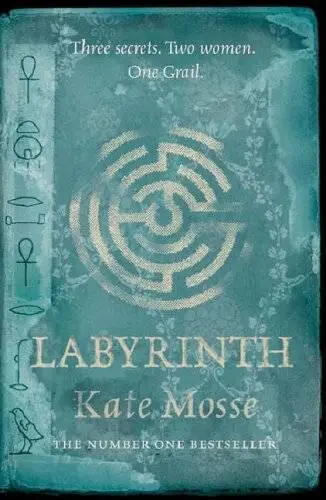
- Название:Labyrinth
- Автор:
- Жанр:
- Год:неизвестен
- ISBN:нет данных
- Рейтинг книги:3 / 5. Голосов: 1
-
Избранное:Добавить в избранное
- Отзывы:
-
Ваша оценка:
Labyrinth: краткое содержание, описание и аннотация
Предлагаем к чтению аннотацию, описание, краткое содержание или предисловие (зависит от того, что написал сам автор книги «Labyrinth»). Если вы не нашли необходимую информацию о книге — напишите в комментариях, мы постараемся отыскать её.
Labyrinth — читать онлайн бесплатно полную книгу (весь текст) целиком
Ниже представлен текст книги, разбитый по страницам. Система сохранения места последней прочитанной страницы, позволяет с удобством читать онлайн бесплатно книгу «Labyrinth», без необходимости каждый раз заново искать на чём Вы остановились. Поставьте закладку, и сможете в любой момент перейти на страницу, на которой закончили чтение.
Интервал:
Закладка:
It’s nothing to do with you.
There was no reason to get involved. And yet, for some reason she couldn’t account for, Alice found herself leaving her room and heading for the square.
There was a police car blocking the small road that led from the corner of the square, its lights flashing silently. Just the other side, a group of people had formed a semicircle around something or someone lying on the ground.
“You’re not safe anywhere,” an American woman was muttering to her husband, “not even in Europe.”
Alice’s sense of foreboding got stronger the closer she got. She couldn’t bear the thought of what she might see, but somehow couldn’t stop herself. A second police car emerged from a side street and screeched to a halt beside the first. Faces turned, the thicket of arms and legs and bodies thinning just long enough for Alice to see the body on the ground. A pale suit, black hair; sunglasses with brown lenses and gold arms, lying close by.
It can’t be him.
Alice pushed her way through, shoving people out of the way until she reached the front. The boy was lying motionless on the ground. Her hand went automatically to the paper in her pocket. This can’t be a coincidence.
Struck dumb with shock, Alice blundered back. A car door slammed. She jumped and spun round, in time to see Inspector Noubel levering himself out of the driver’s seat. She shrank back into the mass of people. Don’t let him see you. Instinct sent her across the square, away from Noubel, her head down.
As soon as she rounded the corner, she broke into a run.
“S’il vous plait,” shouted Noubel, clearing a path through the onlookers. “Police. S’il vous plait.”
Yves Biau was spreadeagled on the unforgiving ground, his arms flung out at right angles. One leg was doubled under him, clearly broken, a white ankle bone protruding from his trousers. The other leg lay unnaturally flat, flopped sideways. One of his tan loafers had come off.
Noubel crouched down and tried to find a pulse. The boy was still breathing, in short, shallow gasps, but his skin was clammy to the touch and his eyes were closed. In the distance, Noubel heard the welcome wail of an ambulance.
“S’il vous plait,” he shouted again, hauling himself to his feet. “Poussez-vous.” Stand back.
Two more police cars arrived. Word had gone out over the radio that an officer was down, so there were more police than bystanders. They cordoned off the street and separated witnesses from onlookers. They were efficient and methodical, but the tension showed in their faces.
“It wasn’t an accident, Inspector,” said the American woman. “The car drove right at him, real fast. He didn’t stand a chance.”
Noubel looked at her intently. “You saw the incident, Madame?”
“Sure I did.”
“Did you see what type of car it was? The make?”
She shook her head. “Silver, that’s as much I can say.” She turned to her husband.
“Mercedes,” he said immediately. “Didn’t get a good look myself. Only turned around when I heard the noise.”
“Registration number?”
“I think the last number was eleven. It happened too quick.”
“The street was quite empty, Officer,” the wife repeated, as if she feared he wasn’t taking her seriously.
“Did you see how many people were in the car?”
“One for sure in the front. Couldn’t say if there were folks in the rear.”
Noubel handed her over to an officer to take down her details, then walked round to the back of the ambulance where Biau was being lifted in on a stretcher. His neck and head were supported by a brace, but a steady stream of blood was flowing from beneath the bandage wrapped around the wound, staining his shirt red.
His skin was unnaturally white, the color of wax. There was a tube taped to the corner of his mouth and a mobile drip attached to his hand.
“ Il pourra’s”en tirer ?“ ‘Will he make it?
The paramedic pulled a face. “If I were you,” he said, slamming the doors shut, “I’d be calling the next of kin.”
Noubel banged on the side of the ambulance as it pulled away, then, satisfied his men were doing their job, he wandered back to his car, cursing himself. He lowered himself into the front seat, feeling every one of his fifty years, reflecting on all the wrong decisions he’d taken today that had led to this. He slid a finger under the collar of his shirt and loosened his tie.
He knew he should have talked to the boy earlier. Biau hadn’t been himself from the moment he’d arrived at the Pic de Soularac. He was normally enthusiastic, the first to volunteer. Today, he’d been nervous and on edge, then he’d vanished for half the afternoon.
Noubel tapped his fingers nervously on the steering wheel. Authie claimed Biau had never given him the message about the ring. And why would he lie about something like that?
At the thought of Paul Authie, Noubel felt a sharp pain in his abdomen. He popped a peppermint in his mouth to relieve the burning. That was another mistake. He shouldn’t have let Authie near Dr. Tanner, although, when he thought about it, he wasn’t sure what he could have done to prevent it. When reports of the skeletons at Soularac had come through, orders that Paul Authie should be given access to the site and assistance had accompanied them. So far, Noubel hadn’t been able to find out how Authie had heard about the discovery so fast, let alone worm his way onto the site.
Noubel had never met Authie in person before, although he knew him by reputation. Most police officers did. A lawyer, known for his hard-line religious views, Authie was said to have half the judiciaire and gendarmerie of the Midi in his pockets. More specifically, a colleague of Noubel’s had been called to give evidence in a case Authie was defending. Two members of a far-right group were accused of the murder of an Algerian taxi driver in Carcassonne. There’d been rumors of intimidation. In the end, both defendants were acquitted and several police officers forced to retire.
Noubel looked down at Biau’s sunglasses, which he’d picked up from the ground. He’d been unhappy earlier. Now he liked the situation even less.
The radio crackled into life, belching out the information Noubel needed about Biau’s next of kin. He sat for a moment longer, putting off the moment. Then he started to make the calls.
CHAPTER 16
It was eleven o’clock when Alice reached the outskirts of Toulouse. She was too tired to carry on to Carcassonne, so she decided to head for the city center and find somewhere to stay the night.
The journey had passed in a flash. Her head was full of jumbled images of the skeletons and the knife beside them; the white face looming out at her in the dead gray light; the body lying in front of the church in Foix. Was he dead?
And the labyrinth. Always, in the end, she came back to the labyrinth. Alice told herself she was being paranoid, that it was nothing to do with her. You were just in the wrong place at the wrong time. But no matter how many times she said it, Alice did not believe it.
She kicked off her shoes and lay down fully clothed on the bed. Everything about the room was cheap. Featureless plastic and hardboard, gray tiles and fake wood. The sheets were overstarched and scratched like paper against her skin.
She took the Bushmills single malt from her rucksack. There were a couple of fingers left in the bottle. Unexpectedly a lump came to her throat. She’d been saving the last couple of inches for her last night at the dig. She tried again, but Shelagh’s phone was still on divert. Fighting back her irritation, she left yet another message. She wished Shelagh would quit playing games.
Читать дальшеИнтервал:
Закладка:
Похожие книги на «Labyrinth»
Представляем Вашему вниманию похожие книги на «Labyrinth» списком для выбора. Мы отобрали схожую по названию и смыслу литературу в надежде предоставить читателям больше вариантов отыскать новые, интересные, ещё непрочитанные произведения.




Обсуждение, отзывы о книге «Labyrinth» и просто собственные мнения читателей. Оставьте ваши комментарии, напишите, что Вы думаете о произведении, его смысле или главных героях. Укажите что конкретно понравилось, а что нет, и почему Вы так считаете.