Kate Mosse - Labyrinth
Здесь есть возможность читать онлайн «Kate Mosse - Labyrinth» весь текст электронной книги совершенно бесплатно (целиком полную версию без сокращений). В некоторых случаях можно слушать аудио, скачать через торрент в формате fb2 и присутствует краткое содержание. Жанр: Триллер, на английском языке. Описание произведения, (предисловие) а так же отзывы посетителей доступны на портале библиотеки ЛибКат.
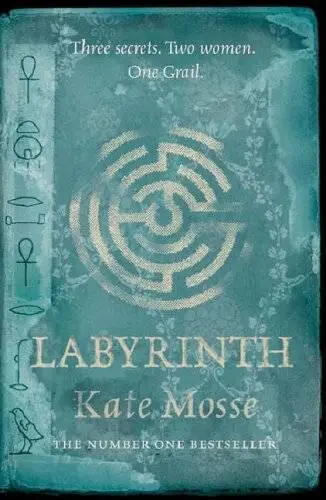
- Название:Labyrinth
- Автор:
- Жанр:
- Год:неизвестен
- ISBN:нет данных
- Рейтинг книги:3 / 5. Голосов: 1
-
Избранное:Добавить в избранное
- Отзывы:
-
Ваша оценка:
Labyrinth: краткое содержание, описание и аннотация
Предлагаем к чтению аннотацию, описание, краткое содержание или предисловие (зависит от того, что написал сам автор книги «Labyrinth»). Если вы не нашли необходимую информацию о книге — напишите в комментариях, мы постараемся отыскать её.
Labyrinth — читать онлайн бесплатно полную книгу (весь текст) целиком
Ниже представлен текст книги, разбитый по страницам. Система сохранения места последней прочитанной страницы, позволяет с удобством читать онлайн бесплатно книгу «Labyrinth», без необходимости каждый раз заново искать на чём Вы остановились. Поставьте закладку, и сможете в любой момент перейти на страницу, на которой закончили чтение.
Интервал:
Закладка:
They had tied her legs again and her arms behind her back, pulling at the bones in her shoulders. One eye was swollen shut. The combination of lack of food and light and the drugs they gave her to keep her quiet meant that her head was spinning, but she knew where she was.
Authie had brought her back to the cave. She felt the change in atmosphere as they emerged from the tunnel into the chamber, felt the tension in his legs as he carried her down the steps to the sunken area where she’d found Alice unconscious on the ground.
Shelagh registered that there was a light burning somewhere, on the Altar perhaps. The man carrying her stopped. They had walked right to the back of the chamber, past the limits she’d gone before. He swung her down off his shoulders, a dead weight, and dropped her. She sensed pain in her side as she hit the ground, but could no longer feel anything.
She didn’t understand why he hadn’t killed her already.
He had his hands under her arms now and was dragging her along the ground. Grit, stones, sharp fragments of rock, cut into the soles of her and her exposed ankles. She was aware of the sensation of her bound hands being tied to something metal and cold, a ring or hoop sunk into the ground.
Assuming she was still unconscious, the men were talking in low voices.
“How many charges have you set?”
“Four.”
“To go off at what time?”
“Just after ten. He’s going to do it himself.” Shelagh could hear the smile in the man’s voice. “Get his hands dirty for once. One press of the button and boom! The whole lot will go.”
“I still can’t see why we had to drag her all the way up here,” he complained. “Much easier to leave the bitch at the farm.”
“He doesn’t want her identified. In a few hours’ time, half this mountain’s going to come down. She’ll be buried under half a tonne of rock.”
Finally, fear gave Shelagh the strength to fight. She pulled against her bonds and tried to stand, but she was too weak and her legs wouldn’t hold her. She thought she heard a laugh as she sank back down to the ground, but she couldn’t be sure. She wasn’t certain now what was real and what was only happening inside her head.
“Aren’t we supposed to stay with her?”
The other man laughed. “What’s she going to do? Get up and walk out of here? I mean, Christ! Look at her!”
The light started to fade.
Shelagh heard the men’s footsteps getting fainter and fainter, until there was nothing but silence and darkness.
CHAPTER 74
“I want to know the truth,” Alice repeated. “I want to know how the labyrinth and the Grail are connected, if they are connected.”
The truth of the Grail,“ he said. He fixed her with a look. ”Tell me, Madomaisela , what do you know about the Grail?“
“The usual sort of stuff, I suppose,” she said, assuming he didn’t really want her to answer seriously.
“No, truly. I am interested to hear what you have discovered.”
Alice shifted awkwardly in her chair. “I suppose I held to the standard idea that it was a chalice which contained within it an elixir that gave the gift of everlasting life.”
Alice broke off and looked self-consciously at Baillard.
“A gift?” he asked, shaking his head. “No, not a gift.” He sighed. “And where do you think these stories come from in the first place?”
“The Bible, I suppose. Or possibly the Dead Sea Scrolls. Perhaps from some other early Christian writing, I’m not sure. I’ve never really thought about it in those terms before.”
Audric nodded. “It is a common misconception. In fact, the first versions of the story you talk about originate from the twelfth century, although there are obvious similarities with themes in classical and Celtic literature. And in medieval France in particular.”
The memory of the map she’d found at the library in Toulouse suddenly came into her mind.
“Like the labyrinth.”
He smiled, but said nothing. “In the last quarter of the twelfth century lived a poet called Chretien de Troyes. His first patron was Marie, one of daughters of Eleanor of Aquitaine, who was married to the Count of Champagne. After she died in 1181, one of Marie’s cousins, Philip of Alsacee, Count of Flanders, became his patron.
“Chretien was immensely popular in his day. He’d made his reputation translating classic stories from Latin and Greek, before he turned his skill to composing a sequence of chivalric stories about the knights you will know as Lancelot, Gawain and Perceval. These allegorical writings gave birth to a tide of stories of King Arthur and his Knights of the Round Table.” He paused. “The Perceval story- Li contes del graal - is the earliest extant narrative of the Holy Grail.”
“But…” Alice started to protest. She frowned. “Surely he can’t have made the story up? Not something like that. It can’t have appeared out of thin air.”
Again, the same half-smile appeared on Audric’s face.
“When challenged to name his source, Chretien claimed that he had acquired the story of the Grail from a book given to him by his patron, Philip. Indeed, it is to Philip that the story of the Grail is dedicated. Sadly, Philip died at the siege of Acre in 1191 during the Third Crusade. As a result, the poem was never finished.”
“What happened to Chretien?”
“There is no record of him after Philip’s death. He just disappeared.”
“Isn’t that odd, if he was so famous?”
“It is possible his death went unrecorded,” said Baillard slowly.
Alice looked sharply at him. “But you don’t think so?”
Audric did not answer. “Despite Chretien’s decision not to complete his story, all the same, the story of the Holy Grail took on a life of its own. There were direct adaptations from Old French into Middle Dutch and Old Welsh. A few years later, another poet, Wolfram von Eschenbach, wrote a rather burlesque version, Parzival , around the year 1200. He claimed he was not following Chretien’s version but another story by an unknown author.”
Alice was thinking hard. “How does Chretien actually describe the Grail?”
“He is vague. He presents it as some sort of dish, rather than a chalice, like the medieval Latin gradalis , from which comes the Old French gradal or graal . Eschenbach is more explicit. His Grail – gral – is a stone.”
“So where does the idea come from that the Holy Grail is the cup used by Christ at the Last Supper?”
Audric pressed his fingers together. “Another writer, a man called Robert de Boron. He wrote a verse poem, Joseph d’Arimathie , some time between Chretien’s Percevaland 1199. De Boron not only has the Grail as a vessel – the chalice of the Last Supper, which he refers to as the san greal – but he also fills it with the blood taken from the Cross. In modern French the sang real , the ”true“ or ”royal“ blood.”
He stopped and looked up at Alice.
“For the guardians of the Labyrinth Trilogy, this linguistic confusion san greal and sang real - was a convenient concealment.”
“But the Holy Grail is a myth,” she said stubbornly. “It cannot be true.”
The Holy Grail is a myth, certainly,“ he said, holding her gaze. ”An attractive fable. If you look closely, you will see that all these stories are embellishments of the same theme. The medieval Christian concept of sacrifice and quest, leading to redemption and salvation. The Holy Grail, in Christian terms, was spiritual, a symbolic representation of eternal life rather than something to be taken as a literal truth. That through the sacrifice of Christ and the grace of God, humankind would live forever.“ He smiled. ”But that such a thing as the Grail exists is beyond doubt. That is the truth contained within the pages of the Labyrinth Trilogy. It is this that the Grail guardians, the Noublesso de los Seres , gave their lives to keep secret.“
Читать дальшеИнтервал:
Закладка:
Похожие книги на «Labyrinth»
Представляем Вашему вниманию похожие книги на «Labyrinth» списком для выбора. Мы отобрали схожую по названию и смыслу литературу в надежде предоставить читателям больше вариантов отыскать новые, интересные, ещё непрочитанные произведения.

Обсуждение, отзывы о книге «Labyrinth» и просто собственные мнения читателей. Оставьте ваши комментарии, напишите, что Вы думаете о произведении, его смысле или главных героях. Укажите что конкретно понравилось, а что нет, и почему Вы так считаете.