Tony Hillerman - People Of Darkness
Здесь есть возможность читать онлайн «Tony Hillerman - People Of Darkness» весь текст электронной книги совершенно бесплатно (целиком полную версию без сокращений). В некоторых случаях можно слушать аудио, скачать через торрент в формате fb2 и присутствует краткое содержание. Жанр: Триллер, на английском языке. Описание произведения, (предисловие) а так же отзывы посетителей доступны на портале библиотеки ЛибКат.
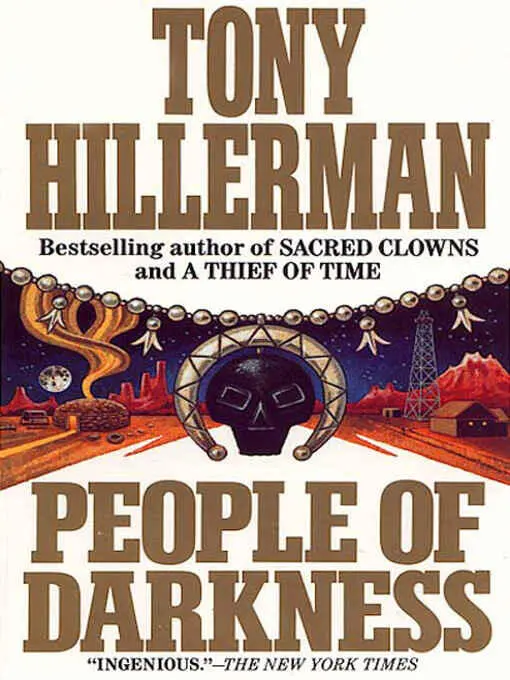
- Название:People Of Darkness
- Автор:
- Жанр:
- Год:неизвестен
- ISBN:нет данных
- Рейтинг книги:3 / 5. Голосов: 1
-
Избранное:Добавить в избранное
- Отзывы:
-
Ваша оценка:
People Of Darkness: краткое содержание, описание и аннотация
Предлагаем к чтению аннотацию, описание, краткое содержание или предисловие (зависит от того, что написал сам автор книги «People Of Darkness»). Если вы не нашли необходимую информацию о книге — напишите в комментариях, мы постараемся отыскать её.
People Of Darkness — читать онлайн бесплатно полную книгу (весь текст) целиком
Ниже представлен текст книги, разбитый по страницам. Система сохранения места последней прочитанной страницы, позволяет с удобством читать онлайн бесплатно книгу «People Of Darkness», без необходимости каждый раз заново искать на чём Вы остановились. Поставьте закладку, и сможете в любой момент перейти на страницу, на которой закончили чтение.
Интервал:
Закладка:
“I don’t see how you can say that,” Mary said. “You told me what they said. Nobody even hinted at anything like that.”
“They wouldn’t,” Chee said, “not to a stranger. I might be a witch myself. Or you might be. And witches don’t like people talking about witches.”
Mary yawned. “You’re stretching things,” she said.
“Did you notice that talking about Tsossie made them nervous? That’s the tip-off.”
“The thing that interests me is I think we’re finally going to find one of them alive,” she said. “What’s he going to tell us? I really think now he’s going to remember something.”
“If he’s alive.”
“He will be.”
“I have the same sort of hunch,” Chee said.
They were driving the subagency’s pickup truck, having traded the relative comfort of the patrol car for the ability to follow wagon tracks. They drove northeastward, mostly in second gear, over a rutted road which now tilted downward. Chee flicked his lights to bright. The beams lit the broad, sandy bottom of an arroyo below. When they reached it, he stopped.
“Chaco Wash,” he said. He switched on the dome light, unfolded his map, and examined it. The map was one entitled “Indian Country,” produced by the Auto Club of Southern California; Chee had found it both accurate and detailed. It rated routes of travel in nine categories, ranging from Divided Limited Access Highways, down through Gravel, Graded Dirt, and Ungraded Dirt to Doubtful Dirt. For the last fifteen miles, they had been driving on Doubtful Dirt. According to the map, the Doubtful Dirt ended at Chaco Wash.
Chee folded the Indian Country map and extracted from his shirt pocket a lined sheet of notebook paper. It had come from a red-covered Big Chief notebook at the home of Mrs. Musket. On it, a grandson of Romana Musket had drawn another map to show how to reach the hogan where Rudolph Charley was conducting a Peyote Way. His grandmother was attending the services. The grandson was about twelve. He wore a T-shirt with the S symbol of Superman decorating its front, and he drew the map carefully with a ballpoint pen, and while he drew he explained that Rudolph Charley was the new peyote chief because somebody had shot the old peyote chief, who was Rudolph Charley’s older brother.
“Right at Chaco Wash the regular road got washed out,” Supergrandson said. “You turn right there, and you drive up the sand if you want to, because it’s smoother. You got to pay attention or you’ll miss the turns. I’ll put down some landmarks to look for.” He glanced up and grinned at Mary, and switched politely to English. “If you’re not careful out there you can get lost,” he assured her.
On the Big Chief map, Supergrandson had penned in “salt cedars” at the point where the Doubtful Dirt road petered out at the wash bottom. Now, in the beam of his headlights, Chee could see a cluster of winter-bare salt cedar below. Chee let the truck roll forward again, past the trees and onto the smoothness of the arroyo floor.
“Here’s where we get to the place where if we’re not careful we can get lost,” Mary said. “Is that right?”
“Right,” Chee said.
“Let’s not,” Mary said. “I’m too tired. I’m flat out exhausted. It seems like we’ve been in this truck about seventeen days.”
“Just since about sunrise,” Chee said.
Mary turned suddenly and stared back out the rear window. “I get a feeling I’ll look back there and see somebody following us,” she said. “Not somebody. That blond man.”
“How could he?” Chee asked. “There’s no way he could know where we’re going.”
She shivered, and hugged herself. “Let’s say he’s smart,” she said. “Or let’s say he has some reason himself to go to this peyote ceremony.”
“I can’t think why he would.”
“It’s a memorial service for Tomas Charley, isn’t it? Or something like that. Maybe he’s looking for people, just as we are. Maybe we’ll just run into him there.”
“I doubt it,” Chee said.
“I think you’re like me. Too tired to care. You’re so tired you’re going to tell me your war name.”
“It won’t be much longer now,” Chee said. “We want to be at Charley’s place at midnight, and then Mrs. Musket will tell us that Windy is living in Grants and give us his address and telephone number. Then we go get some sleep and tomorrow we’ll call Tsossie, and he’ll tell us who blew up the oil well and why, and where to find the evidence to give to the grand jury, and who to arrest and why Emerson Charley’s body was taken out of the hospital, and who hired the blond man to shoot Tomas Charley, and…”
“Oh, stop,” Mary said. She yawned hugely behind her hand. “With the luck you and I have,” she said through the end of the yawn, “that kid gave us the wrong address or the wrong night, or Mrs. Musket won’t be there, or she never heard of Windy Tsossie, or she won’t like your looks and won’t talk to you, or she’ll tell you Tsossie moved to Tanzania and didn’t leave an address, or it’s the wrong Tsossie, or the blond will be there and he’ll shoot you. Or even worse, he’ll shoot me.”
Chee smiled. “Well,” he said, “we’ll soon know.”
At seven minutes to midnight the track they were following skirted a rocky outcrop covered with stunted juniper. The truck’s headlights reflected from a windshield, and then from the corrugated metal roof of a shack and the glass of the window below the roof. Chee slowed the truck to a crawl and examined what the headlights showed him. Three pickup trucks, an old white Chevy, and a wagon on which bales of hay served as seats. Twenty yards behind the shack was the round stone shape of a hogan, with a thin wisp of blue smoke emerging from the smoke hole in the center of its conical dirt-insulated roof. No one was in sight.
Chee parked the truck beside the newest of the pickups, flicked off the headlights, and stepped out into the darkness. The moon was down and the black sky was brilliant with a billion stars. He stood with face raised, drinking it in – the great fluorescent sweep of the Milky Way, the pattern of the winter constellations, the incredible silent brightness of the universe.
Mary was standing beside him now. “My God,” she said in a hushed voice. “I never saw the sky like that.”
“Altitude,” Chee said. “We’re almost at the Continental Divide here. Mile and a half above sea level; air’s thin. And partly it’s because there’s no ground lights. Look,” he said, pointing to the southeast. “See that little glow on the horizon? That’s Albuquerque. Hundred miles away, but you can see what it does.”
“It makes you forget for a minute how cold you are,” Mary said. She shuddered. “The minute’s up. I’m cold.”
From the hogan came the sound of song and the tapping of a pot drum. Distance and the hogan walls muted it, and the singing was not much more than a rising and falling rhythm, part of the background of the windless night. Chee glanced at his watch. The followers of Lord Peyote wouldn’t recess their ceremonial until midnight. They began at sunset after a prayer to inform the setting sun that their intentions were holy, and the ritual would not end until sunrise. But at midnight there was a break. And that meant another five minutes to wait.
“When I was a boy,” Chee said, “sometimes my mother would wake me up in the darkest part of the night, and we’d go out away from the hogan, and she’d teach me star lore. How the constellations move and how you can tell the direction and the time of night if you know the time of year. And how it all began.”
“How did it all begin?” Mary asked.
“There weren’t any Navajos yet. Just Holy People. First Man, First Woman, Talking God, Gila Monster, Corn Beetle, all the various yei figures. At night, the sky was black and blank except for the moon. So First Man decided to hang out the stars. And he put up the Blue Flint Boys” – Chee pointed to Cepheus – “and the Bear, and the Stalking God, and all the rest. And along came Coyote, and he grabbed the blanket where First Man had the stars waiting to be hung, and he gave it a toss and threw all that were left out in one great swinging motion. That’s what made the Milky Way.”
Читать дальшеИнтервал:
Закладка:
Похожие книги на «People Of Darkness»
Представляем Вашему вниманию похожие книги на «People Of Darkness» списком для выбора. Мы отобрали схожую по названию и смыслу литературу в надежде предоставить читателям больше вариантов отыскать новые, интересные, ещё непрочитанные произведения.







Обсуждение, отзывы о книге «People Of Darkness» и просто собственные мнения читателей. Оставьте ваши комментарии, напишите, что Вы думаете о произведении, его смысле или главных героях. Укажите что конкретно понравилось, а что нет, и почему Вы так считаете.