William Bernhardt - Capitol Murder
Здесь есть возможность читать онлайн «William Bernhardt - Capitol Murder» весь текст электронной книги совершенно бесплатно (целиком полную версию без сокращений). В некоторых случаях можно слушать аудио, скачать через торрент в формате fb2 и присутствует краткое содержание. Жанр: Триллер, на английском языке. Описание произведения, (предисловие) а так же отзывы посетителей доступны на портале библиотеки ЛибКат.
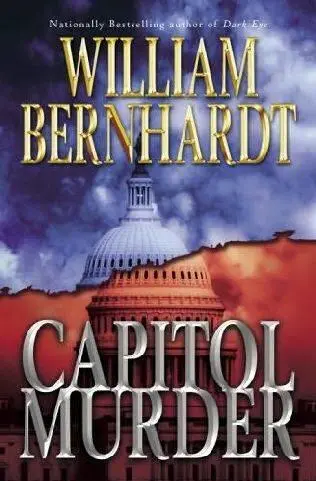
- Название:Capitol Murder
- Автор:
- Жанр:
- Год:неизвестен
- ISBN:нет данных
- Рейтинг книги:3 / 5. Голосов: 1
-
Избранное:Добавить в избранное
- Отзывы:
-
Ваша оценка:
Capitol Murder: краткое содержание, описание и аннотация
Предлагаем к чтению аннотацию, описание, краткое содержание или предисловие (зависит от того, что написал сам автор книги «Capitol Murder»). Если вы не нашли необходимую информацию о книге — напишите в комментариях, мы постараемся отыскать её.
Kincaid's legal success has earned him a dubious reward: a journey through the looking glass into the Beltway. Here, in the heart of the nation's capital, a powerful U.S. senator has been caught first in a sordid sex scandal, then in a case of murder.
Senate aide Veronica Cooper was found in a secret Senate office beneath the Capitol building, on Senator Todd Glancy's favorite couch, blood pouring from the knife wound in her throat. The young woman's death comes on the heels of the release of a sordid videotape depicting her and Senator Glancy in compromising positions.
With the senator's reputation in tatters, the evidence against him-as a sexual predator and possibly a killer-mounts. By the time a nationally televised murder trial begins, Kincaid and his team know they're facing the challenge of a lifetime. According to public opinion, and even in Kincaid's most private thoughts, Glancy is one more politician who cannot admit his own culpability.
But while a dramatic trial unfolds in the courtroom-loaded with pitfalls, traps, and an astounding betrayal-another trial is taking place on the mean streets of D.C., as Kincaid's investigator pursues a young woman who was a friend of Veronica Cooper's, plunging Kincaid into a bizarre world of Goths, sadomasochists, and a community of self-proclaimed vampires. Somewhere in this violent underworld lies the secret behind Veronica Cooper's demise… and the crux of Senator Glancy's innocence or guilt.
In a case that pits Kincaid and his freewheeling partner Christina McCall against the brutal machinery of Washington politics, the answers they seek are hidden in a murderous maze of lies and hidden motives. And in William Bernhardt's best novel yet, getting to the truth is an unparalleled experience in pure, satisfying suspense.
Capitol Murder — читать онлайн бесплатно полную книгу (весь текст) целиком
Ниже представлен текст книги, разбитый по страницам. Система сохранения места последней прочитанной страницы, позволяет с удобством читать онлайн бесплатно книгу «Capitol Murder», без необходимости каждый раз заново искать на чём Вы остановились. Поставьте закладку, и сможете в любой момент перейти на страницу, на которой закончили чтение.
Интервал:
Закладка:
Ben took a few steps forward and laid his hands gently upon the rail. “Let me ask you, ladies and gentlemen of the jury. Are you convinced that they have the right man? Has the prosecution proven to you-beyond a reasonable doubt-that Todd Glancy killed Veronica Cooper? Or is it just possible that it was someone else? Is it just possible that it happened exactly as described by Beatrice Taylor, the closest thing we have to an eyewitness in this case, the woman who knows more about what went on in Veronica Cooper’s life than anyone else in the world. Is it possible? Do you have a reasonable doubt? Because if you do-if, when you walk back into that jury room, you have a reasonable doubt about what really happened, then you must find my client not guilty. Why? Because this is the United States of America.” He let several seconds pass before he added, quietly: “And that’s the way we do things here.”
25
“H oly smokes, Ben,” Glancy said, shaking his head. He was waiting, with Ben and Christina, in a small room just a few doors down from where the jury was deliberating. “If you can give a speech like that every day, you should run for President.”
“You’re too kind.”
“No, I’m a politician-or was, anyway-and I’ve heard enough orations to know a good one from a bad one. That was a humdinger. All you needed was some facile remark about family values and the invocation of the deity and it would’ve been perfect.” He stopped, then his voice dropped a few notches. “But was it enough to convince the jury?”
Ben had to be honest. “I don’t know.”
Christina jumped in. “I thought you covered all the main points. Brilliantly and persuasively.”
“Perhaps. But we had some bad evidence. The pathetic thing is, the worst of it had nothing to do with who murdered Veronica Cooper. But the jury still heard it.”
Glancy didn’t respond. They all knew what Ben was talking about.
“What about me?” Glancy asked. “How did I do on the stand? You never said.”
Ben chose his words carefully. “I thought you did the best you could… given the circumstances.”
“You had to handle some tough questions,” Christina interjected, trying to add a more upbeat note.
“Yeah, sure, I know all that. But did I have… duende?”
Ben frowned. “Would it be a good thing if you did?”
Glancy smiled. That’s Spanish. It’s like… charisma. The power to attract and persuade through personal magnetism and charm. I’m asking you if I seemed… charismatic?”
Ben stared at him with weary eyes. Were you charismatic while you were talking about your affair with a minor and your aberrant sexual fetishes? “Juries are more interested in what a witness has to say than how they say it.”
Glancy blew Ben a raspberry. “Says you. Charisma is all. If you’ve got enough of it, you can get away with anything.”
“That hasn’t been my experience.”
“It sure as heck has been mine. Haven’t you noticed how no one ever talks about whether a White House candidate is smart or knowledgeable or experienced or capable anymore? They talk about whether he’s electable. Whether he seems presidential.”
“The legal world operates differently.”
“Does it? Answer me this: Why did every single member of Nixon’s staff of any importance whatsoever do jail time-except Henry Kissinger, the most active and influential of them all?”
Ben hazarded a guess. “Charisma?”
“Darn tootin’. And he was a funny-looking German Jew with an almost incomprehensible accent. But he courted the press. He had PR people releasing statements about how he was dating Jill St. John or whatever. Meanwhile, he orchestrated the secret and illegal bombing of Cambodia. He authorized the Indonesian invasion of East Timor. He pushed for and got a CIA coup to overthrow the democratically elected Allende government in Chile. If someone had done stuff like that in Germany during World War II they’d’ve been tried at Nuremberg for war crimes. But when Kissinger did it, what happened? Criminal charges? No. Instead, he became a wealthy businessman and a senior statesman on CNN. And you know why?”
“Charisma?”
“Bingo. He was just so charming-no one could believe he knew about those naughty Watergate plumbers and their friends, even when common sense tells us he couldn’t have been a part of that administration and not have known about it. Some people think the whole reason for the Watergate burglary was to see if the Democrats knew Kissinger had sabotaged the ’68 Democratic Vietnam peace initiative which, if successful, would’ve almost certainly given Humphrey the presidency. Remember, Nixon won by less than one percent of the popular vote.”
“I think that’s a bit of a stretch,” Ben said.
“Of course you do. You’re a good guy. So you assume everyone else is, too. But mark my words, Ben-one day that foolish assumption is going to drop-kick you right between the legs.”
Actually, Ben thought, it already had, on more than one occasion, but those were stories he didn’t care to repeat.
Glancy stretched back into his chair. “So what are the odds? Fifty-fifty? Better? Worse?”
“I never make predictions,” Ben answered. “Juries are too unpredictable.”
“Aw, come on. Give me a hint.”
“Sorry. I don’t know. We’ll all find out together.”
“Fine.” Glancy scrunched down in his seat. “But if we lose, I’m not inviting your mother to my annual May Day barbecue.”
“Just as well,” Ben said, smiling slightly. “She wouldn’t come.”
The outside door whipped open. Padolino leaned inside. “It’s showtime!” He shut the door behind him.
“Already?” Glancy said. “They’ve barely been out two hours! What does that mean?”
Ben glanced at Christina, his lips pursed. “It means they didn’t need much time to make up their minds.”
Ben thought they got it from television, but Christina’s theory was that every person-and thus every juror-had a secret sadistic streak, a Mr. Hyde lurking in the back of the cerebral cortex waiting for a proper exercise of power to give it expression. Either way, it was a universal constant that when the jury returned from deliberation, they took great pains to give no indication of their decision. Their faces were blank. They looked at no one.
“Has the jury reached a verdict?” Judge Herndon asked.
“We have,” said the foreperson, an older woman sitting on the far left of the front row. The bailiff took the folded verdict form to the judge, who carefully scrutinized it with the same stoic expression that was plastered on the jurors. Finally, without a word of comment, he returned it to the bailiff.
“The defendant will rise.”
Glancy did so, followed by his counsel. To their surprise, just behind them, Marie Glancy rose as well.
The foreperson cleared her throat. “We the jury, in the case of the District of Columbia versus Todd K. Glancy, on the charge of first-degree murder-” She stopped.
Ben winced. Why did they always insist on the dramatic pause?
“-on the charge of first-degree murder,” she continued, “and for that matter, on the charge of second-degree murder and manslaughter, we find the defendant Todd K. Glancy not guilty.”
The courtroom exploded. That was the only way Ben could describe it. Some people were shouting with joy. Some were expressing disgust. But whether out of surprise, relief, or pure cynicism, everyone was talking.
“Oh my God,” Ben heard Glancy muttering softly beside him. “Much as I tried to keep my spirits up, I never really believed-never thought it was possible-” His voice choked. “Oh. My. God.”
Ben closed his eyes. They had actually managed to pull it off. Against all odds, he and Christina had actually managed to pull it off. O frabjous day!
Читать дальшеИнтервал:
Закладка:
Похожие книги на «Capitol Murder»
Представляем Вашему вниманию похожие книги на «Capitol Murder» списком для выбора. Мы отобрали схожую по названию и смыслу литературу в надежде предоставить читателям больше вариантов отыскать новые, интересные, ещё непрочитанные произведения.



Обсуждение, отзывы о книге «Capitol Murder» и просто собственные мнения читателей. Оставьте ваши комментарии, напишите, что Вы думаете о произведении, его смысле или главных героях. Укажите что конкретно понравилось, а что нет, и почему Вы так считаете.