Mark Billingham - Buried
Здесь есть возможность читать онлайн «Mark Billingham - Buried» весь текст электронной книги совершенно бесплатно (целиком полную версию без сокращений). В некоторых случаях можно слушать аудио, скачать через торрент в формате fb2 и присутствует краткое содержание. Жанр: Триллер, на английском языке. Описание произведения, (предисловие) а так же отзывы посетителей доступны на портале библиотеки ЛибКат.
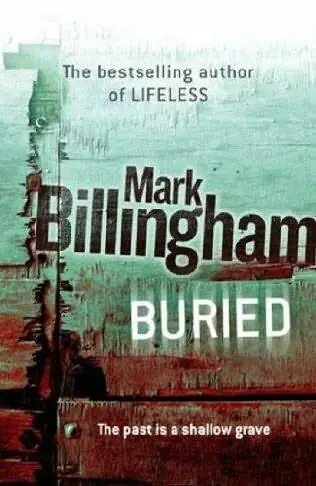
- Название:Buried
- Автор:
- Жанр:
- Год:неизвестен
- ISBN:нет данных
- Рейтинг книги:5 / 5. Голосов: 1
-
Избранное:Добавить в избранное
- Отзывы:
-
Ваша оценка:
Buried: краткое содержание, описание и аннотация
Предлагаем к чтению аннотацию, описание, краткое содержание или предисловие (зависит от того, что написал сам автор книги «Buried»). Если вы не нашли необходимую информацию о книге — напишите в комментариях, мы постараемся отыскать её.
Buried — читать онлайн бесплатно полную книгу (весь текст) целиком
Ниже представлен текст книги, разбитый по страницам. Система сохранения места последней прочитанной страницы, позволяет с удобством читать онлайн бесплатно книгу «Buried», без необходимости каждый раз заново искать на чём Вы остановились. Поставьте закладку, и сможете в любой момент перейти на страницу, на которой закончили чтение.
Интервал:
Закладка:
It had been slow and difficult, feeling his way around, with the rope tying his hands together cutting off the feeling in his fingers.
He was in a cellar, maybe fifteen feet by twenty. There was a longer bit that narrowed and ran to a wall which sloped suddenly away from his touch and upwards. He was sure this was an old coal chute; he’d seen one before at a friend’s house when they’d gone down to collect a bottle of wine to have with dinner. The walls at his friend’s place had been plastered and painted, but these were rough, just the original brick, and the ceiling was only a few inches above his head. There were some shelves on one side, thick with dust where they weren’t crammed with cans and open boxes of tiles. Beneath were rolls of paper, a heavy bag of hardened cement, what felt like picture frames leaning one against the other. He could smell paint and turpentine; could taste brick dust and damp earth in another corner. He heard something scurrying as he tried to get to sleep.
When the man had opened the door and stood at the top of the stairs, it had been dark behind him. He’d shone a torch to light his way down. He’d brought a hamburger and fries in a bag, a plastic cup of Coke. He’d crouched, ripped the tape from Luke’s face, then let the torch beam drop to the filthy floor while Luke ate, and while he talked.
When the man had finished, he’d waited, staring at Luke as though he were expecting a reaction to what he’d said. To the mad, vile shit he’d said about everyone Luke loved. He’d raised the torch up to Luke’s face.
But Luke had just sat, and wolfed down the food, and hated himself for wanting to cry.
Afterwards, the man had asked Luke if he thought he needed to put the tape back over his mouth. Luke had shaken his head. The man had told him that there was no point in shouting anyway because nobody would hear him, but that this would be a test. If Luke behaved himself, and didn’t shout, then maybe next time the man would take the rope from around his wrists as well. The man was sure that Luke would pass the test. He’d said that Luke was a good lad, a sensible boy; that he knew what a very good boy he was.
Luke had nodded. Kept on nodding.
Now, sitting in the dark, he was trying to work it out. Was the man just talking, or did he really know? Did he know particular stuff about him? He certainly claimed to know the people Luke cared about very well…
He was wide awake; as awake as he could remember being since this whole thing had started. Maybe it was because he hadn’t been drugged again; not since the man had taken him from the flat and put him in the car. Maybe it was because he had slept, though Luke couldn’t say for sure if he had, at least not for any length of time. Perhaps he was just at that stage beyond tiredness, where you started to feel fine again; where you could think clearly about something other than sleep.
He was thinking about survival.
He knew that his mother and father would do whatever the man wanted to get him back, but he’d seen enough films and TV shows to know that plans sometimes went wrong. As far as things between him and the man went, it was obvious that the key to getting through it was control. Control would give him his best chance.
He just didn’t know whether that meant keeping it or losing it.
TWELVE
Below the calendar, on the pale yellow kitchen wall, there was some kind of poem or story in old-fashioned copperplate. It was about a man walking along a beach and always seeing two sets of footprints: his and God’s. Except for those dark periods of his life when he was unhappy or struggling with some great problem, when one set of footprints seemed to disappear. In the poem, the man is angry with God for deserting him in his time of greatest need, but God explains that although there was only one set of footprints on the beach, the man was never really alone. That it was at those very darkest of times, when God was carrying him…
Heeney shook his head, nodded towards the large sitting room that was used as a therapy area. ‘I never realised it would be, you know… God Squad.’
Neil Warren finished stirring the last of the three teas and lobbed the spoon into the sink. ‘It isn’t… necessarily,’ he said. ‘ I am, though.’ He handed Heeney his tea.
‘Right,’ Heeney said.
‘Most people need to find something that’s more important to them than the drugs or the drink, you know? Something that isn’t going to fuck their lives up in quite the same way. Then they make a choice.’
‘Right,’ Heeney said again.
‘For me, it came down to God or cocaine.’
He handed Holland a mug, and Holland took it with a smile, enjoying Heeney’s discomfort just as much as Warren clearly was.
Nightingale Lodge was a privately run halfway house, owned by an organisation called Pledge. It was a large, double-fronted Victorian place on Battersea Rise, where up to six recovering addicts at a time – those who’d completed eight weeks of rehab but were deemed to be ‘still at risk’ – could readjust to a drug-free way of life while waiting for permanent accommodation. Though Pledge was a registered charity, the residents of Nightingale Lodge paid a decent enough whack to live there, and it seemed likely that someone was making a profit. Neil Warren was one of two full-time counsellors and admitted to being a little unclear as to exactly who was paying his wages. He did know that they were a damn sight higher than those he’d been paid back when he’d worked for the London Borough of Bromley, several years before.
‘Getting people off drugs is a boom industry,’ he’d said when Holland had spoken to him on the phone first thing. ‘There’s no shortage of customers.’ The voice was high and light, with a trace of a northern accent. Holland had imagined six foot something of emaciated hippy, in denim, with a ponytail.
Warren was in his late thirties, short and stocky, with dark hair shaved close to the skull. He wore a plain grey sweatshirt over khaki combats and Timberlands. He looked like he could handle himself.
‘Might as well call this an official fag break,’ Warren said. He produced a tobacco tin from his back pocket, took out a lighter and one of several prepared roll-ups. He offered the tin to Heeney, who declined but gratefully took it as a cue to reach for his own pack of Benson & Hedges. Holland shook his head.
‘You talk about cocaine or whatever,’ Heeney said, stuffing the cigarette between his lips. ‘I can’t even give these up.’
Warren lit up. ‘Harder to quit than heroin,’ he said.
‘Cheaper, though.’
‘Not by much…’
‘That’s the bloody truth.’
Holland looked at Heeney, leaning back against the worktop, with his fag and his mug of tea, like he was at home talking bollocks to his wife. It wasn’t often Holland yearned to be working with someone like Andy Stone, but it would have been a joy by comparison. Perhaps it was the Brummie accent. It had seemed as good a reason as any to take against his newest partner almost immediately, and first impressions had proved horribly accurate. They’d quickly settled into a pattern that saw Holland doing most of the work while Heeney stood around, made facile comments, and tried to pick his nose while no one was looking.
‘We’ll talk in here,’ Warren said. ‘Some of the residents are having an unsupervised therapy session in the living room.’ Heeney sniffed, and Warren saw it for the expression of disdain that it was. ‘Therapy doesn’t always mean “wanky”.’ The edge in his voice was clear. ‘It’s bloody hard work in here. They have to pull their weight and follow the regime, and if they don’t, they’re out. As it happens, I’m the nice cop. The other counsellor makes anyone who fucks up spend the day with a toilet seat round their neck.’
Читать дальшеИнтервал:
Закладка:
Похожие книги на «Buried»
Представляем Вашему вниманию похожие книги на «Buried» списком для выбора. Мы отобрали схожую по названию и смыслу литературу в надежде предоставить читателям больше вариантов отыскать новые, интересные, ещё непрочитанные произведения.



Обсуждение, отзывы о книге «Buried» и просто собственные мнения читателей. Оставьте ваши комментарии, напишите, что Вы думаете о произведении, его смысле или главных героях. Укажите что конкретно понравилось, а что нет, и почему Вы так считаете.