Mark Billingham - Buried
Здесь есть возможность читать онлайн «Mark Billingham - Buried» весь текст электронной книги совершенно бесплатно (целиком полную версию без сокращений). В некоторых случаях можно слушать аудио, скачать через торрент в формате fb2 и присутствует краткое содержание. Жанр: Триллер, на английском языке. Описание произведения, (предисловие) а так же отзывы посетителей доступны на портале библиотеки ЛибКат.
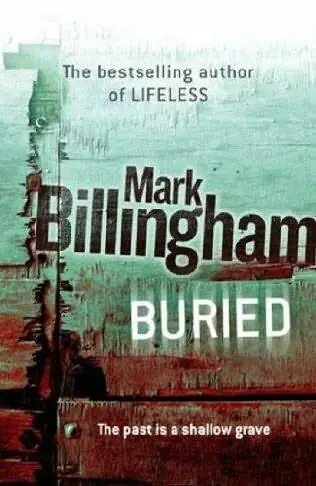
- Название:Buried
- Автор:
- Жанр:
- Год:неизвестен
- ISBN:нет данных
- Рейтинг книги:5 / 5. Голосов: 1
-
Избранное:Добавить в избранное
- Отзывы:
-
Ваша оценка:
Buried: краткое содержание, описание и аннотация
Предлагаем к чтению аннотацию, описание, краткое содержание или предисловие (зависит от того, что написал сам автор книги «Buried»). Если вы не нашли необходимую информацию о книге — напишите в комментариях, мы постараемся отыскать её.
Buried — читать онлайн бесплатно полную книгу (весь текст) целиком
Ниже представлен текст книги, разбитый по страницам. Система сохранения места последней прочитанной страницы, позволяет с удобством читать онлайн бесплатно книгу «Buried», без необходимости каждый раз заново искать на чём Вы остановились. Поставьте закладку, и сможете в любой момент перейти на страницу, на которой закончили чтение.
Интервал:
Закладка:
Kitson took a step closer, flashing a pretty decent smile of her own. ‘It’s not about Luke Mullen,’ she said. ‘We’re investigating another matter.’
They were gathered outside a bakery and sandwich bar in a small, pedestrianised precinct off the Broadway. The place was busy, with workers from local shops and offices zigzagging between pushchairs to grab lunch or do a quick bit of shopping. Farrell and his two friends leaned against the window, eating sausage rolls from paper bags. They’d stopped talking, elbowed each other and stared as Kitson and Stone had walked up the gentle slope of a long wheelchair ramp towards them.
One of the boys in the baseball caps nudged his companion, nodding towards Farrell. ‘They’ve finally come to get you, guy.’
‘Yeah, the cops is well on to you for sure.’ His friend spluttered the words through a mouthful of hot food and started to laugh.
Farrell grimaced at the pair of them. ‘Shut it.’ Then, back to Kitson: ‘Sorry about them. Bloody rabble.’
‘A student was murdered a couple of miles from here,’ Kitson said. ‘Last October, in Edgware, you probably saw it on the news.’ Farrell’s expression scrunched up, like maybe he thought he had. ‘Ring a bell?’ Kitson watched his eyes drop for half a second to her tits, then back up again. ‘His name was Amin Latif.’
Farrell certainly looked as though the name meant nothing to him.
‘You don’t remember it? I’m quite surprised.’
‘I remember our chaplain leading a special prayer in assembly. Right before the hymn. He does that, you know, for disaster victims, stuff like that. Yes, there was definitely one for some poor bugger who’d been murdered. It would probably have been around that time.’
There was loud music coming from the record shop opposite. Something cheery and pointless.
‘So?’
‘So what?’
Kitson tried hard to meet his eyes. ‘Did you say a prayer for Amin Latif?’
Farrell sniffed and looked away from her, stepping aside as a group of teenage girls came out of the bakery. One of his friends made a comment under his breath. A girl told him to piss off.
‘Should you be talking to me?’ Farrell asked.
‘Sorry?’
‘Without the presence of any legal representation. Without my parents.’
There was an impressed whistle from beneath one of the baseball caps.
‘It’s just an informal chat, Adrian.’
For the first time the boy looked slightly alarmed, though only for a second or two. ‘How d’you know my name?’
‘The police know everything,’ one of his friends said.
The other pointed at Farrell, mock-serious. ‘They know when you last had a wank, guy.’
Andy Stone stepped forward, corralled the designer-clad double act into an adjacent doorway. ‘Why don’t I get your names? Just so we don’t feel like strangers.’
‘You’re seventeen,’ Kitson said. ‘Which makes you legally responsible.’
Farrell watched his friends, nodding his head to the rhythm of the pop song.
‘Anyway, there’s really no need to get worked up.’
‘Who’s worked up?’ Farrell said.
‘That’s all right, then.’
‘It’s not true, though, is it?’ He leaned towards her, conspiratorial. ‘You don’t really know the last time I shook hands with my best friend?’
She smiled, not quite so easily thrown. ‘As it goes, we’d be delighted to fix you up with whoever would make you more comfortable. A lawyer, if you want; your mum and dad. Maybe that nice chaplain of yours, if it would help. We could all reconvene at the station, do everything properly.’
‘I don’t actually have to do anything, though, do I?’
‘No, absolutely not. We’re just talking.’
‘Fine then.’ He put all his weight on one foot, preparing to leave. ‘Nice to talk to you.’
‘But when that happens, we just sit around and start asking questions. Of ourselves, I mean. We wonder why you don’t like us. Why you’re so reluctant to help. What you might be trying to hide.’
Farrell started to shake his head, grinning like he thought her efforts were clumsy and amateurish. ‘I’m going back to school now,’ he said. ‘It’s double history this afternoon, and that’s my favourite.’
Kitson wanted to slap him stupid.
‘Come on, wankers.’ Farrell shouted across to his friends and started to walk away. Once there was breathing space between themselves and Stone, the other boys puffed out their chests, fell into step with each other and quickly caught Farrell up.
Stone moved across to Kitson. ‘They’re not afraid of very much, are they?’ he said.
They watched the boys swagger down the ramp. As they reached the bottom, one of Farrell’s friends tossed his empty bag towards a litter bin. The others jeered at the miss and the three kept on walking.
‘It’s easy when there’s a few of you,’ Kitson said.
Farrell glanced back, a couple of steps before he turned the corner; looked round as though he’d forgotten something, just for a second or two before he disappeared.
His hand was slapping the side of his leg in time to the music.
Kidnap or not, as operation posts went, the security was fairly relaxed. Thorne had taken part in plenty of intelligence operations – usually involving the Serious and Organised boys – where a steady stream of visitors to the target address had meant days on end in the back of a stinking van, pissing in plastic bottles and living on biscuits. In this instance, the surveillance provided by the cameras meant that there was no need for any vehicle to be located within direct sight of Conrad Allen’s flat. So there was a degree of flexibility in terms of individual movements, and conditions within the team vehicles themselves were not quite as spartan.
Less than a minute on foot from Allen’s flat, Porter had spent most of her morning south of the Bow Road, on a one-way street between Tower Hamlets cemetery and the tube station. After their brief meeting on Fairfield Road, Thorne had joined her in the back of a dirty Transit, its panels boasting the logo and contact details of a local roofing contractor.
That had been just after three o’clock. Nearly an hour before.
A trestle table ran down one side of the van. Two small monitors displayed the black-and-white shots from the cameras front and back, while a scarred metal speaker broadcast communications from the assortment of unit vehicles in the vicinity. A strip of grubby brown carpet had been laid on the floor, and a plastic bag was wedged into one corner, bulging with Styrofoam containers, newspapers, empty cans and cartons.
‘So what do we think?’
‘It’s been forty-five minutes since we went into the old woman’s flat.’
‘Longer,’ Porter said.
Two other officers were sharing the space with Porter and Thorne. Kenny Parsons sat in one of two folding canvas chairs, with the other taken by a fat DS named Heeney – a gobby Midlander with a lazy eye and an attitude to match. Porter looked less than delighted at being harassed by either of them. She brought the radio handset to her mouth. ‘How are we doing, Bob?’
There was a pause.
‘I’m sure he’ll let you know,’ Thorne said.
Porter gave him a look like he wasn’t helping a hell of a lot, either.
Then, from the speaker, with a hint of annoyance: ‘Still nothing.’
‘You’ve checked the equipment?’
‘Twice. The equipment’s fine.’
‘Sorry…’
It had been a stupid question. The microphones were about as high tech as they could ask for, and she knew that the technical operator had done his homework. They’d established that the flat was rented, had guessed correctly that the firm below it would have handled the letting and had gone in bright and early to acquire a diagram of the layout. A kitchen-diner, two small bedrooms and a bathroom, all leading off the single corridor. The listening equipment that had been set up in the premises next door would be more than adequate: nowhere in a flat that size would be out of range.
Читать дальшеИнтервал:
Закладка:
Похожие книги на «Buried»
Представляем Вашему вниманию похожие книги на «Buried» списком для выбора. Мы отобрали схожую по названию и смыслу литературу в надежде предоставить читателям больше вариантов отыскать новые, интересные, ещё непрочитанные произведения.





Обсуждение, отзывы о книге «Buried» и просто собственные мнения читателей. Оставьте ваши комментарии, напишите, что Вы думаете о произведении, его смысле или главных героях. Укажите что конкретно понравилось, а что нет, и почему Вы так считаете.