C Box - Winterkill
Здесь есть возможность читать онлайн «C Box - Winterkill» весь текст электронной книги совершенно бесплатно (целиком полную версию без сокращений). В некоторых случаях можно слушать аудио, скачать через торрент в формате fb2 и присутствует краткое содержание. Жанр: Триллер, на английском языке. Описание произведения, (предисловие) а так же отзывы посетителей доступны на портале библиотеки ЛибКат.
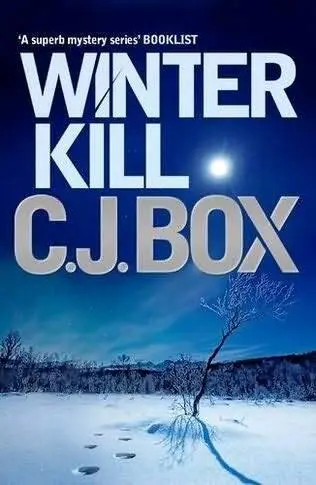
- Название:Winterkill
- Автор:
- Жанр:
- Год:неизвестен
- ISBN:нет данных
- Рейтинг книги:3 / 5. Голосов: 1
-
Избранное:Добавить в избранное
- Отзывы:
-
Ваша оценка:
Winterkill: краткое содержание, описание и аннотация
Предлагаем к чтению аннотацию, описание, краткое содержание или предисловие (зависит от того, что написал сам автор книги «Winterkill»). Если вы не нашли необходимую информацию о книге — напишите в комментариях, мы постараемся отыскать её.
Winterkill — читать онлайн бесплатно полную книгу (весь текст) целиком
Ниже представлен текст книги, разбитый по страницам. Система сохранения места последней прочитанной страницы, позволяет с удобством читать онлайн бесплатно книгу «Winterkill», без необходимости каждый раз заново искать на чём Вы остановились. Поставьте закладку, и сможете в любой момент перейти на страницу, на которой закончили чтение.
Интервал:
Закладка:
Joe thought about what Wardell had said. He thought about how cruel it was of the driver of the light-colored truck to leave Wardell behind like that. Surely the driver would have seen or heard Wardell crash, and realize that if Wardell wasn’t killed on impact, he would likely freeze to death out there. Either way, it was a bad way to die. It had suddenly occurred to Joe when he was talking to Wardell that the viciousness was similar to how Lamar Gardiner had been treated.
If the same person who was responsible for Gardiner’s murder was involved in leaving Birch Wardell to freeze to death, then the killer was not Nate Romanowski. The likelihood that the perpetrator was a Sovereign, as Wardell had suggested, didn’t make sense to Joe, since Birch had seen the truck well before the Sovereigns had set up camp. It was unlikely, Joe knew, that any of the Sovereigns-including Jeannie Keeley-had the kind of intimate familiarity with the BLM land and the complicated terrain within it to know the secret route that Wardell said the light-colored pickup had taken. Joe shuddered. The more he thought about it, the more convinced he became that neither the Sovereigns nor Nate Romanowski were to blame. And that the real killer was still out there.
They drove slowly down Main Street while the defroster cleared ever-larger sweating holes in the ice on the windshield. Saddlestring was still. Streetlights illuminated the clouds of heat and steam that escaped from the vents of dark buildings, giving the illusion that they were silently breathing. Joe noticed a few more cars than normal still parked downtown, and guessed they belonged to revelers who would come and get them in the morning.
The only place with lights and cars out front was the Elks Club. As they passed, Joe rolled his head over on the headrest. A couple stood in profile in the front door, backlit by a bare porch light, their outlines in silhouette. The woman wrapped her arms around the man, and his cowboy hat tipped back as he lowered his head to kiss her.
Joe moaned, and turned to stare straight out the front window.
“Are you alright?” the doctor asked.
“Yup,” Joe answered. “I just thought I saw my mother-in-law back there.”
Joe thanked the doctor and gingerly approached his front door, careful of the ice on the walk. Inside, he confirmed that the couch bed had not been slept in.
Dragging himself upstairs, he wondered how long it would take for word to get out that another federal employee in Twelve Sleep County had been assaulted.
The news would no doubt supercharge Melinda Strickland’s crusade.
Fourteen
On Sunday, New Year’s Day, Joe mixed pancake batter in a bowl with a whisk and watched the snow fall outside the kitchen window. It was a light snow, powdery as flour, and it skittered along over the top of the week-old glaze, settling into cracks and crevices. In the living room, the girls watched the Rose Bowl parade-a sun-drenched pageant of flowers, floats, and Pasadena Parade Committee members in matching blazers-while wrapped in robes and blankets on the floor. Marybeth had made room for them by folding up the couch bed when Missy had finally awakened. Missy was now upstairs preparing herself for the day. Joe had learned that this took about two hours and ten minutes.
Joe let his mind wander as he prepared the batter, unwrapped the bacon, and put the “special” bottle of real maple syrup in a pan to warm. He was tired, and already forecasting an afternoon nap. The night at the hospital, and several sleepless hours afterward thinking about Birch Wardell, Nate Romanowski, the Sovereigns, Lamar Gardiner, Missy Vankueren, and Melinda Strickland had wiped him out. He woke up feeling worried and unfocused. Joe was thankful he had the day off, and the fresh snow was not unwelcome.
He had heard that the Inuit people had scores of words to describe snow, and that had always impressed him until he thought of how many he knew. Most described the condition of snow. There was powder, packed powder, slush, wind-groomed, wind-loaded, fluff, glazed, crud, rain crust, cold smoke, and corduroy. Also carvy, sugary, tracked out, white smoke, dust on crust, ice cube, gropple, granular, and wind butter. He knew lots of snow words.
Marybeth came into the kitchen and nodded her approval at the breakfast he was preparing. Then she checked over her shoulder to make sure no one was listening.
“Mom came in at five-thirty this morning.” Her eyes were disbelieving. “I can’t imagine ever coming home that late when I was growing up.”
“I told you I saw her last night,” Joe said. “She sure doesn’t waste any time.”
“Joe!” Marybeth scolded, but didn’t really argue. “Don’t let the girls hear you.”
“I won’t.”
Marybeth leaned forward conspiratorially. “Could you tell who she was kissing?”
“I wasn’t sure at the time,” he said, pouring palm-sized rounds of batter onto the griddle. “But it might have been Bud Longbrake.”
Marybeth moaned. She knew that Longbrake’s wife-Nate Romanowski’s supposed alibi-was out of the country.
“It fits the profile,” Joe said. “One, he’s a state senator. Two,” Joe held up his hand and raised a finger as he made each point, “He’s wealthy. Three, he’s sort of single at the moment. Four, she’s sort of single at the moment. Five, she apparently needs a man in the on-deck circle in case the one at bat strikes out.” He grinned ruefully. “Like if he goes to federal prison or something.”
Marybeth shook her head at him, mildly disapproving.
“What’s gotten into you?” she asked.
“I’ve got a question for you,” Joe said. “How in the hell did you ever turn out to be so wonderful?”
She smiled at him. Then, apparently jarred by the earlier mention of Mrs. Longbrake, she told Joe to follow her into his office.
“While I was waiting up for you last night, I did an Internet search,” Marybeth said over her shoulder while she settled into Joe’s office chair. “I wanted to see if I could find anything on a car crash in Montana a year and a half ago.”
Joe arched his eyebrows and waited for more. She handed him several sheaves of paper that she had hidden under a stack of files.
Joe took them and read. They were stories from the Great Falls Tribune from three consecutive days in June eighteen months ago. The first was headlined TWO DEAD IN U.S. 87 ROLLOVER. The story said that a damaged vehicle with out-of-state plates had been called in to the Montana highway patrol twenty-one miles north of town near Fort Benton. The identities of the occupants were unknown at the time, but authorities were investigating.
On the next page, a smaller story identified the victims of a multiple-rollover accident as two men, aged 32 and 37, from Arlington, Virginia and Washington, D.C., respectively. Both were killed on impact. The highway patrol suggested that, judging by the skid marks, it was possible that the engine of the late-model SUV had died on a sharp grade with several turns, and that the driver, unable to negotiate the sharpest of the turns, had blown through a guardrail. The SUV had rolled at least seven times before it reached the bottom of the canyon. The passenger was thrown from the vehicle, and the driver was crushed behind the wheel.
“The engine lost power. No power steering, no power brakes. Yikes,” Joe said absently, and read on.
WITNESS SOUGHT IN ROLLOVER INVESTIGATION, the third and smallest headline read. In the story, the highway patrol reported that they were seeking a potential witness to the rollover on U.S. 87 that had killed two men from out of state. Specifically, they were looking for the driver of an older-model Jeep with Montana plates that was seen passing a speed checkpoint near Great Falls. The authorities estimated that the Jeep may have been in the vicinity of the rollover and that the driver could have seen the accident happen.
Читать дальшеИнтервал:
Закладка:
Похожие книги на «Winterkill»
Представляем Вашему вниманию похожие книги на «Winterkill» списком для выбора. Мы отобрали схожую по названию и смыслу литературу в надежде предоставить читателям больше вариантов отыскать новые, интересные, ещё непрочитанные произведения.








Обсуждение, отзывы о книге «Winterkill» и просто собственные мнения читателей. Оставьте ваши комментарии, напишите, что Вы думаете о произведении, его смысле или главных героях. Укажите что конкретно понравилось, а что нет, и почему Вы так считаете.