Джонатан Келлерман - Night Moves
Здесь есть возможность читать онлайн «Джонатан Келлерман - Night Moves» весь текст электронной книги совершенно бесплатно (целиком полную версию без сокращений). В некоторых случаях можно слушать аудио, скачать через торрент в формате fb2 и присутствует краткое содержание. Город: New York, Год выпуска: 2018, ISBN: 2018, Издательство: Ballantine Books, Жанр: Триллер, Детектив, на английском языке. Описание произведения, (предисловие) а так же отзывы посетителей доступны на портале библиотеки ЛибКат.
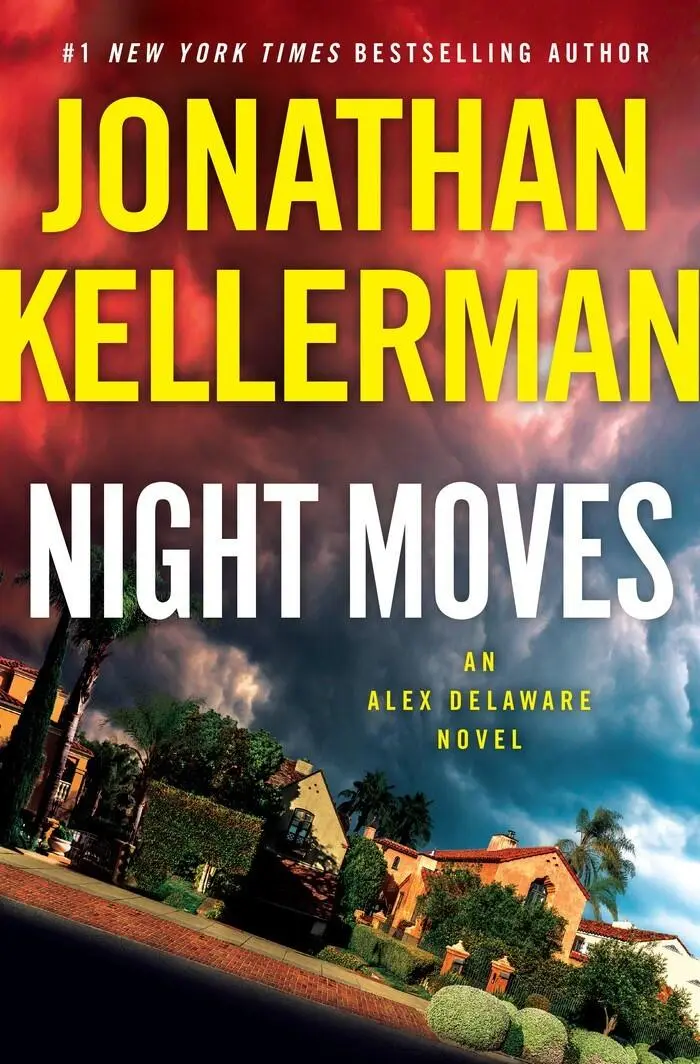
- Название:Night Moves
- Автор:
- Издательство:Ballantine Books
- Жанр:
- Год:2018
- Город:New York
- ISBN:978-0-345-54146-8
- Рейтинг книги:4 / 5. Голосов: 2
-
Избранное:Добавить в избранное
- Отзывы:
-
Ваша оценка:
Night Moves: краткое содержание, описание и аннотация
Предлагаем к чтению аннотацию, описание, краткое содержание или предисловие (зависит от того, что написал сам автор книги «Night Moves»). Если вы не нашли необходимую информацию о книге — напишите в комментариях, мы постараемся отыскать её.
There’s no spilled blood, no evidence of a struggle, and, thanks to the victim’s missing face and hands, no immediate means of identification. And no telling why the disfigured corpse of a stranger has appeared in an upscale L.A. family’s home. Chet Corvin, his wife, and their two teenage children are certain the John Doe is unknown to them. Despite that, their cooperation seems guarded. And that’s more than Milo and Alex can elicit from the Corvins’ creepy next-door neighbor — a notorious cartoonist with a warped sense of humor and a seriously antisocial attitude.
As the investigation ensues, it becomes clear that this well-to-do suburban enclave has its share of curious eyes, suspicious minds, and loose lips. And as Milo tightens the screws on potential persons of interest — and Alex tries to breach the barriers that guard their deepest secrets — a strangling web of corrupted love, cold-blooded greed, and shattered trust is exposed. Though the grass may be greener on these privileged streets, there’s enough dirt below the surface to bury a multitude of sins. Including the deadliest.
Night Moves — читать онлайн бесплатно полную книгу (весь текст) целиком
Ниже представлен текст книги, разбитый по страницам. Система сохранения места последней прочитанной страницы, позволяет с удобством читать онлайн бесплатно книгу «Night Moves», без необходимости каждый раз заново искать на чём Вы остановились. Поставьте закладку, и сможете в любой момент перейти на страницу, на которой закончили чтение.
Интервал:
Закладка:
“Cruel world,” he said. “Lucky for me.”
A mile later: “You were snoozing away, amigo. How the hell do you sleep like that?”
I rarely do but how would he know? “Clear conscience.”
“Damn,” he said, slapping his forehead. “Too late for that.”
The outskirts of San Bernardino were what you’d expect, made dreary by Beijing-level smog.
The airborne dirt vanished a few miles into Highway 18, the state route’s primary access to the San Bernardino Mountains. Four lanes that shift gradually to a gear-challenging climb and top-of-the-world views.
Eighteen snakes up to a series of ski resorts before sloping east and descending to the Mojave Desert. The final stop is Adelanto, a town founded over a century ago as a citrus-growing community, switching to poultry farming when that didn’t work out, continuing to struggle as the economic allure of two private prisons proved illusory.
I’d been there a few years ago, evaluating the custodial fitness of a father imprisoned for a massive insurance scam and about to be released. The kind of guy who could easily fool a polygraph. My report was thin on details but loaded with implication. The judge got the point.
Today’s trip included only the first twenty or so miles of 18, as we entered Arrowhead Village. Along the way, signs proclaiming gated, guarded communities and admonishing trespassers had alternated with flecks of lake view that pierced the tree canopy randomly — loose sapphires in a green velvet box. On the water side of the commercial center’s cottagey shops and restaurants, the forest had been cleared, exposing an expanse of blue peppered by white boats.
The lake itself is pure Southern California: theatrically gorgeous but artificial. Created as a reservoir left unfinished after being ruled illegal and subject to decades of shifting ownership, fraudulent land transfers, and inside deals, it had finally settled as a weekend escape where dockside mansions served as stopovers for movie stars and tycoons.
We continued west, turned onto Brewer Road, and entered a tract of modest residences widely spaced on generous lots. Weekend places for the financially comfortable. The attraction here was the much smaller Grass Valley Lake and a golf course. No gates, no warnings.
Our destination, marked by a rustic address sign on a tilting stake, was curtained by white pines, black oaks, and ponderosas and visible only as a smear of cedar siding.
Milo said, “Just Molly and me-ee, in our brown heaven,” and hooked onto a long dirt driveway bordered by rocks the size of Galapagos tortoise shells. The house finally came into view seconds later, shoved off center by a clutch of monumental firs.
One-story A-frame, cedar planks oiled long ago and graying at the edges. No garage, no fencing. Two large plastic garbage cans stood to the left.
We got out of the car, greeted by chittering birds and rustling leaves. Milo checked the cans. Empty. His eyes shifted to the ground nearby. Three mousetraps, one hosting a rodent skeleton. Close by was a rogue patch of grass defying its host patch of gravel. Ruts and tracks ran through the blades and continued to the gravel: wildlife partying, most likely squirrels, chipmunks, and raccoons. The trash-can lids were held in place by metal clasps. Claw marks scored the tops. Coons or bears — juveniles lacking the skill and attention span to pull off a prolonged assault.
Milo returned to the Dodge, now dusted with pollen, popped the trunk, and removed his attaché case. Out came two sets of booties and gloves.
I said, “Expecting a crime scene?”
“Expecting anything.” We covered our shoes and hands and I followed him to the front door.
Big lumbering shape in coarse brown.
Adult bear, ready to forage.
The alarm panel just inside the door whined. Milo punched buttons from the code he’d memorized, created silence, took in the layout.
A single high-peaked space was sectioned by furniture and appliances into a living room with a doorway to the left, a dining area, and a kitchen separated from a laundry room by a waist-high partition.
Open beamed ceiling. Cheap blue felt carpeted the entire floor. The rear wall was glass, a triangle composed of several window frames and interrupted by a rear door. Outside was a skimpy lawn, then a mass of black-green, the rear boundary unclear. A glass-shaded chandelier — unreasonable facsimile of Tiffany — dangled from a center beam. The furniture was bolted-together blond wood and plastic, contrasting with dark-stained wood walls and ceiling. Every upholstered surface was brown; if Milo sat down, he might disappear.
Still in the doorway, he called out, “Police. Anyone home?”
Nothing.
Placing his hand on his Glock but leaving it holstered he motioned me to wait and entered.
A minute later he was back. “All clear.”
He picked up his case, sniffed, nostrils flaring.
I said, “Exactly.”
Empty house but the air lacked the dirty-socks must of disuse. Instead, a pleasant scent washed through, aromatic, familiar.
Armani.
I pointed to a brown princess phone on the floor, next to a couch. Eighties vintage, the closest thing to an antique.
He took an evidence bag out of his case, uncoupled the phone from its cord, bagged it. “If there are prints anywhere, they’ll be here. Not that we don’t know who was answering Chet’s calls. This clinches it, again, you’re right. Girlfriend, not a pro, in that motel room.”
I said nothing.
He said, “Stop bragging. Look what happened to Chet.”
He walked around, opening and shutting drawers and cabinets. Cheap crockery, glassware, utensils, pots and pans. Stepping around the partition to the laundry room, he took his time with the washer-dryer.
Empty, spotless, dry. Same for a plastic utility sink and a cheap wicker hamper. Utility storage consisted of detergent, bug spray, a coiled garden hose, a toolbox whose stiff latch said it hadn’t been opened for a while, four mousetraps in heat-sealed plastic packets.
We returned to the living room, continued through the left-hand doorway. Two identical nine-by-nine bedrooms were dimmed by pebbled windows set high in a tongue-and-groove wall and separated by a Jack-and-Jill bathroom. Nothing in the medicine cabinet.
The master bedroom at the end of the hall was larger but far from generous. The smell of perfume was stronger. Clear-glass windows provided the same green view as the living room triangle. The lav was en suite but drab. No sheets, pillows, or cases on the queen bed; one dresser, also unused. No clothes in the closet but lots of neatly folded percale and terry cloth.
I said, “Rarely used until now. And she cleaned up compulsively. Same as the motel. Same as Braun.”
He stared. “She’s more than a love interest?”
“Just throwing out ideas.”
Noise from the front of the house whipsawed both our heads.
A door closing. Footsteps.
Milo unsnapped his gun and pulled it out, sidled toward the doorway.
He tensed for a second, slipped through, pointed the Glock. “Freeze!”
A male voice said, “Oh, Jesus God!”
The man’s hands were up and they trembled. So did his legs. “Please, man.” High-pitched nasal voice. “Take what you want and—”
Milo said, “Police. Continue to cooperate.” Extricating his badge, he flashed it.
The man said, “Jesus Mary Mother of God.” A meaty face that had gone pale began to take on color, achieved ruddiness within seconds. His posture loosened but he continued to shake.
“Can I?” he said, waving his fingers. “Got a sore rotator cuff.”
Milo said, “Name.”
“Dave Brassing.”
“The caretaker.”
“That’s me, sir, I promise, there’s I.D. in my pocket.”
Читать дальшеИнтервал:
Закладка:
Похожие книги на «Night Moves»
Представляем Вашему вниманию похожие книги на «Night Moves» списком для выбора. Мы отобрали схожую по названию и смыслу литературу в надежде предоставить читателям больше вариантов отыскать новые, интересные, ещё непрочитанные произведения.











Обсуждение, отзывы о книге «Night Moves» и просто собственные мнения читателей. Оставьте ваши комментарии, напишите, что Вы думаете о произведении, его смысле или главных героях. Укажите что конкретно понравилось, а что нет, и почему Вы так считаете.