Randy White - Everglades
Здесь есть возможность читать онлайн «Randy White - Everglades» весь текст электронной книги совершенно бесплатно (целиком полную версию без сокращений). В некоторых случаях можно слушать аудио, скачать через торрент в формате fb2 и присутствует краткое содержание. Жанр: Триллер, на английском языке. Описание произведения, (предисловие) а так же отзывы посетителей доступны на портале библиотеки ЛибКат.
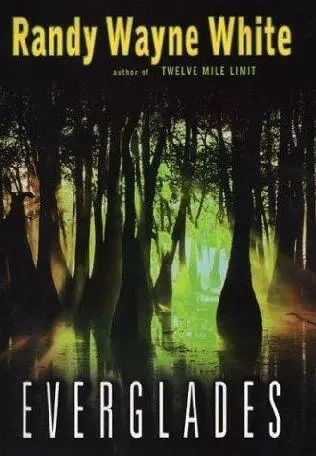
- Название:Everglades
- Автор:
- Жанр:
- Год:неизвестен
- ISBN:нет данных
- Рейтинг книги:5 / 5. Голосов: 1
-
Избранное:Добавить в избранное
- Отзывы:
-
Ваша оценка:
Everglades: краткое содержание, описание и аннотация
Предлагаем к чтению аннотацию, описание, краткое содержание или предисловие (зависит от того, что написал сам автор книги «Everglades»). Если вы не нашли необходимую информацию о книге — напишите в комментариях, мы постараемся отыскать её.
Everglades — читать онлайн бесплатно полную книгу (весь текст) целиком
Ниже представлен текст книги, разбитый по страницам. Система сохранения места последней прочитанной страницы, позволяет с удобством читать онлайн бесплатно книгу «Everglades», без необходимости каждый раз заново искать на чём Вы остановились. Поставьте закладку, и сможете в любой момент перейти на страницу, на которой закончили чтение.
Интервал:
Закладка:
Her terms, it seemed, included getting to know us better before she volunteered information. “She’s getting the feel of us,” Tomlinson whispered to me as we followed her back to the main camp.
Now she took a seat at a table beneath one of the chickees, and spoke generally, telling us about herself, what she was doing. She owned a condo in Coral Gables-she was working on her doctorate in political history at the University of Miami-but she lived here much of the time with two older aunts and three much older uncles. The six of them, along with Ginny Egret and James Tiger, made up the voting board of the Tribe of Egret Seminoles, Inc., a trademarked corporation formed to ensure that the tribe-once formally recognized-had both a business and political infrastructure in place.
“Under the corporation, we also created the Egret Seminole Land Development Enterprise,” she said. “We did it to explore how we can best use the little bit of land we own jointly, and the possibility of purchasing-or annexing-property that adjoins ours.
“That’s how I met Geoff. He came to me as the front man for Jerry Singh. They had a business offer. Singh wanted to sell us thirteen hundred acres of adjoining land on a long-term deferred loan, and at a price next to nothing. In return, we’d allow him to build and manage a casino resort.”
DeAntoni said, “He wanted to sell you church property.”
“Yes, and he still does. Singh bought the land cheap when he was first starting out. Back when it cost next to nothing because it’s mostly swamp. A little later, if you don’t mind getting your feet wet, I’ll walk you to where the property lines meet.”
Billie told us she felt the casino idea was plausible and the potential for profit was huge. But, as she explained to Minster, even if she did get the tribe to go along with the idea, it wouldn’t be easy. There was a lot of red tape involved; several government agencies to deal with. First and foremost, though, the Egret Seminoles had to successfully petition the Department of Interior’s branch of Acknowledgment and Recognition.
So she and Minster had spent a lot of time together, trying to work out the details.
She said, “The main problem is that the U.S. government is constantly… daily… perpetually devising ways they can erode Indian sovereignty. The gaming industry is their favorite target. Have you ever heard of James Billy?”
“I was talking about him on the way here,” Tomlinson told her. “A tough old ’Nam vet who really got the tribe on its feet.”
“That’s him. When I’d go on a rant about protecting tribal sovereignty, he’d tell me, ‘Hell, honey, sovereignty ain’t nothin’ but who’s got the biggest gun!’ In the final analysis, he was absolutely correct.
“So now we’re working on getting our guns together. Back in the nineteen fifties, when James was growing up, less than a half-dozen Seminoles had even graduated from high school. Today, we dress our warriors up in three-piece suits and pay them to fire off injunctions instead of bullets. So that’s how I got to know Geoff.”
There was an odd modulation when she said his name, Geoff. Was I imagining a hint of tenderness?
No.
Because she then added, “I hope you’re right about him still being alive. I don’t believe it, but I hope you’re right.”
The way she said it was like she cared about the guy. Cared about him a lot.
Why was there a Sawgrass maintenance truck backed into what looked to be a long-abandoned limestone quarry?
That’s what Billie wanted to know.
It was a white, ton-and-a-half GMC, double tires in the back with a skid-mounted tank in the bed and Sawgrass decals on the doors. A dark-haired man in coveralls was standing at the rear of the truck, doing something with a wrench.
It was the quarry I’d seen on the way in.
“That’s odd; he’s on our property,” she said. “He’s got no business being in here. What I don’t understand is, Why would he want to be there?” Meaning a shallow, marl-looking pit fifty yards or so wide, with an access road that was overgrown with brush. The road ended abruptly where the truck was parked, backed up to the wall of the quarry as if it were a bunker.
I thought, Dumping garbage, but said nothing. A man alone, not dozing, not eating. It was the only explanation that made sense.
We’d walked a mile or so north. Had waded through a couple of sections of sawgrass and water, which DeAntoni didn’t like. Wild animals, he said, made him jumpy.
“All the snakes and crap Florida’s got. Alligators. We’ve already seen enough big gators, sister. So no more, okay? Then you got your black widows, scorpions, plus that hurricane business with a wind that comes blowing down and puts the snatch on people.”
Billie chuckled when he added, “Hell, you Indians can have the freaking place, far as I’m concerned.”
Most of our walk was on high ground. Dry, too, after one of the driest winters in the state’s history, but starting to green now that we were entering the rainy season.
We’d followed the woman through pinelands and grass prairie, through stands of young cypress where she pointed out ghost orchids growing wild, swamp lilies and leather ferns. She knew the names of all the birds, too: wood storks, hawks and great egrets with their reptilian eyes.
Once, she stopped, knelt and touched a finger to a paw print that was bigger than my hand. “Black bear,” she said. “A big one. Big and healthy.”
She said she often found panther tracks in the area, too.
When I inquired, she told me she’d noticed a significant increase in the amount of wildlife in the ’Glades since her childhood, particularly gators and wading birds. “But that doesn’t mean the Everglades is back to the way it was when Chekika and Osceola were alive. And there may be a lot more damage to come.”
Her reasoning surprised me. She said she felt the biggest threat to the region now came from the state and federal governments, and a mega-billion-dollar project called the Comprehensive Everglades Restoration Plan.
“But that’s a good thing,” Tomlinson argued. “The scientists, most of them, anyway, say we need to make the ’Glades a free-flowing water system again. Restore the Kissimmee and increase the amount of wetlands by a couple of hundred thousand acres.”
That, Billie told him, is exactly what scared her.
In explanation, she first listed a string of environmental disasters masterminded by government scientists and engineers. Back in 1912, they used biplanes to seed the Everglades with a paper-barked, Australian tree called the melaleuca. The exotic tree reproduced like wildfire and displaced whole regions of natural habitat. Then they did the same with casuarinas, or Australian pines. “Environmentally safe windbreaks,” state biologists called the tree at the time.
It was government “experts” who transformed the Kissimmee from a hundred miles of pristine river into a fifty-six-mile ditch, renaming it C-38 Canal. The results were ruinous.
Then, in 1957, at the southern base of mainland Florida, government engineers dug the Buttonwood Canal to drain the area north of Flamingo and provide easy boat access to the mangrove backcountry. For the first time in history, the canal allowed fresh water, laden with decaying sediments, to flow directly into Florida Bay.
Again, the results were disastrous. It all but destroyed the fishery in Florida Bay, yet state biologists balked at admitting the truth, or taking responsibility. It wasn’t until 1982 that the canal was finally plugged.
“I don’t trust them,” Billie said. “Government scientists use Florida like a lab rat. They say they want to return the natural flow of water? The Everglades used to include nearly all the land south of Orlando. It’s less than half that size now. When they started draining the sawgrass, tree islands like Chekika’s Hammock got bigger. The bigger islands provided more habitat for wildlife that’d been forced inland by development.
Читать дальшеИнтервал:
Закладка:
Похожие книги на «Everglades»
Представляем Вашему вниманию похожие книги на «Everglades» списком для выбора. Мы отобрали схожую по названию и смыслу литературу в надежде предоставить читателям больше вариантов отыскать новые, интересные, ещё непрочитанные произведения.
Обсуждение, отзывы о книге «Everglades» и просто собственные мнения читателей. Оставьте ваши комментарии, напишите, что Вы думаете о произведении, его смысле или главных героях. Укажите что конкретно понравилось, а что нет, и почему Вы так считаете.