Randy White - Everglades
Здесь есть возможность читать онлайн «Randy White - Everglades» весь текст электронной книги совершенно бесплатно (целиком полную версию без сокращений). В некоторых случаях можно слушать аудио, скачать через торрент в формате fb2 и присутствует краткое содержание. Жанр: Триллер, на английском языке. Описание произведения, (предисловие) а так же отзывы посетителей доступны на портале библиотеки ЛибКат.
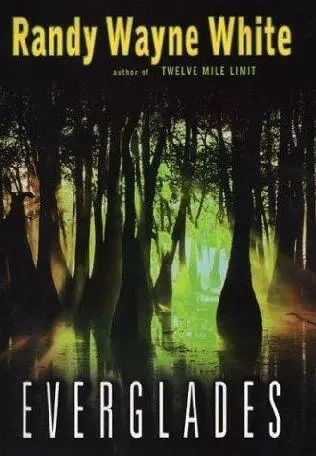
- Название:Everglades
- Автор:
- Жанр:
- Год:неизвестен
- ISBN:нет данных
- Рейтинг книги:5 / 5. Голосов: 1
-
Избранное:Добавить в избранное
- Отзывы:
-
Ваша оценка:
Everglades: краткое содержание, описание и аннотация
Предлагаем к чтению аннотацию, описание, краткое содержание или предисловие (зависит от того, что написал сам автор книги «Everglades»). Если вы не нашли необходимую информацию о книге — напишите в комментариях, мы постараемся отыскать её.
Everglades — читать онлайн бесплатно полную книгу (весь текст) целиком
Ниже представлен текст книги, разбитый по страницам. Система сохранения места последней прочитанной страницы, позволяет с удобством читать онлайн бесплатно книгу «Everglades», без необходимости каждый раз заново искать на чём Вы остановились. Поставьте закладку, и сможете в любой момент перейти на страницу, на которой закончили чтение.
Интервал:
Закладка:
We were approaching what appeared to be a sinkhole now-a crater-sized lake surrounded by cypress. As we neared it, I could feel the temperature drop, as if the dome of cypress was absorbing sunlight. Within the dome, the crater was a pool of black water that was carpeted with fire flags and lily pads, white and yellow flowers blooming.
In my earphones, I heard James say, “See the marsh way to the north?”
I looked to see a broad expanse of swamp plain near what appeared to be an abandoned limestone pit.
He said, “We call that Lost Lake. The reason is, there’s another sinkhole out there, a lake without no bottom. But you can’t see the shape of the lake unless water in the swamp gets real low. Used to be, tarpon would show up there about this time every year. But it hasn’t happened for a while.”
A tarpon is a saltwater game fish: a chromium-scaled pack animal that migrates into the Florida littoral each spring. All my life, I’d heard rumors that there were certain inland lakes where tarpon would appear as abruptly as they disappeared-the implication being that the lakes were connected by underground tunnels with the open sea. Some were well known: Rock Lake, Tarpon Lake, Deep Lake and Lake Sampson. I’d visited a couple of them.
We were headed for a tree island now. As James banked toward it, I heard Tomlinson say, “This is starting to look familiar. Man, I think I know where we are. We’re getting close to Sawgrass, aren’t we?”
James told him, “If you cut straight across the prairie, it’s only a mile or so to the back boundary.” Then he said what sounded like, “Up ahead is Chekika’s Hammock.”
Tomlinson repeated the name phonetically, “Che-kii-ka’s Hammock.”
“Uh-huh. Back in eighteen forty, it’s where the white soldiers caught Chekika, an Indian. They said he murdered Dr. Perrine and six or seven other people down on the Florida Keys. Chekika, he was a big man. A Calusa, like Joseph. When the soldiers caught him, they hanged him. Ask her to show you the tree. It’s still there.”
DeAntoni said, “Ask who to show us the tree?”
Tomlinson answered for James: “Billie Egret. This is where she lives.”
Tomlinson, my intuitive friend. chapter nineteen
Billie Egret, tribal chair of the Egret Seminoles, had inherited Joseph Egret’s height, his elongated wedge of a nose and his eyes. She had liquid eyes; black, intense eyes that seemed to add weight to the air when she stared at you.
She was staring at me now, as she said, “My father once told me he considered you more like a son than just some cracker boy. So I guess that could make the two of us brother and sister in a way. He also told me you kept your brain where your heart should be. True?”
There are rare people who exude sufficient confidence that they can direct outrageous questions at strangers, yet make the question sound reasonable, even flattering. She was one of those few.
I said, “Personally, I don’t see anything wrong with that.”
I watched her smile for the second time since our arrival. “Guess he was right, huh?”
We were standing in a clearing between four pole houses-chickees-that were built around a central fire pit. The chickees consisted of a sapling floor built a couple of feet off the ground beneath a roof of palm thatching. The cooking chickee was open on all sides. There was a pump for water, a wood-burning stove and a porcelain sink that drained onto the ground.
We’d already seen the tree where, according to the woman, Chekika had been hanged a hundred-and-fifty-some years earlier. The “Hanging Tree,” she called it, her inflection making it a proper noun.
It was a massive Madeira mahogany, long dead. Put three or four men at the base, and they might be able to circle their arms around it. Most of the upper limbs were broken off; woodpeckers had riddled it with striated holes, but it was still solid. Perched on the highest knob was one of the rarest birds in the Everglades, a snail kite. The snail kite sat one hundred feet above, indifferent to us, a large, hawkish looking male, cobalt blue.
“When we were kids,” Billie told us, “Joseph used to talk about Chekika, because Chekika was his great-grandfather. Which means he’s my great-great-grandfather. He was what the old people, the elders, called a Spanish Indian.
“It’s because the government sent the last band of Calusas to live in Cuba. They had to learn Spanish. They gave them a spot on a hill just west of old Havana, but it wasn’t their home; it wasn’t Florida. So they paddled back. More than a hundred miles of open water in dugouts.
“Chekika was different. Like my father. Now like us.”
We listened to the woman talk about it. She said if the American military had attacked Indians down on the Keys, it would have been called an engagement. But because it was Chekika who initiated the attack, history referred to it as a massacre.
There is a predictable variety of bitterness associated with the cliche thinking that every conquest-minded European was evil, and all indigenous peoples were noble. But there was no hint of that in her voice.
She told us that there are five hundred and fifty federally recognized tribes in the United States. The largest, the Cherokee and the Navajo, have close to a million members. Some of the smallest tribes have fewer than a dozen men and women left; are on the verge of extinction.
“For the enemies of Native Americans,” she said, “extinction has always been the favorite option.”
She told us that her band, the Egret Seminoles, were just one unrecognized tribe out of two-hundred-and-forty-some groups petitioning, trying to get the federal government to verify all the research that had been done, to grant confirmation, and make it official.
She spoke matter-of-factly, like an interested historian. She looked the part, standing there in her park ranger khaki shorts and man’s rainbow-banded Seminole shirt, strings of traditional glass beads around her neck. An interesting-looking woman: a little over six feet tall, narrow-hipped, flat-chested with good shoulders, high cheekbones beneath velvet cocoa skin, her hair cut short. Plus those eyes. Star tlingly intense eyes.
I liked her frankness; her no-nonsense manner.
When Tomlinson placed both his hands on the tree, closed his eyes for a moment, saying, “There’s a powerful spirit in this creature; it’s still strong and alive-” she cut him off abruptly, saying, “If you’re doing that for my benefit, please stop.”
As Tomlinson turned to her, smiling, she added, “Sorry. It’s just that I don’t have much patience with the whole Indian stereotype business. We don’t worship nature-never did. We don’t all have fuzzy animal names. We’ve never had shamans-that’s a Russian word-and the only people who give any credence to that ridiculous book, Black Elk Speaks, are New Age whites who have more money than brains. Turquoise Indians, I call them, because they wear turquoise like it’s supposed to mean something.”
Still smiling, Tomlinson said something heavy and guttural that surprised the woman, then made her laugh. It also seemed to cut through the awkwardness of strangers meeting. Seemed to put her at ease. She answered Tomlinson in the same singsong language, before adding, “I’m impressed. That’s a Maskoki maxim I haven’t heard since my grand-mother died. Very appropriate, too.”
Now she didn’t seem to mind at all when Tomlinson placed his hands on the Hanging Tree again, eyes closed, and asked, “How often is she struck by lightning?”
Billie Egret answered, “A lot,” walking away.
She’d already put DeAntoni in his place, too. The first thing he’d asked her after stepping off the airboat was, “Did you know a Geoff Minster?” To which she replied, “You wouldn’t be here if I didn’t. And you’re not going to stay here long unless you agree to talk about it on my terms.”
Читать дальшеИнтервал:
Закладка:
Похожие книги на «Everglades»
Представляем Вашему вниманию похожие книги на «Everglades» списком для выбора. Мы отобрали схожую по названию и смыслу литературу в надежде предоставить читателям больше вариантов отыскать новые, интересные, ещё непрочитанные произведения.
Обсуждение, отзывы о книге «Everglades» и просто собственные мнения читателей. Оставьте ваши комментарии, напишите, что Вы думаете о произведении, его смысле или главных героях. Укажите что конкретно понравилось, а что нет, и почему Вы так считаете.