Randy White - Everglades
Здесь есть возможность читать онлайн «Randy White - Everglades» весь текст электронной книги совершенно бесплатно (целиком полную версию без сокращений). В некоторых случаях можно слушать аудио, скачать через торрент в формате fb2 и присутствует краткое содержание. Жанр: Триллер, на английском языке. Описание произведения, (предисловие) а так же отзывы посетителей доступны на портале библиотеки ЛибКат.
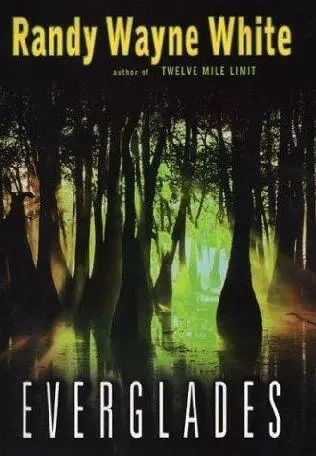
- Название:Everglades
- Автор:
- Жанр:
- Год:неизвестен
- ISBN:нет данных
- Рейтинг книги:5 / 5. Голосов: 1
-
Избранное:Добавить в избранное
- Отзывы:
-
Ваша оценка:
Everglades: краткое содержание, описание и аннотация
Предлагаем к чтению аннотацию, описание, краткое содержание или предисловие (зависит от того, что написал сам автор книги «Everglades»). Если вы не нашли необходимую информацию о книге — напишите в комментариях, мы постараемся отыскать её.
Everglades — читать онлайн бесплатно полную книгу (весь текст) целиком
Ниже представлен текст книги, разбитый по страницам. Система сохранения места последней прочитанной страницы, позволяет с удобством читать онлайн бесплатно книгу «Everglades», без необходимости каждый раз заново искать на чём Вы остановились. Поставьте закладку, и сможете в любой момент перейти на страницу, на которой закончили чтение.
Интервал:
Закладка:
As we planed westward, running parallel to the Tamiami Trail, he told us about Devil’s Garden, that it was named during the Seminole Wars for a famous Indian, Sam Jones, who retreated there after battling U.S. troops, and was never caught.
“The soldiers called him Devil Sam because he just seemed to disappear into a place so beautiful, all the cypress and moss and orchids. After that, white men came and farmed on the same high slough ground that Indians had been farmin’ for hundreds of years.
“The strangest folks who ever lived in Devil’s Garden, though-this is fact-was a group of people from up north, and they was nudist. They come to the Garden to live in a commune. They bragged to the local folks that they were all so intelligent, they were such perfect specimens of people, the men were going to breed with the women, and start their own super-race-this was back just before the time of the Nazis. Because of the mosquitoes, this is a rough place to go naked. They lasted less than six months.”
Through the earphones, I could hear DeAntoni laughing.
Then Tiger told us about other characters who’d spent their lives in the ’Glades near the two-lane highway.
There was a woman he called Mama Hokie, wife of Sam Hokie. The two of them made a meager living selling drinks and bait to passing fishermen-which explained the cryptic sign
outside their shack: BEER WORMS FOR SALE.
Her Seminole neighbors called Mama “Alligator Lady,” and for good reason. One morning, back in the 1990s, when she went to the canal to dip water for her adopted stray cats, a gator lunged from the bottom, and bit off her right arm. Mama Hokie made her own tourniquet, watered her cats, and went on not only to survive, but to adopt a lot more cats-which she watered every morning from the same canal.
There was Al Seely, a northern artist with an alcohol addiction so severe that, in desperation, he loaded his car with pots and clothes and food, and made his wife abandon him on an island so remote that he couldn’t possibly escape to find booze. He lived in a shack in that brackish ’Glades wa tershed for years, painting striking primitives, and getting roaring drunk on the rare occasions when a passing stranger offered him a ride into Goodland, the nearest town.
There was Buffalo Tiger, first chairman of the Miccosukee, and an Everglades legend who, by flying to Cuba and shaking Castro’s hand, guaranteed the sovereignty of his tribe.
There was A. C. Hancock, who was born on Sand Fly Pass, just off Everglades City. He was a master boatbuilder, guide and, for a time, sheriff’s deputy, who scrambled to a complaint of “foreigners with machine guns” running a military camp in the ’Glades. He arrived to confront Anglo men in sunglasses: They were CIA officers training Cuban officers for the Bay of Pigs invasion.
“The Everglades is known for its strong women,” James’s voice said through my earphones-not talking to us, just playing his role as guide, reciting his speech.
I listened to him tell us about the legendary Smith sisters, Sarah and Hannah. Just hearing the name Hannah Smith squeezed at my heart, and caused a familiar sense of loss. I could feel Tomlinson’s eyes on my back as Tiger continued to tell us about the namesakes and relatives of a woman I’d known: a strong, good woman whom I had loved and lost.
Sarah was known as the Ox Woman, because she was the first person-male or female-ever to drive an ox cart across the Everglades. Hannah, who cut firewood and drove cattle for a living, was known as Big Six, because like her sister, she was a couple of inches over six feet tall. The tough men of the Everglades not only respected the sisters; they feared them.
Big women. It made me think of Jenny Egret. It also made me think of my lost girl, a tall woman, legs as long as mine, with eyes that could penetrate a man’s head, or his heart.
I was pleased when he moved on to other subjects. He told about Jim Sheely, who so devoutly believed in the Swamp Ape that he set out food for the beast, and about Mrs. Jimmie Robinson, wife of an island crabber, who rallied the men of Florida’s fishing community, went personally to Tallahassee and founded the Organized Fishermen of Florida.
It was only when James moved onto other famous ’Glades pioneers-Ervin T. Rouse, composer of the “Orange Blossom Special,” Totch Brown, Joseph Egret and Capt. Tucker Gatrell-that I interrupted, saying, “Jimmy. Jimmy. ”
Getting him to stop in midspeech was like trying to awaken him from a trance.
“Are you talkin’ to me, Dr. Ford?”
I told him, “Joseph and Tucker-we already know about them. You don’t need to tell us. Ervin Rouse and Totch were friends, too. You can skip that part of the talk.”
Tiger smiled, embarrassed. “Sorry. Once I get going, I can’t hardly stop, or I have to start from the beginning again.”
I slid the earphones back on my head, tuning him out as he fumbled for his place, listening to him say, “… uhhh, another interesting aspect of the Florida Everglades is what scientists call the flora and fauna…”
We were traveling on a trail of sawgrass that leaned as if a tornado had carved a pathway through it. I concentrated on the scenery. There was plenty to see.
As we flew along, the noise of the boat flushed clouds of white ibis, bright as flower petals above the gray grass. We flushed sandhill cranes, a couple of black feral hogs and a herd of a dozen or so white-tailed deer, spotted fawns in tow.
In literature about the Everglades, the point is often made that the region is more of a cerebral pleasure than a visual wonder. This theme, in a stroke, seems to recognize the delicate balance of water and life, while apologizing for the absence of mountains.
There are no mountains, true, but the region is made up of more than just grass and water. The Everglades is a massive biological unit of varied landscapes that once included nearly half the state. It begins just south of Orlando, where Florida settles slate-flat on a porous, limestone base that tilts just enough to keep water flowing toward the Keys.
Once you get south of Lake Okeechobee, beyond cane fields, the land empties. It is veined with creeks, shaded with tear-shaped tree islands and pocked with holes ragged as a moonscape. The Everglades is honeycombed with subterranean rivers and caverns.
South Florida’s largest underground river is known as the Long Key Formation.
The Long Key River runs for several hundred miles beneath highways and homes, cities and wild places, mostly through limestone. It begins near Lake Wales, northwest of Lake Okeechobee, and currents southward toward the Everglades.
The river flows beneath State Route 80, Alligator Alley and the Tamiami Trail-the region’s only east-west highways. The underground river flows beneath sawgrass, swamp, mangrove fringe and Florida Bay.
The Long Key River then rises to within about 35 feet of the earth’s surface at Flamingo, and abruptly descends deep underground as it flows beneath Florida Bay-a freshwater column traveling an isolated course beneath salt water. By the time the river gets to Marathon and Long Key, its limestone conduit is 158 feet beneath the sea bottom.
Limestone can accurately be called a skeletal structure by virtue of having been formed by the calcium remains of long-dead sea creatures. The limestone skeleton upon which modern Florida exists is porous, delicate, unpredictable. Craters in the limestone can and do appear suddenly. They are formed when the limestone scaffolding gives way, and implodes. Sinkholes, they are called. In South Florida, sinkholes occur commonly. They have swallowed houses, whole business districts and portions of highway.
Sinkholes are an incisive reminder of how fragile our peninsula really is.
Читать дальшеИнтервал:
Закладка:
Похожие книги на «Everglades»
Представляем Вашему вниманию похожие книги на «Everglades» списком для выбора. Мы отобрали схожую по названию и смыслу литературу в надежде предоставить читателям больше вариантов отыскать новые, интересные, ещё непрочитанные произведения.



Обсуждение, отзывы о книге «Everglades» и просто собственные мнения читателей. Оставьте ваши комментарии, напишите, что Вы думаете о произведении, его смысле или главных героях. Укажите что конкретно понравилось, а что нет, и почему Вы так считаете.