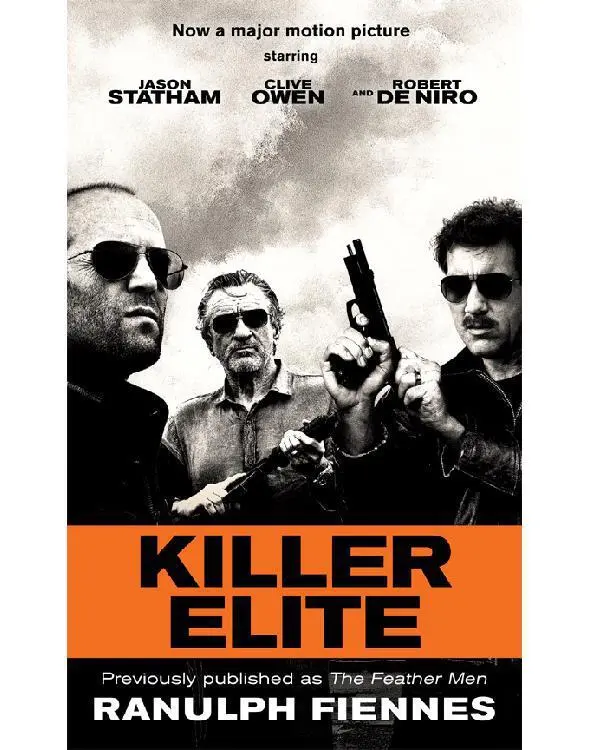
Ranulph Fiennes - Killer Elite
Здесь есть возможность читать онлайн «Ranulph Fiennes - Killer Elite» весь текст электронной книги совершенно бесплатно (целиком полную версию без сокращений). В некоторых случаях можно слушать аудио, скачать через торрент в формате fb2 и присутствует краткое содержание. Жанр: Триллер, на английском языке. Описание произведения, (предисловие) а так же отзывы посетителей доступны на портале библиотеки ЛибКат.
- Название:Killer Elite
- Автор:
- Жанр:
- Год:неизвестен
- ISBN:нет данных
- Рейтинг книги:3 / 5. Голосов: 1
-
Избранное:Добавить в избранное
- Отзывы:
-
Ваша оценка:
Killer Elite: краткое содержание, описание и аннотация
Предлагаем к чтению аннотацию, описание, краткое содержание или предисловие (зависит от того, что написал сам автор книги «Killer Elite»). Если вы не нашли необходимую информацию о книге — напишите в комментариях, мы постараемся отыскать её.
Killer Elite — читать онлайн бесплатно полную книгу (весь текст) целиком
Ниже представлен текст книги, разбитый по страницам. Система сохранения места последней прочитанной страницы, позволяет с удобством читать онлайн бесплатно книгу «Killer Elite», без необходимости каждый раз заново искать на чём Вы остановились. Поставьте закладку, и сможете в любой момент перейти на страницу, на которой закончили чтение.
Интервал:
Закладка:
Before leaving Britain, Davies had marked an Ordnance Survey map with the detailed route of the SAS “endurance march,” with highlights where the track bottlenecked in especially remote reaches.
Midweek, midwinter, and during the hours of darkness it was safe to count on very few hill walkers being abroad on the Beacons. Such were the conditions required by Davies’s plan.
Well after dark Meier watched the two men arrive back at the Renault. Neither showed signs of exhaustion. As they took off their boots and rucksacks their conversation centered on the Shah’s flight from Iran the previous week.
As Kealy closed the trunk on their wet equipment he said to his companion, “Well, that wasn’t so bad. We should give the selection lads a good run for their money on Thursday.”
“What time does it start?” the other SAS man asked.
“The three-tonners leave Hereford at 1:30 a.m. and the first walkers set out from here around 3 a.m.”
“The forecast is lousy.”
“I know but that’s unlikely to stop play.”
“What’s the standard weight these days?”
“Same as always,” said Kealy, “fifty-five pounds.”
“And the course?”
“Still forty-one miles to be done in a maximum of seventeen hours.”
As the Renault departed, the sound in Meier’s earphones faded and quickly disappeared. He switched off the receiver, for he had no need to hear more.
Over the next three days of deteriorating weather, the Clinic and their helpers familiarized themselves with the misty heights of the barren Brecon Beacons.
De Villiers had purchased his clothing and equipment from a government-surplus shop in the Strand. The owner had explained the various army-surplus items: Denison camouflage smock, OG trousers, KF shirt, khaki puttees, DMS boots and a Royal Engineers’ badge fitted to a standard black beret. Ancillaries included a poncho ground sheet, hexamin stove with fuel blocks, fifty-seven-pattern webbed belt with pouches, three plastic water bottles, mess tins, eating irons and a large rucksack of the type known to airborne soldiers as a bergen.
With his hair cut short, army-style, de Villiers parked himself and his bergen on one of the wooden benches at Hereford railway station. The London train was due in twenty minutes. He opened a pack of Players No. 6 and offered a cigarette to the tall man in blue jeans and leather jacket slumped dejectedly beside him. De Villiers had selected him from among some twenty others over the past two days.
“Don’t mind if I do,” was the only response.
De Villiers produced a Ronson Storm lighter and lit their cigarettes. “Haven’t seen you around,” said de Villiers, glancing sideways at the man. “What went wrong?”
“One of their bastard staff,” the soldier grunted, “thought I swore at him yesterday on the Fan.”
“Did you?”
The man gave a half smile. “Maybe. I felt more knackered than I thought was possible on the second time ’round. All my blisters burst. Maybe it’s all for the best but I hate the thought of the lads back in Catterick. They’ll take the mickey something awful for months. I was so sure I’d make it. What about you?”
De Villiers was as charming as only he knew how, and as convincing. They traveled to Paddington together and exchanged cap badges, and by the time they went their separate ways there was little de Villiers had not learned about the SAS selection course to date and the expected horrors to come.
At 11:45 p.m. on the night of January 31 and in heavy rain, a Ford Transit van in its GPO livery backed up briefly against the perimeter fence to the rear of the SAS officers’ mess. From its roof de Villiers threw down his bergen and dropped down over the high fence, breaking his landing with a standard parachute roll.
Within seconds he was hidden behind the dark walls of the NAAFI, adjacent to the regimental cookhouse. With an hour or so to wait, he settled back under a shrub, his poncho drawn over his beret. Even if Meier failed, the first stage of the evening’s plans were under way and the weather forecast was hopeful: severe gales and snow on high ground. Meier had tried to woo one of the Army Catering Corps cooks but was foiled by SAS Security. His plan had been simple: identify one of the white uniformed chefs by the bins at the rear of the cookhouse. Not difficult with binoculars from his car in Bullingham Lane. Track the man to his drinking spot in the evenings and bribe him, as part of a wager, to let a fellow soldier, Meier himself, into the camp in his company and wearing “whites.” But as Meier learned when he befriended a pimply ACC youngster, the SAS forbade the cookhouse personnel ever to leave camp in their uniforms. Instead there was a changing room within the cookhouse and any unrecognized cook entering the main gate would be challenged by the MOD Police to show his ID card. Furthermore, Pimples informed Meier that Scouse, the chief SAS cook, who had been there twenty years, was a terror who kept close tabs on all his staff however temporary their posting. One of his rulings was “no strangers behind the hotplate.”
Meier racked his brains, but nontechnical improvisation was not his forte and when by 10:30 p.m. that Thursday night he had no safe means of entry to the camp, he left the matter to de Villiers’s skill and drove south to Talybont.
Forty-five minutes after midnight, with the rain still drumming down, de Villiers recognized Mike Kealy emerging from the shadows to the right-hand side of the HQ block, the direction of the officers’ mess. Kealy was fully equipped but moved quietly and easily.
De Villiers swung his bergen over his back and followed Kealy to the nearby cookhouse. He climbed the four stone steps immediately behind him and they entered together. Inside the well-lit, L-shaped room thirty or forty students and selection staff were already seated and stuffing themselves with food. There was little chatter or camaraderie, for this was the final test of Selection Week, a milestone in the careers of the lucky few.
De Villiers kept his belt kit on. He dumped his bergen beside Kealy’s and slipped a tiny radio bleeper into one of its side pockets. He joined the food queue at the hotplate, where the duty cook soon helped him to a large plate of mixed grill and a mug of hot tea. He had watched Kealy pass by the table where the instructing staff sat; the only animated group. The senior instructor, a giant of a man, greeted the major with a smile.
“Hallo, Lofty.” Kealy smiled and took a seat at one of the tables reserved for the students.
De Villiers, careful to avoid any eye contact with students or staff, sat close to Kealy, and when the latter went off to fetch a spoon, he reached across for sugar and palmed the contents of a packet of white powder into Kealy’s tea.
The powder, ground down from four 250 mg. tablets of chlorpropamide, would not have an immediate or predictable effect. After an hour or two Kealy would begin to feel sweaty, weak, and increasingly disorientated, for chlorpropamide is a drug that promotes the action of insulin within the body. Kealy’s blood sugar would slowly fall below a tolerable level and would leave him dangerously vulnerable to the elements. The effects of hypoglycemia would steadily increase to a peak, or from Kealy’s point of view a nadir, somewhere between three and six hours after ingestion.
Many of the students were loners. Some were veteran sergeants, even sergeant-majors, from airborne units with years of service behind them. If these men passed into the SAS they would enter as mere troopers and take their chances of promotion alongside far younger and less experienced soldiers.
Initially over 150 soldiers from throughout the British Army had signed on for selection. After a week’s introduction to navigation and other basic skills, they were subjected to three weeks of softening up with ever-increasing grades of difficulty. They had fallen like flies, for the SAS selection staff watched every move and circled vulturelike to pounce on the merest whiff of weakness. The unfortunates found themselves waiting on Hereford station with a one-way ticket back to their own regiment.
Читать дальшеИнтервал:
Закладка:
Похожие книги на «Killer Elite»
Представляем Вашему вниманию похожие книги на «Killer Elite» списком для выбора. Мы отобрали схожую по названию и смыслу литературу в надежде предоставить читателям больше вариантов отыскать новые, интересные, ещё непрочитанные произведения.











Обсуждение, отзывы о книге «Killer Elite» и просто собственные мнения читателей. Оставьте ваши комментарии, напишите, что Вы думаете о произведении, его смысле или главных героях. Укажите что конкретно понравилось, а что нет, и почему Вы так считаете.