Ranulph Fiennes - Killer Elite
Здесь есть возможность читать онлайн «Ranulph Fiennes - Killer Elite» весь текст электронной книги совершенно бесплатно (целиком полную версию без сокращений). В некоторых случаях можно слушать аудио, скачать через торрент в формате fb2 и присутствует краткое содержание. Жанр: Триллер, на английском языке. Описание произведения, (предисловие) а так же отзывы посетителей доступны на портале библиотеки ЛибКат.
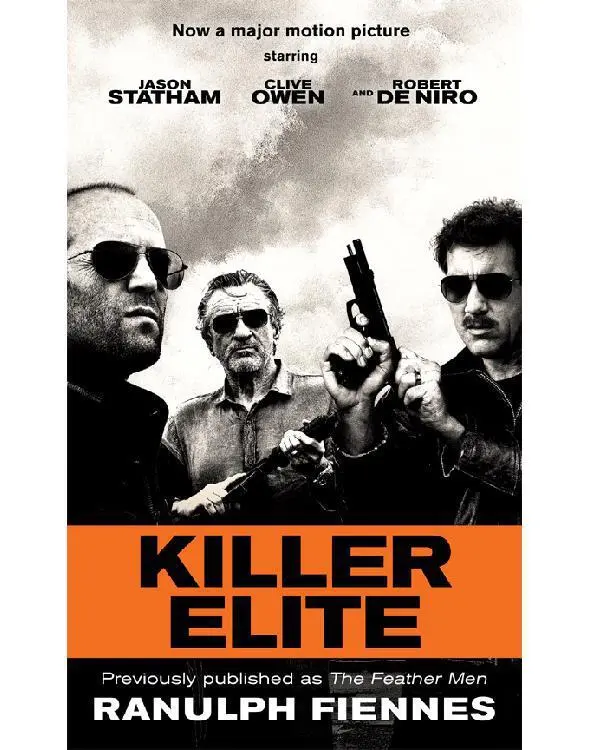
- Название:Killer Elite
- Автор:
- Жанр:
- Год:неизвестен
- ISBN:нет данных
- Рейтинг книги:3 / 5. Голосов: 1
-
Избранное:Добавить в избранное
- Отзывы:
-
Ваша оценка:
Killer Elite: краткое содержание, описание и аннотация
Предлагаем к чтению аннотацию, описание, краткое содержание или предисловие (зависит от того, что написал сам автор книги «Killer Elite»). Если вы не нашли необходимую информацию о книге — напишите в комментариях, мы постараемся отыскать её.
Killer Elite — читать онлайн бесплатно полную книгу (весь текст) целиком
Ниже представлен текст книги, разбитый по страницам. Система сохранения места последней прочитанной страницы, позволяет с удобством читать онлайн бесплатно книгу «Killer Elite», без необходимости каждый раз заново искать на чём Вы остановились. Поставьте закладку, и сможете в любой момент перейти на страницу, на которой закончили чтение.
Интервал:
Закладка:
Mike Panny’s eyebrows rose. “What aspects thereof?” He always enjoyed seeing his name in the minutes as the instigator of penetrating questions and worthy new ideas.
“Any which reveal our outlook to be muffled by cobwebs. Exactly what activities should we become involved with? At what point should we tip off the police? How much force or coercion may our Locals use? To what extent must they feel bound by the letter of the law in cases where we know the law cannot help?”
“Not forgetting,” Panny added, “the other side of the coin. I believe we should change the ground rules for the control of Locals. It cannot be right that only Spike knows the identity of our own men, that only he can contact them. I mean nothing personal, but I believe we should as a committee have a much closer control over the controller, be he Spike or some other person.”
Bletchley and Bob Mantell were nodding, Graves and the twins shaking their heads, and the don airing a sardonic smile. Personal viewpoints were fairly evenly balanced on such topics. This was just as well since, far from being flexible, they were not far short of intractable.
“Chairman.” It was Macpherson again. “This meeting has to end by 10 a.m., as you know. We are here to decide upon a single question. May I suggest we agree to a separate meeting to discuss general policy changes? This meeting must keep to specifics.”
“That’s all very well,” said Mantell, filling the gap caused by an unexpected silence from the chairman, who looked decidedly unwell: he appeared to lack tongue control and mopped sweat from his brow with his pocket handkerchief, “but the chairman is rightly concerned that any agreement to further activity on this specific matter involves a basic change of direction in our general policy. We therefore need to reassess the latter before we can address Spike’s immediate needs.”
“Look, mate,” August Graves interrupted the excavation work of his little finger in his right ear to stab the air in Mantell’s direction. “Wiv due respect to our chairman, Spikey asked us ’ere to give ’im yes or no on the ’Ereford geezer. We all knew that when we turned up this mornin’. Right? Am I right? ’Course I am, so none of yer bleedin’ moral yatter. I say put it to the vote and give the lad ’is answer one way or t’other.”
The don shook his head in disbelief and said nothing. The twins nodded as vigorously as their age and double chins permitted and Jane continued with her note-taking.
Bletchley found his voice. “Since we are indeed pressed for time we will vote on the immediate matter and at next month’s meeting we will review the overall policy.” He nodded at Jane, who handled the agendas. “I must again advise the committee that in my opinion we should never have sanctioned last year’s Oman operation. The pilot Milling had no connections at all with our interests and our man was of course unable to prove any links between his death and the Welshman we picked up in Hereford.” He turned to Mantell. “That is correct, is it not?”
Mantell nodded, and answered, “We passed the photographs to our friends in Scotland Yard. There was no record from their files nor those of the antiterrorist branch. Immigration also drew a blank. None of the three men photographed by Spike’s man in Oman have previous records on UK or Interpol computers.”
“There can be little point then, surely, in wasting further time on this Welshman. He may well be involved in skullduggery; in fact there can be no doubt of it, but the unfortunate Milling, I repeat, had nothing whatever to do with Mirbat nor with our people. My recommendation is that we direct Spike to leave the matter well alone and that you, Mantell, leak Friday’s sighting of the Welshman in Hereford to the relevant police authorities.”
Mantell nodded. Spike raised his hand. “The police can do nothing. They need proof and motives and names. We have none of these things. Either we follow up this new visit by the Welshman or no one does. If the latter, then it is my opinion that another death will result and almost certainly it will be one of the Mirbat survivors who dies.”
“Why so,” asked the don, “if Milling had nothing to do with Mirbat?”
“I don’t know,” Spike said simply, “but the Welshman who was last year linked to both Milling and Mirbat is now making fresh inquiries about Mirbat and is known to have located the names of those SAS men who fought there. There is, at the very least, a risk that he may try to kill one or more of them.” Spike looked around the room. “This is clearly a direct threat to persons we are tasked by our founder to protect. If one should die following our inaction, that will lie heavily on my conscience. I have no vote on the committee but I strongly recommend that you direct me to have the Welshman found and followed immediately.”
Spike collected the nine sheets of A4 paper. Five were marked with a tick, four with a cross. Both chairmen were permitted to vote and Spike could guess which course each person, other than Jane and the don, had supported. He was relieved. As he left the room he saw that Bletchley was sweating profusely and staring at the fireplace with an expression akin to despair.
They met halfway, at the Leigh Delamere service station, and Spike climbed into Darrell Hallett’s Avenger in a corner of the busy car park. As usual the rear half of the car was stacked high with packs of Yorkie bars. Against the roar of the evening traffic on the M4 motorway, Spike gave Hallett his briefing.
Hallett studied the list of the seven Mirbat survivors, their addresses and known activities. Only three were currently in Britain and one of these was Captain Michael Kealy, still a serving officer in the British Army.
“I am working the central district at present,” Hallett said. “I might as well concentrate on Bennett and Kealy, since they will both be in Hereford. I have a colleague in Bristol who can keep tabs on the third guy.”
“Remember,” Spike emphasized, “if you locate the Welshman, let me know as soon as he steps out of line in any way or if he meets either of the two in the photos. Have camera and recording kit ready for any meeting he’s involved in. But don’t get involved in any rough stuff unless he attacks you, Kealy or Bennett. As soon as you pick up any usable evidence we hand this one over to the boys in blue.”
22
Aware of the increasing sophistication of IRA active service units in mainland Britain, the Lord Chancellor issued on February 26, 1982, a directive entitled “Disclosure of Information from Personal Records.” From that date onward no records could be divulged by the authorities without the specific permission of the servicemen involved.
On December 4, 1978, Davies had faced no such bureaucratic obstacles when he telephoned the Ministry of Defense Officers’ Inquiries Department and asked for the current address of Captain Michael Kealy.
“May I ask your name?”
Davies gave a name.
“And the reason for your inquiry?”
“Yes, of course. I am sending out centenary details of Captain Kealy’s old school, Eastbourne College.”
“I am afraid, in Captain Kealy’s case, I am not at liberty to give you his address, but I can give you that of his parents, which you could, of course, also obtain through Directory Inquiries.”
“That would be most kind,” purred Davies.
The following day he was on the road before dawn in a Ford Escort from Tadnams. From London he followed the A23 as far as Albourne, then turned east to the sleepy village of Ditchling under the shadow of the South Downs.
Forge House was not difficult to find, being on the main road through the village and directly opposite the North Star pub. Davies parked in a side street and settled down to a cup of tea and fresh doughnut in the Tudor Bakery. Refreshed, he returned to the car and made ready his standard country gear consisting of basic bird-watcher’s ensemble, shooting stick, binoculars, and a camera with an indecently long lens attached.
Читать дальшеИнтервал:
Закладка:
Похожие книги на «Killer Elite»
Представляем Вашему вниманию похожие книги на «Killer Elite» списком для выбора. Мы отобрали схожую по названию и смыслу литературу в надежде предоставить читателям больше вариантов отыскать новые, интересные, ещё непрочитанные произведения.











Обсуждение, отзывы о книге «Killer Elite» и просто собственные мнения читателей. Оставьте ваши комментарии, напишите, что Вы думаете о произведении, его смысле или главных героях. Укажите что конкретно понравилось, а что нет, и почему Вы так считаете.