Luis Rocha - Papal decree
Здесь есть возможность читать онлайн «Luis Rocha - Papal decree» весь текст электронной книги совершенно бесплатно (целиком полную версию без сокращений). В некоторых случаях можно слушать аудио, скачать через торрент в формате fb2 и присутствует краткое содержание. Жанр: Триллер, на английском языке. Описание произведения, (предисловие) а так же отзывы посетителей доступны на портале библиотеки ЛибКат.
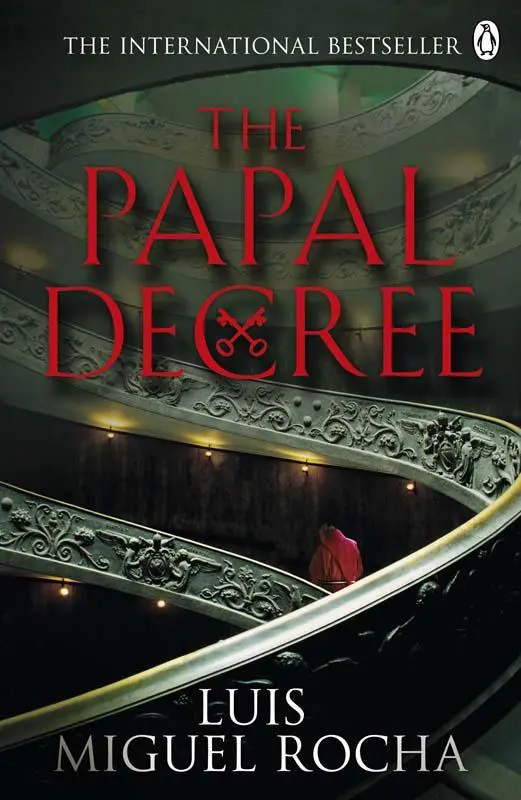
- Название:Papal decree
- Автор:
- Жанр:
- Год:неизвестен
- ISBN:нет данных
- Рейтинг книги:4 / 5. Голосов: 1
-
Избранное:Добавить в избранное
- Отзывы:
-
Ваша оценка:
Papal decree: краткое содержание, описание и аннотация
Предлагаем к чтению аннотацию, описание, краткое содержание или предисловие (зависит от того, что написал сам автор книги «Papal decree»). Если вы не нашли необходимую информацию о книге — напишите в комментариях, мы постараемся отыскать её.
Papal decree — читать онлайн бесплатно полную книгу (весь текст) целиком
Ниже представлен текст книги, разбитый по страницам. Система сохранения места последней прочитанной страницы, позволяет с удобством читать онлайн бесплатно книгу «Papal decree», без необходимости каждый раз заново искать на чём Вы остановились. Поставьте закладку, и сможете в любой момент перейти на страницу, на которой закончили чтение.
Интервал:
Закладка:
‘Reverend Father Hans Matthaus Schmidt,’ Monsignor Scicluna began faintly. ‘Having read your works attentively, I confess I am struck primarily by the titles, which are certainly peculiar. The first is Jesus Is Life, which I must say I agree with, though I’ll ask you to explain certain ideas in it. The second is The Man Who Never Existed. In both books we are dealing with the same person.’ He sipped some water to moisten his dry throat. ‘My first question to you is how can Jesus be life if, in your own words, He never existed?’
Schmidt had anticipated that this would be the first question. He hadn’t wasted time thinking of hypothetical questions. If the roles were reversed, he would logically ask this same question.
He straightened his back, not so much that he would show nervousness or disquiet, but because he wanted to be comfortable. He took his time opening a bottle of water sitting on the desk in front of him and poured some in a glass. He wet his lips, put the glass down, and smiled.
‘Good Morning, Reverend Prefect, Mr. Secretary, and you other counselors. I understand your doubt perfectly, my dear Monsignor Scicluna. On the one hand Jesus is life, and on the other, He never existed. What an outlandish idea… at first glance.’ His voice reverberated through the room. Everyone listened intently, and the cherub had closed his eyes, as if he didn’t want to listen. ‘The message I want to convey is that one can live in two ways. There is no one right way with Jesus or another wrong way without Him, or, if you wish, with whatever other divinity.’ Schmidt noticed some red faces and a deepening irritation in Scicluna’s. He wasn’t there to be friendly. He wanted to start out forcefully. ‘What I intend by Jesus Is Life is to provide teachings about how to live day by day in Jesus by abstracting the essence of His words, and in The Man Who Never Existed the same message without Jesus, because it is possible to live with Jesus or without Him, in God or without Him. However God is understood.’
‘What are you saying?’ Monsignor Scicluna protested, rising and bracing his hands on the table.
‘I have come to the conclusion that all forms of religion are true. The Jewish Bible is true, as is the Catholic, and all the others. The Torah is true, along with the Talmud and the Koran. We are neuro-divine.’ A clamor arose among the counselors, the prefect, and the secretary.
‘All forms of faith are true. Even believing in nothing is true,’ Schmidt concluded in the same reasonable manner.
‘That is heresy,’ Monsignor Scicluna accused, the veins in his neck protruding in fury.
‘That which in this room is a heresy,’ Schmidt returned, ‘would also be so in any synagogue or mosque, but that doesn’t really matter… to me.’
William covered his face in his hands. Schmidt was a fool. He knew very well what he could and could not say in that room. He’d chosen something else… something more difficult.
‘Are you saying that the Word or the Mystery is of secondary or little importance?’ the monsignor demanded.
Schmidt shook his head no. ‘No, nothing like that. I’m saying that the Word or Mystery have the importance that the believer wants to give them.’ He let the idea sink in. ‘Great importance,’ he paused dramatically, ‘or nothing.’
‘The gentleman is putting himself into a very delicate position,’ Monsignor Scicluna warned in a cold, dry voice.
Schmidt got up and confronted the others with an attitude that some would consider disrespectful. ‘Everyone in this room knows I am right. Isn’t that so?’
29
It’s not a good sign when a ritual changes, especially if it’s repeated, like a sacred act, without variation in content or feeling. The purpose of rituals is to evoke, venerate, and honor relevant events, whether historical, political, religious, or — no less important — personal.
The year 2010 would be registered in Ben Isaac’s storage safe, five hundred feet from the main house, below the toolshed, as the year when it was opened twice, a unique occurrence in more than five decades.
He positioned his eyes in front of the visual reader so that the computer could recognize him as the owner. Another change to the ritual was that this time Ben Isaac would not descend the twenty steps alone, but with two other people. The fluorescent lights came on as they advanced and went out behind them, creating a sensation of endless darkness in front of them and unknown secrets behind them.
‘I cannot believe that you’ve always had this here and I didn’t know, Ben Isaac,’ Myriam complained, alert to every sound, her eyes wide open.
‘I couldn’t tell you, Myr. The less you knew, the better,’ the Israeli argued. It was never a good sign when Myriam called him by both his first and last name.
‘I’m your wife, a part of you. You can’t keep secrets to yourself.’
Myriam was visibly angry and disillusioned with him. Ben knew she was right, but this was how he was, he kept things to himself. It was an immense effort to bring them there.
The mechanism opened the heavy door with a sigh and, for a few moments, they just looked inside without moving. Myriam took the first step decisively. Sarah followed her, and Ben was the last to enter the room.
Sarah had not imagined such a bare space. Three display cases, nothing more, and cold, unadorned walls. She thought she would find shelves full of other singular things, of lesser significance certainly, but full of sacred relics with many stories to tell. She never thought that the large room would contain only three cases. She joined Myriam, who was examining the parchments displayed under glass. She couldn’t understand a single word written there. Elaborate letters written in an ornate style, unintelligible to her.
‘Can you understand anything, Myriam?’ she dared to ask, as if she were creating an explosion in the awkward silence.
Myriam looked at the small document in the first case and shook her head no.
‘No.’ Myriam looked at Ben Isaac. ‘Is it Latin?’
Her husband affirmed it.
‘I didn’t study Latin, but it looked like it,’ Myriam offered, her eyes fixed on the parchment. ‘Yeshua ben Joseph. And it talks about Jesus in Rome,’ she said, more to herself than the others.
She moved to the second case and frowned. Sarah looked at her but couldn’t tell whether or not Myriam understood what was written there. For Sarah it was impossible. She couldn’t begin to unravel whatever was written there. It was not in the Roman alphabet, like the other one, but in a series of strange letters.
‘What is this? Ancient Hebrew?’ Myriam wanted to know. Her voice seemed worried.
‘Aramaic,’ Ben Isaac answered. He had remained behind, observing his wife.
‘Of course Aramaic.’ Myriam looked at the parchment in a different light. ‘I still don’t understand anything all this time.’
‘Aramaic is similar to ancient Hebrew,’ Ben Isaac explained.
‘Is this the gospel?’ Myriam asked in a halting voice.
Ben did not respond. Silence meant yes.
‘Walk over here next to me,’ Myriam said, more like an order than a request.
Ben approached her step by step, slowly, timidly, as if walking on shaky ground, until he was next to Myriam, who continued looking carefully at the gospel. For a few seconds no one said anything.
‘Read it to me,’ Myriam finally ordered.
‘Myriam,’ Ben sighed, as if it were a painful experience.
Myriam gave him a hard, pained look. ‘Read it.’
Ben hesitated. It troubled him to reveal something only he and a few others knew about. Myriam needed to know what the text said. If that piece of lamb or calfskin was worth more than a human life, than that of their son, their Ben, who had left her heart weeping in such a deep sorrow.
Читать дальшеИнтервал:
Закладка:
Похожие книги на «Papal decree»
Представляем Вашему вниманию похожие книги на «Papal decree» списком для выбора. Мы отобрали схожую по названию и смыслу литературу в надежде предоставить читателям больше вариантов отыскать новые, интересные, ещё непрочитанные произведения.



Обсуждение, отзывы о книге «Papal decree» и просто собственные мнения читателей. Оставьте ваши комментарии, напишите, что Вы думаете о произведении, его смысле или главных героях. Укажите что конкретно понравилось, а что нет, и почему Вы так считаете.